Why bank statement analysis moved to the centre of Indian credit decisions
Three shifts have pushed the bank statement from a supporting document to a primary underwriting input.
The first is who is borrowing. A large share of new credit demand in India comes from self-employed borrowers, MSMEs and first-time borrowers with thin bureau files. For these applicants, audited financials are often unavailable, ITRs understate turnover, and the bureau record is sparse. The bank statement is frequently the only continuous, verifiable record of income and obligations that exists.
The second is volume. Digital origination has compressed the time a borrower is willing to wait. An underwriter reading twelve months of transactions by hand can process a handful of files a day. At several thousand applications a month, manual reading becomes the constraint on growth rather than risk appetite.
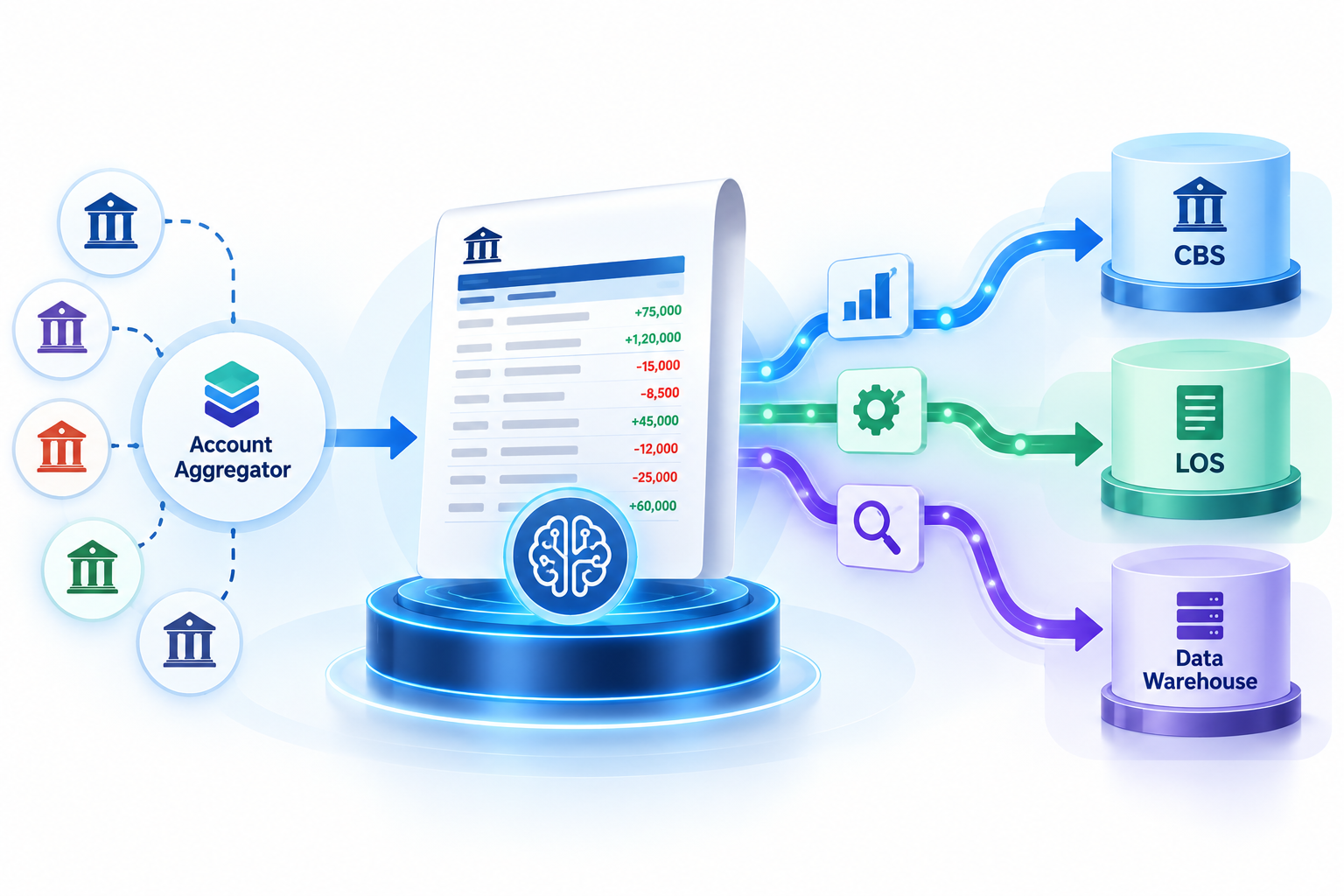
The third is access. Account Aggregator consent flows, API-based document collection and the wider digital lending infrastructure have made it easy to obtain statement data at scale. Obtaining the data is no longer the bottleneck. Interpreting it is.
This is the gap that software to analyse bank statements fills: turning a document that any lender can collect into intelligence that a credit team can act on.
The gap between reading a bank statement and understanding it
Most first-generation tools answered one question: what transactions appear in this bank statement? Credit underwriting needs a different question answered: what do these transactions say about the borrower's capacity to repay?
Consider an applicant showing twelve lakh rupees in monthly account credits. On its own the figure means almost nothing. Those credits could be business receipts, salary, inter-company transfers, loan disbursements from another lender, a property sale or round-tripped funds moved in to make the account look healthier before application. Treat them all as income and the assessed repayment capacity is wrong by a wide margin.
Debits carry the same ambiguity. A large monthly outflow may be an operating cost, an existing EMI, a transfer to a related account or a one-off payment. Each implies something different about the borrower's fixed obligations.
The practical consequence is that extraction accuracy and underwriting accuracy are not the same thing. A system can lift every figure from the bank statement perfectly and still produce a misleading view of the borrower if it does not understand what each figure represents.
What AI software to analyse bank statements actually does
A capable platform runs the bank statement through several distinct layers. Each one produces something the next layer depends on, and a weakness at any layer travels downstream into the credit decision.
Layer | What it produces | What goes wrong without it |
Document ingestion and OCR | Machine-readable text from digital PDFs, scanned copies, password-protected files and photographs | Statements from smaller banks and regional formats fail to process, forcing manual rekeying |
Transaction parsing | Structured rows of date, narration, debit, credit and running balance | Columns misalign on multi-page or multi-currency statements and totals silently drift |
Tamper and authenticity checks | Confirmation that balances reconcile and the file has not been edited | Doctored statements enter the credit file undetected |
NLP-driven narration analysis | Interpretation of cryptic narrations such as NEFT, UPI, IMPS and RTGS references into counterparty and transaction type | Every transaction looks the same to the model, so classification collapses |
Cash-flow classification | Separation of income, transfers, obligations, operating expenses and discretionary spend | Repayment capacity is calculated on gross credits rather than genuine income |
Anomaly and pattern detection | Flags for circular transactions, sudden behavioural change, cheque returns and unusual inflow timing | Risk that is visible in the data reaches the committee only after disbursal |
Credit signal generation | Scored, evidence-linked indicators ready for policy evaluation | The credit team receives data rather than a decision input |
Integration layer | Structured output delivered into LOS, CBS and the data warehouse through APIs | Analysts copy figures between systems by hand, reintroducing the bottleneck |
The layer that most buying decisions underweight is narration analysis. Indian bank statements carry narrations that are abbreviated, inconsistent across banks and frequently truncated. Everything downstream of that layer inherits its quality.
Cash-flow classification is where the credit judgement actually happens
Once transactions are structured, the system moves from reading the bank statement to interpreting behaviour. This is the step that separates a document automation tool from a credit intelligence tool.
Take two applicants. The first shows eighteen lakh rupees in monthly credits with high outflows, three identifiable EMIs and a closing balance that drops to near zero before each salary cycle. The second shows nine lakh rupees in credits, stable month on month, modest obligations and a consistent average balance. On gross credits the first borrower looks twice as strong. On cash flow the second is the better risk.
The measures that carry weight in practice are income consistency rather than income size, average and minimum balance behaviour, the ratio of identified obligations to net income, volatility across the observed period, and the presence of inward cheque returns or insufficient-funds events.
For MSME and self-employed files this matters more than anywhere else. A trading business with seasonal revenue, an informal line of credit from a supplier and partial digital collections cannot be assessed from a profit and loss statement alone. The bank statement shows the working capital cycle as it actually runs.
Twelve months of data is the usual standard. Six months can be sufficient for salaried applicants, but it hides seasonality and is rarely enough for a business borrower.

Anomaly detection, and what a flag should and should not mean
Credit risk is often visible not in a single number but in a change of behaviour. Anomaly detection exists to surface those changes at a scale no underwriter can match by eye.
The patterns worth detecting in a bank statement include funds that enter and leave within days in near-identical amounts, a cluster of large credits appearing only in the weeks before the application, cash withdrawal behaviour that departs sharply from the borrower's own history, repeated inward cheque returns, salary credits that arrive from an entity unrelated to the declared employer, and balance maintained artificially high across a month-end reporting date.
The discipline that matters here is treating a flag as a question, not a verdict. A borrower who received three unusual credits last quarter may have sold a vehicle, received a maturity payout or been repaid a personal loan. A system that declines on the pattern alone will reject good applicants and generate appeals the credit team has to unpick manually.
The better design routes the flag to a human with the surrounding evidence attached, so the underwriter sees the transaction, its context and the borrower's baseline in one view. Automation decides what deserves attention. The institution decides what it means.
Explainable credit signals instead of an unexplained score
As AI moves closer to the credit decision, one question decides whether a credit committee will adopt it: can the system show its working?
An output that labels an application high risk gives an underwriter nothing to act on. An output that says repayment capacity is constrained because identified obligations consume sixty-one percent of assessed net income, with the three contributing EMIs listed and linked to the transactions that evidence them, is something a credit officer can verify, override or escalate.
That chain matters for four reasons. It lets the underwriter check the machine rather than trust it. It gives the risk team a way to find out why a policy is approving or declining more than expected. It produces an audit trail when the regulator, an internal auditor or a co-lending partner asks how a decision was reached. And it makes model drift visible, because a signal that stops tracking its evidence is a signal that needs retraining.
Explainability is not a reporting feature added at the end. It is a property of how the system is built, and it is the single most useful question to ask any vendor during evaluation.
Connecting bank statement intelligence to CBS, LOS and the Account Aggregator stack
A bank statement analyser that produces a standalone report has moved the manual work rather than removed it. Someone still has to read the report and type its conclusions into the loan origination system.
The integration points that matter in an Indian lending stack are the loan origination system, where parsed signals should populate the credit appraisal screen directly, the core banking system for account and customer context, the Account Aggregator framework for consented statement retrieval without document collection, bureau and GST and ITR feeds so cash-flow evidence can be triangulated against declared figures, and the data warehouse so the same signals feed portfolio monitoring and early warning after disbursal.
That last point is routinely missed at evaluation. The parsed output of a bank statement is valuable long after onboarding. If a lender can re-run statement analysis on an existing borrower, early warning signals such as deteriorating balances or rising obligations appear before a missed instalment does.
Pre-built connectors matter more than they sound. The difference between a vendor with a tested LOS connector and one that promises a custom build is usually several months of integration effort and a materially different go-live date.