

Apply for a loan today and much of the lending journey can happen with very little manual intervention. Documents can be uploaded digitally, verification can happen in the background, bank statements can be analysed automatically, bureau information can be accessed almost instantly, and rules engines can help determine whether an application meets the lender’s criteria. Processes that once required hours of manual effort can now be completed much faster.
But once the loan is approved, an important question remains:what happens next?
A borrower’s financial situation does not remain the same after a loan is sanctioned. Over the following months, cash flows may slow down, collections may become less predictable, external borrowing may increase, or transaction behaviour may start to change. None of these changes necessarily indicates that the borrower is moving towards default. The challenge is understanding whether several such changes, when viewed together and compared with previous behaviour, indicate a shift that deserves the lender’s attention.
This is where Autonomous Lending begins to change how lenders can think about credit. Instead of treating approval as the point where the credit decision ends, it treats the borrower relationship as something that continues to evolve. Financial evidence, behavioural changes, historical patterns and lending policies can be brought together to understand what is happening and determine what action may be appropriate.
What Is Autonomous Lending?
Autonomous Lending is about making credit decisioning continuous rather than limiting intelligence to a few specific stages of the lending journey. The idea is to move from assessing a borrower only when a particular decision needs to be made towards continuously understanding how that borrower is behaving throughout the relationship.
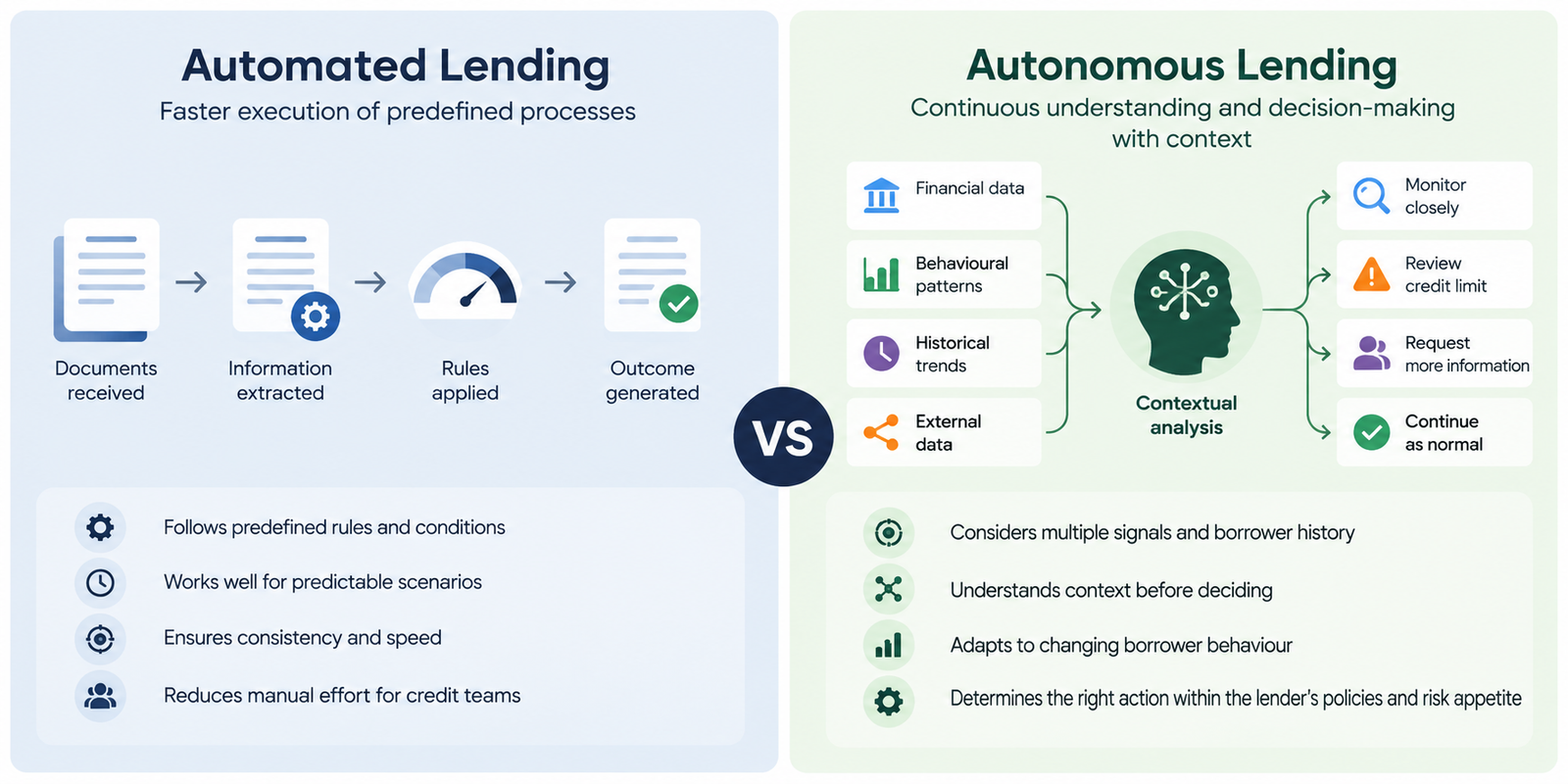
Traditional lending automation works well when there is a clearly defined process. A document is received, information is extracted, a bureau check is completed, rules are applied and an outcome is generated. This makes lending faster and reduces repetitive work for credit teams. The challenge is that a borrower’s financial circumstances do not follow a predefined workflow.
A business may have a strong quarter and then experience slower collections. A company may increase short-term borrowing because it is expanding, while another may increase borrowing because its cash flow has become tighter. The same financial change can therefore have different implications depending on the circumstances around it.
Autonomous Lending gives the lending system more context to make that distinction. It can consider what is happening with the borrower, compare current behaviour with historical patterns, understand how different signals relate to one another and determine whether a response is appropriate within the lender’s policies and risk appetite.
Automated vs. Autonomous Lending: What’s the Difference?
Lending technology has evolved from manual credit processes to digital journeys, automation, advanced analytics and machine learning. Each stage has addressed a different limitation. Automation allows lenders to apply the same rules consistently across large volumes of applications, while machine learning can identify patterns that may not be obvious through conventional rules.
However, most automated processes still depend on conditions and actions defined in advance. When a particular condition occurs, the system knows which process it is expected to execute. This works well when the situation is predictable, but borrower behaviour can be much more complex.
Autonomous Lending addresses situations where the system needs to understand the context before deciding what should happen. It requires multiple signals to be considered together, the borrower’s history to be taken into account and the significance of a change to be assessed before an action is determined. Automation makes an existing process more efficient, while autonomy introduces continuous interpretation and decision-making within the boundaries established by the lender.
Why Is a Point-in-Time Credit Assessment Not Enough Anymore?
Consider a small business applying for working capital. At the time of underwriting, its bank account shows healthy inflows, GST filings are consistent, bureau information is stable and existing repayments are being made on time. Based on the information available at that point, the lender may have every reason to approve the loan.
Six months later, collections may be taking longer, account balances may have become more volatile, outward transactions may have increased and the business may be relying more heavily on short-term funding. These changes alone do not provide enough information to determine whether the borrower’s financial position has deteriorated.
The business may be expanding and spending more on inventory, or additional borrowing may be supporting that expansion. Slower collections could also be part of a seasonal pattern. Without understanding the broader context, treating any one of these changes as evidence of rising risk could lead to the wrong interpretation.
What becomes more useful is looking at how these signals interact and how significantly the borrower’s current behaviour has moved away from its historical pattern. A point-in-time assessment can tell the lender whether the borrower appeared creditworthy when the loan was sanctioned, but it cannot explain how that borrower’s circumstances may have changed several months later.
Autonomous Lending brings that change into the credit relationship by allowing lenders to continue evaluating whether current behaviour remains consistent with the financial capacity and assumptions that supported the original decision.
How Is Borrower Intelligence Transforming Credit Decisioning?
Creditworthiness is often treated as a relatively fixed assessment at the point of underwriting. The difficulty is that the underlying financial position of a borrower can change even when formal credit indicators have not yet changed.
A borrower may continue making EMI payments on time while cash inflows slow, cash-flow volatility increases and dependence on external borrowing grows. The bureau may still appear stable because there has not yet been a formal delinquency. If the lender waits for a missed payment before reassessing the borrower, it may only be seeing the visible outcome of deterioration that began much earlier.
This is why borrower intelligence needs to look at behaviour over time. The system needs to understand what normal financial behaviour looks like for a particular borrower and identify when that behaviour begins to move meaningfully away from the established pattern.
That does not mean every deviation should result in intervention. Businesses experience stronger and weaker periods, and individuals can also experience changes in income and spending. The important question is whether several changes, considered together and in the context of historical behaviour, indicate a material shift in the borrower’s financial position.
What Role Does Data Play in Autonomous Lending?
Lenders today can access considerably more information than they could a decade ago. Bureau records, bank statements, GST and ITR information, repayment histories, transaction data and portfolio-level information can all contribute to a broader understanding of a borrower’s financial position.
The challenge is that more data does not automatically make a credit decision better. The real value comes from understanding what different signals mean when considered together.
An increase in outward payments could indicate that a business is expanding and paying more to suppliers. It could also reflect rising operating costs. Similarly, higher borrowing could be associated with expansion, but it could also indicate growing dependence on external funds to manage everyday cash flow.
Autonomous Lending therefore needs a contextual layer that understands historical borrower behaviour, establishes a meaningful baseline and compares current activity against it. It also needs to consider relationships between signals rather than treating every deviation as an independent warning. The purpose is not to monitor every available data point, but to identify changes that have a meaningful connection to the borrower’s credit relationship.
How Does AI Drive Autonomous Credit Decisioning?
AI can help lenders process large volumes of financial information, recognise patterns, detect unusual activity and identify changes that could otherwise require substantial manual effort. These capabilities become particularly valuable when lenders need to understand borrower behaviour continuously across large portfolios.
However, identifying a pattern does not by itself determine what the lender should do. If a system identifies an increase in risk, the lender still needs to understand what that change means in context and what response would be appropriate. Depending on the situation, the response could involve closer monitoring, a credit-limit review, a request for additional information or engagement with the borrower. In another situation, the same change could simply be part of a temporary business cycle.
Decision intelligence connects AI-generated understanding with lending policy, risk appetite, context and available actions. It creates the link between financial evidence and the response that should follow, allowing lenders to move beyond isolated predictions towards a more connected decisioning process.
Where Does Agentic AI Fit Into Autonomous Lending?
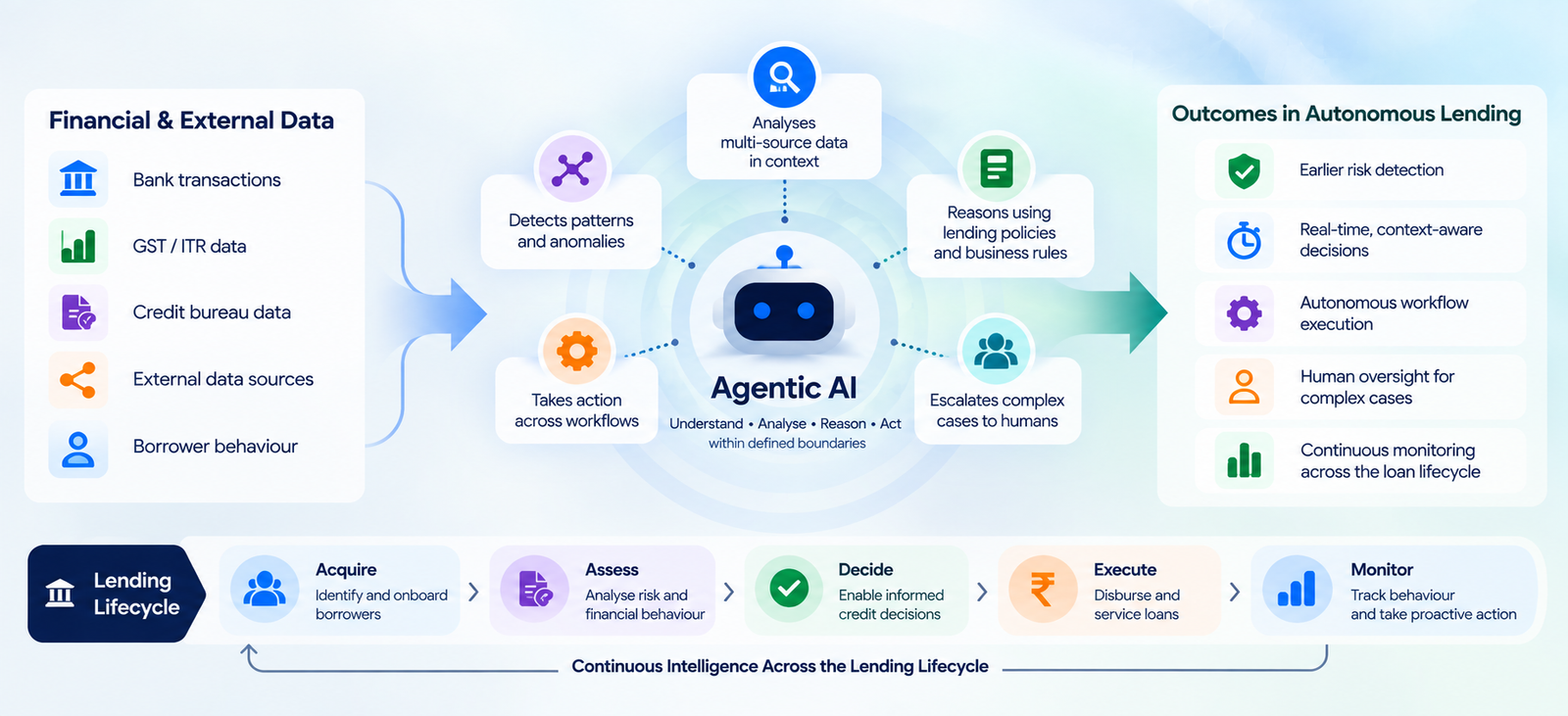
Agentic AI extends autonomous decision-making by allowing a system to work through a sequence of activities rather than simply producing a prediction or classification. An agentic system can gather relevant information, examine the situation, reason across different sources of evidence and determine an appropriate next action within defined boundaries.
Consider a portfolio monitoring system that identifies a decline in a borrower’s inflows. Rather than immediately classifying the borrower as risky, the system can examine historical transaction behaviour, repayment patterns, external funding and other relevant information.
If the decline occurs during a normally seasonal period and other financial indicators remain stable, the situation may be interpreted differently from a case where declining inflows are accompanied by increasing leverage, greater volatility and changes in repayment behaviour.
The value comes from understanding the relationship between
those signals. When they are considered together, the system can build a more
contextual view of what is happening and determine whether a particular
response is warranted.
How Can Autonomous Lending Work Across the Credit Lifecycle?
Autonomous Lending does not have to be limited to underwriting or post-loan monitoring. Its larger potential comes from connecting intelligence across the different stages of the credit lifecycle.
Information collected during acquisition can provide useful inputs for underwriting. The information used during underwriting can establish a baseline for future monitoring. Once the loan is disbursed, actual borrower behaviour can provide additional evidence for credit-limit decisions, portfolio monitoring, collections and renewals.
Renewals are a useful example. Instead of relying mainly on information collected when the original loan was sanctioned, lenders can consider how the borrower has behaved throughout the relationship. Repayment behaviour, transaction patterns and changes in financial circumstances can become part of the evidence used to understand the borrower’s current position.
This creates a connected credit lifecycle where information gathered at one stage can improve decisions at the next.
Does Autonomous Lending Mean Replacing Humans in Credit?
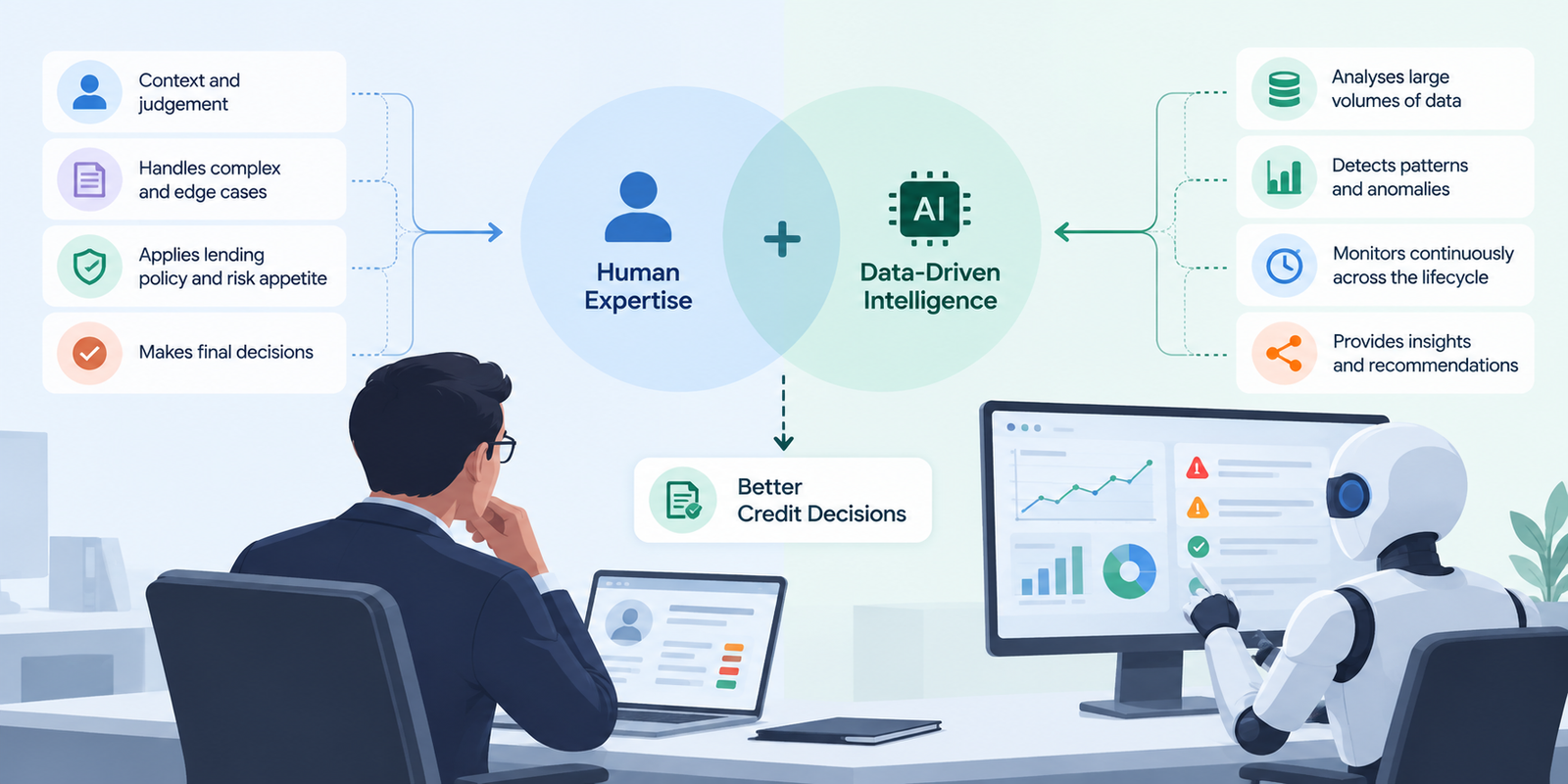
Autonomous Lending is not about removing human judgment from credit. Complex exposures, unusual borrower circumstances, policy exceptions and unfamiliar risk patterns will continue to require human involvement.
The opportunity is to change how credit teams use their time. Technology can continuously process large volumes of information, identify meaningful changes and handle decisions that fall within established boundaries. Credit professionals can then focus on situations that require experience, interpretation and judgment rather than repeatedly reviewing information that a system can already process.
This is where human-governed autonomy becomes important. The system may operate independently within defined limits, but those limits are still established and monitored by people. Explainability, escalation mechanisms, audit trails, exception handling, model monitoring and governance remain essential because lenders need to understand how decisions are made and retain control over the boundaries within which technology operates.
The future of lending is unlikely to be defined by another automation layer or another isolated AI model. The larger opportunity is to create continuous intelligence across the entire credit relationship, so information gathered at one stage can continue to influence decisions at later stages.
Information collected during acquisition can contribute to underwriting. Underwriting can establish the borrower’s financial and behavioural baseline. Post-disbursement behaviour can show how that baseline is changing, and those changes can then inform monitoring, credit limits, collections or renewals.
This creates a different way of looking at credit. Instead of treating underwriting, monitoring, collections and renewals as separate activities, lenders can see them as connected parts of the same relationship, where each new piece of information helps refine the understanding of the borrower.
The central question therefore moves beyond whether a loan should be approved. As lending becomes more continuous and intelligence becomes more contextual, lenders can increasingly focus on what has changed, why that change matters, how it compares with previous behaviour and what response is appropriate within their policies.
That is the broader shift behind Autonomous Lending. The borrower’s circumstances continue to evolve after the loan is approved, so the intelligence supporting the relationship needs to evolve as well. The decision made at origination remains important, but it should not be the last meaningful assessment of the borrower.
The future of credit is therefore not simply about making decisions faster. It is about building lending systems that can continue to understand the borrower as circumstances change, connect new evidence with existing context and support better-informed decisions throughout the relationship.