
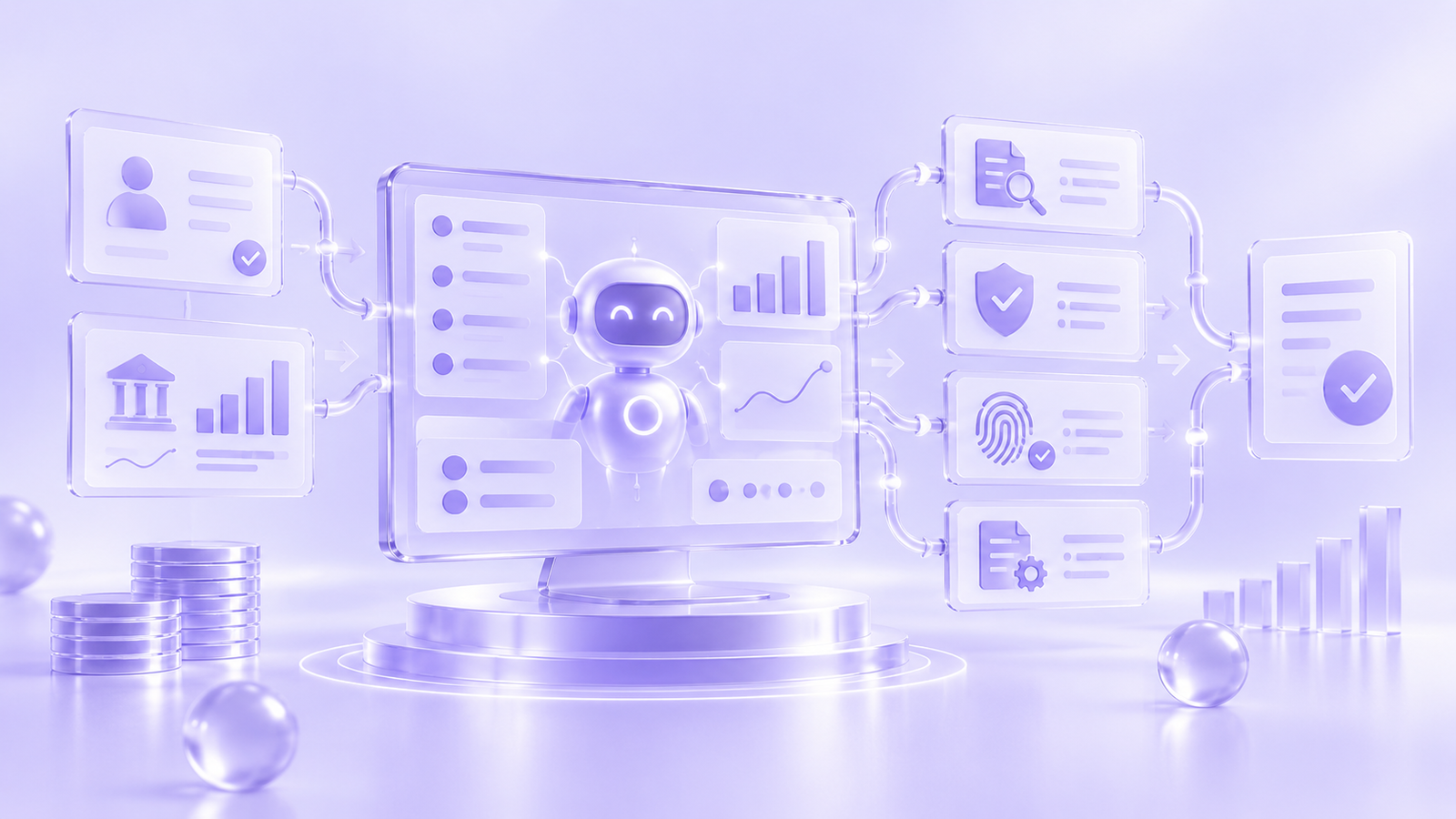
Technology transformation has already occurred in lending in several waves. Digital workflows replaced manual underwriting, document automation reduced operational effort, and AI started to help lenders analyze financial information and identify credit risks. The next step is more fundamental: the shift from systems that automate individual tasks to systems that can orchestrate an entire lending workflow.
That's where Agentic AI in lending comes in.
Agentic AI is able to work across a workflow, interpret context, use available tools, evaluate intermediate outcomes and decide what action should happen next, rather than just generate an insight or execute a predefined rule. By 2027, it could change the way that lending operations are designed for banks and NBFCs from fragmented automation to coordinated, intelligent decision workflows.
Why Lending Automation Is Entering Its Next Phase
Today, most digital lending environments consist of multiple
specialized systems. One does customer onboarding, another pulls financials,
another does bureau checks, another analyzes bank statements. Credit policy and
approval workflows are somewhere else.
Automation can speed up any activity. The harder problem is coordinating these
activities into a continuous decision process.
Let’s consider a borrower applying for an MSME loan. Credit decisions are made
after collecting financial data, examining bank statements, analyzing GST &
ITR information, verifying bureau records, analyzing income, applying policy
conditions and identifying exceptions.
The chance for agentic AI is not just to automate each step. It is to
orchestrate the sequence of steps intelligently, using the output of one
activity to decide what should happen next.
From Automated Tasks to Agentic Lending Workflows
Most traditional automation is rule-based, which is a euphemism for following a predetermined path: if this happens, then do this.The agentic workflows add another layer of intelligence. The AI agent can understand the current context, figure out what information or tool is needed, execute the relevant job, evaluate the result, and continue the workflow or escalate an exception.
In lending, this could be an agent realizing a borrower’s stated income is not consistent with transaction behavior and triggering further verification. Another agent could parse financial data, while a credit decisioning layer checks the evidence against the lender's policies.
The goal isn’t to take away controls. It intends to make the workflow more adaptive while maintaining the policy, accountability and defined human intervention points intact.
What is unique about Agentic AI in Lending?
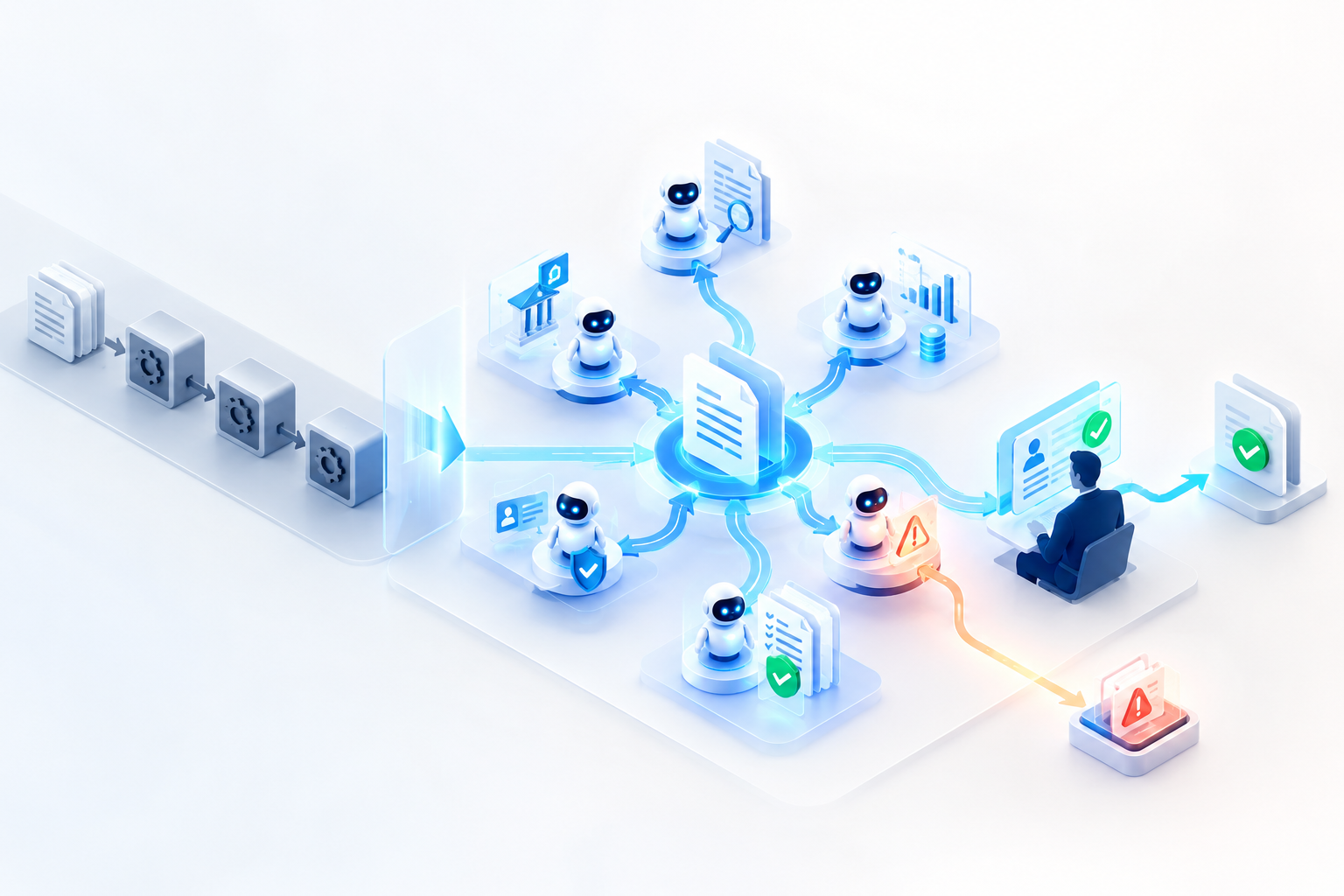
The distinction between traditional AI automation and agentic AI is especially important in credit.A traditional AI model might decide how to classify a transaction, pull information from documents or generate a risk score. These capabilities could be used by an agentic system as part of a larger workflow.
An agent, for example, might be:
- Identify an application's missing information.
- Obtain or request the correct information.
- Analyze financial information.
- Trigger a fraud or risk check when an anomaly is detected.
- Implement correct policy logic.
- Determine if the case can move forward or requires review.
- Keep context as application moves through the workflow.
This moves AI from performing a task to coordinating a sequence of tasks toward a defined lending outcome.
How AI Agents Are able to Understand the Credit Journey
The lending journey is a natural place for multi-agent workflows.
Architecture may link specialized agents from lead qualification to post-disbursement monitoring including KYC, data collection, financial analysis, credit assessment, decisioning, documentation and disbursement in the future.
The agents don’t have to do all the final decisions themselves. Instead they can do the analysis and coordination needed in advance of a designated human control point.
This results in a model that allows routine cases to flow through the workflow with minimal intervention and complex or exceptional cases to route to credit professionals.
So for banks and NBFCs, the value is not just in reducing manual work but in creating a continuous lending workflow where context is carried from one stage to the next.
The Lending Decision Engine in an Agentic Architecture
Agentic AI does not obsolete the lending decision engine. Its role changes.
A lending decision engine can still be responsible for executing credit policies, decision rules, eligibility criteria and other controlled decision logic. Agentic AI is able to circumvent this decision layer by determining which information should be collected, what analysis should be performed, and what workflow should be triggered next.
This leads to a layered architecture:
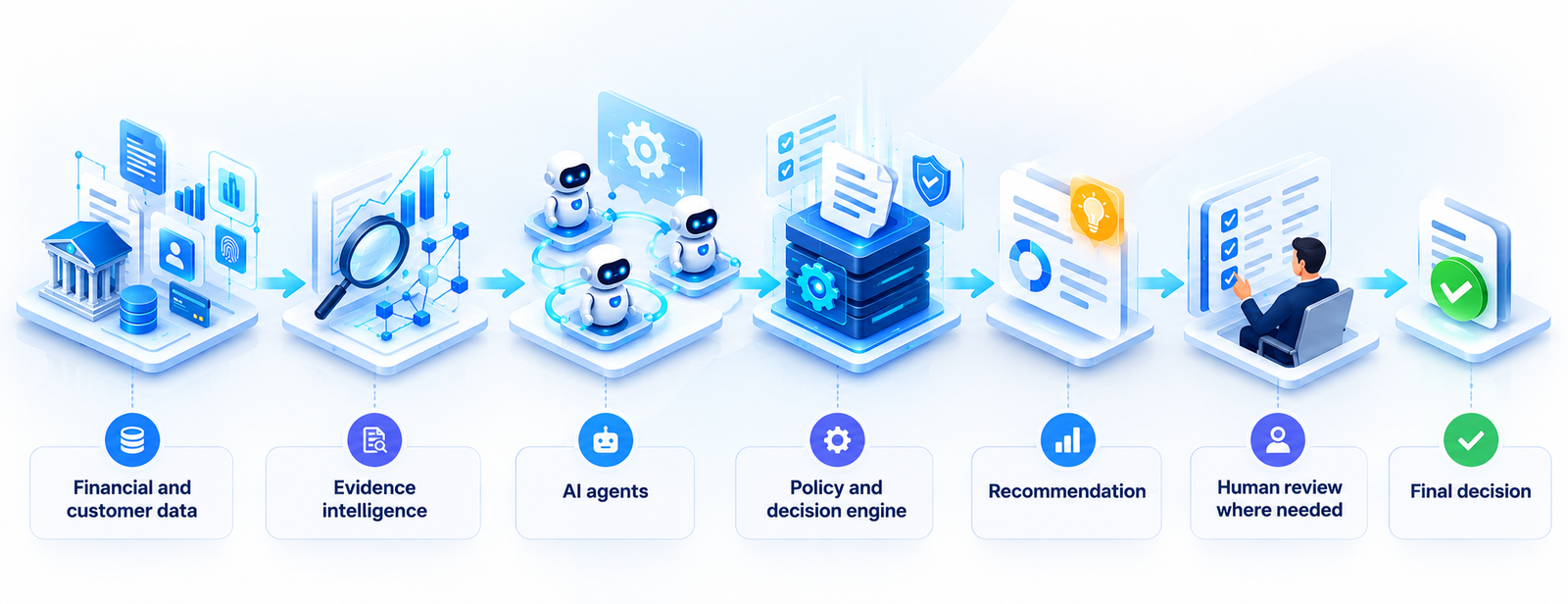
This kind of architecture separates authority from wisdom. Artificial intelligence can assist in orchestrating and interpreting, while policy and defined decision controls continue to govern the credit process.
From Financial Data to Decision Intelligence
The future of lending will also be determined by how well lenders are able to connect different sources of financial evidence.
Bank statements, Account Aggregator data, Credit bureau data, GST, ITR, Salary information, Application data and other documents can provide different views on the same borrower.
It is no longer a question of just collecting these sources. “It’s knowing how they relate to each other.
Agentic AI may help contextualize these signals. For instance, an abnormal transaction pattern may be a trigger for additional analysis, a mismatch between reported and observed income may be a trigger for validation, or a risk signal may be a trigger for further assessment of an application.
What Agentic AI Could Change for Banks and NBFCs by 2027
The biggest change in 2027 might not be that AI models will be inside lending systems Could be the rise of AI-native lending workflows.
Instead of employees moving applications between disparate systems, agents could coordinate activities across those systems. Instead of analysts having to collect the evidence, AI could constantly gather the relevant information around the credit decision. Workflows might no longer see exceptions as interruptions in operations, but as events to be detected and routed according to their context.
This can help to make lending processes more responsive, scalable and consistent, and also free up credit teams to spend more time on cases that require judgment.
Will Agentic AI Replace Credit Underwriters?
Agentic AI will likely change, rather than simply eliminate, the role of credit professionals.
When cases present ambiguity, unusual borrower behavior, policy interpretation, material exceptions or strategic judgment, credit expertise is still required.
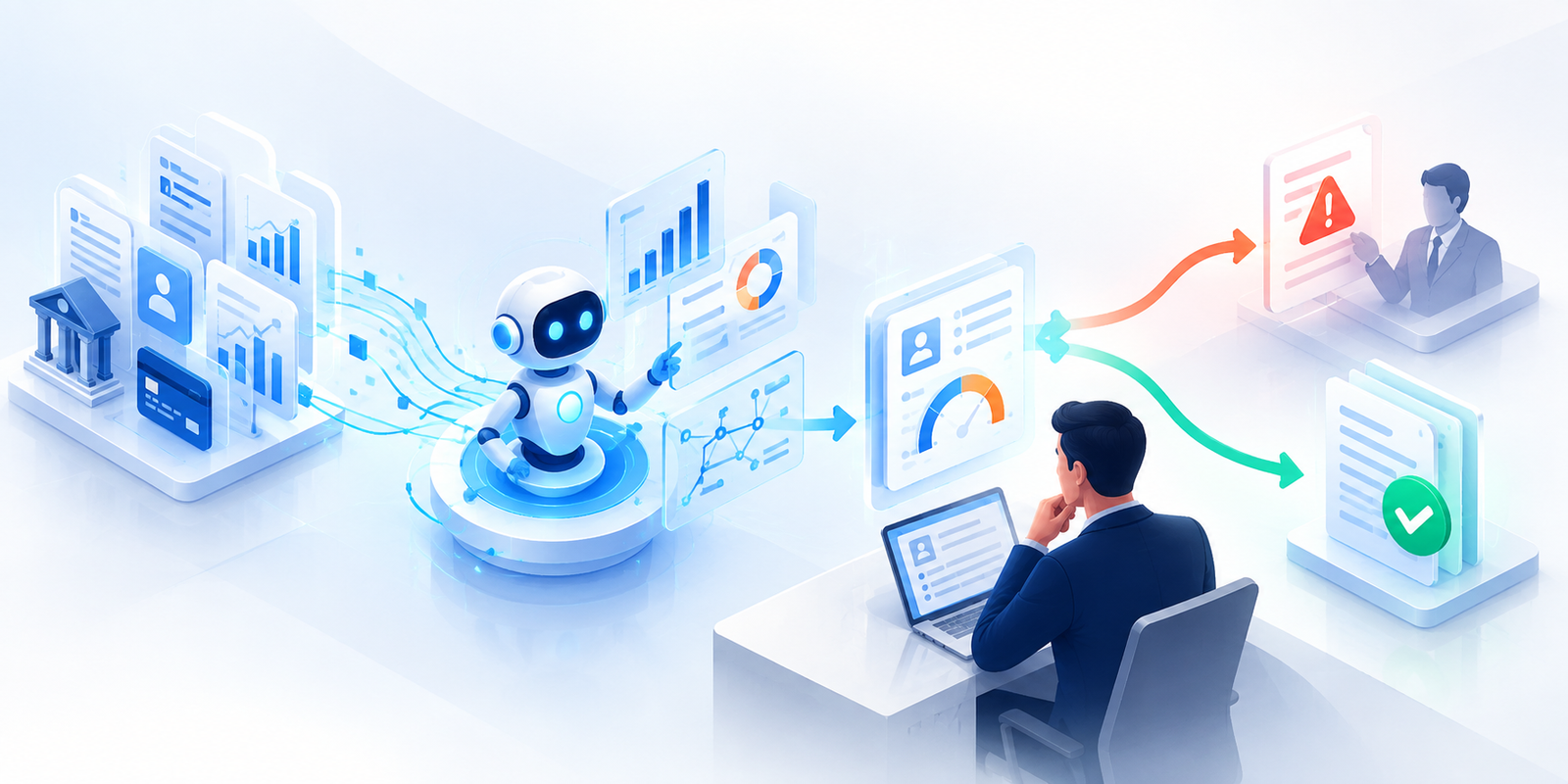
The emerging model is therefore not necessarily man versus AI. It is an AI-managed workflow with human authority at defined control points.
The AI is able to evaluate, coordinate actions, surface evidence and recommend a path to follow. The credit professional still bears responsibility for decisions that are material to judgment and accountability.
What Banks and NBFCs Must Develop Today
Moving toward agentic lending is more than simply putting an AI model to work.
Lenders need connected data foundations, API-enabled systems, structured credit policies, reusable decision logic, explainable AI capabilities, workflow orchestration, strong auditability and clearly defined human-in-the-loop controls.
Most importantly, organizations need to think beyond automating standalone activities. The strategic question is:
Can the lending architecture understand an application as a journey of continuous decisions, not as a series of disconnected tasks?
The change will determine how well banks and NBFCs can transition to AI-native lending.
From Automated Lending to Autonomous Decision Workflows
The next generation of lending is not going to be just faster underwriting or more automation. The whole credit workflow will be determined by how smartly it can function.
Agentic artificial intelligence can shift from task-level automation to more coordinated decision workflows where agents are able to understand context, deploy specialized capabilities, handle exceptions, and advance applications, all under the control of policies and human supervision.
For banks and NBFCs gearing up for the next wave of digital lending, the opportunity is to build the decision infrastructure today that can support increasingly intelligent workflows tomorrow.
It may not be adding AI to existing processes for the future of lending. It could be about re-engineering the process of lending for AI.
Ready to Build the Next Generation of Lending?
Agentic AI is transforming what’s possible in lending workflows. Novel Patterns enables banks and NBFCs to transition to intelligent, connected decisioning by integrating AI, financial data, credit intelligence, policy logic and human judgment into a single lending architecture.
Build lending workflows that transcend automation, from AI-powered underwriting and financial analysis to intelligent decisioning and post-disbursement monitoring.
Learn how Novel Patterns can help your institution build an AI-native lending ecosystem.