
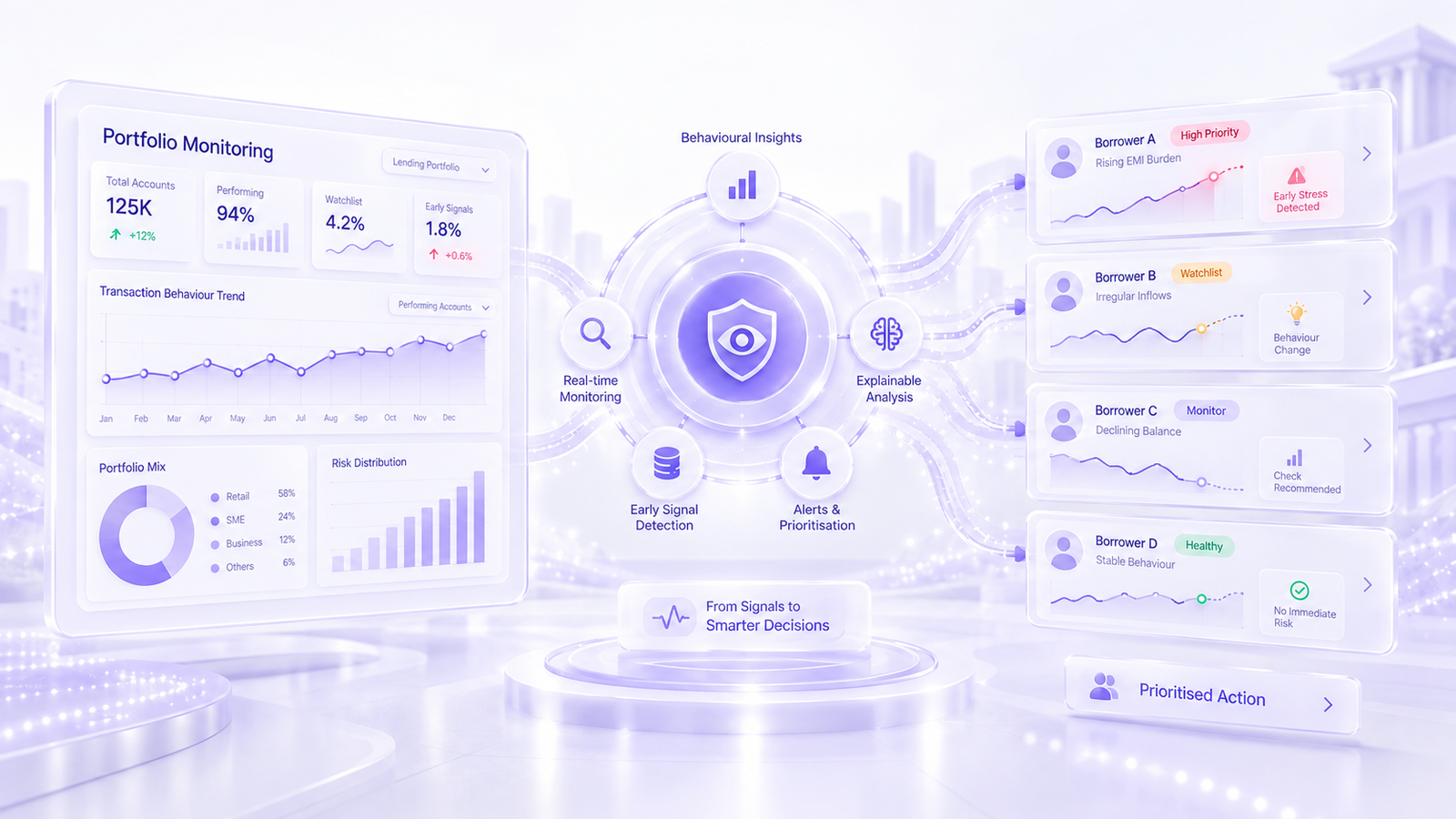
If you do credit or risk for an NBFC or bank, you probably already know this story - a loan looked fine and then it didn’t. Anyone who manages a portfolio knows that already. The more difficult question, the main thrust of this piece, is what separates a platform that detects that shift as an early warning signal from one that simply creates yet another dashboard that no one trusts.
Because here’s the inconvenient truth: most institutions already have an EWS. Very few do actually have an early one.
Why 'We Already Have an EWS' Isn't the Same as Being Safe
RBI has been clear about it. NBFCs have been asked to identify early signs of stress in an account before it becomes an NPA - not after, and not just to document the account when it’s already in trouble. Tracking accounts showing early signs of stress is now an explicit regulatory expectation, not a nice-to-have.
That’s a much different bar than most legacy monitoring set-ups were built for. Not that a system that refreshes on a bureau cycle, checks repayment status periodically and flags accounts once they cross a fixed threshold is wrong, exactly - it’s just answering a question regulators and boards have stopped considering sufficient on its own: has this account already gone bad? The more useful question, and one an early warning signal platform needs to be answering, is, "Is this borrower's financial behavior changing right now, whilst the loan is still performing?"
That space between those two questions is where delinquency really starts to cost - the institution and a borrower who may have been okay had the conversation occurred earlier.
What Really Distinguishes a Legacy EWS from a Modern One
This is the part most vendor conversations skip. Here’s a quick way to gauge what you’re seeing:
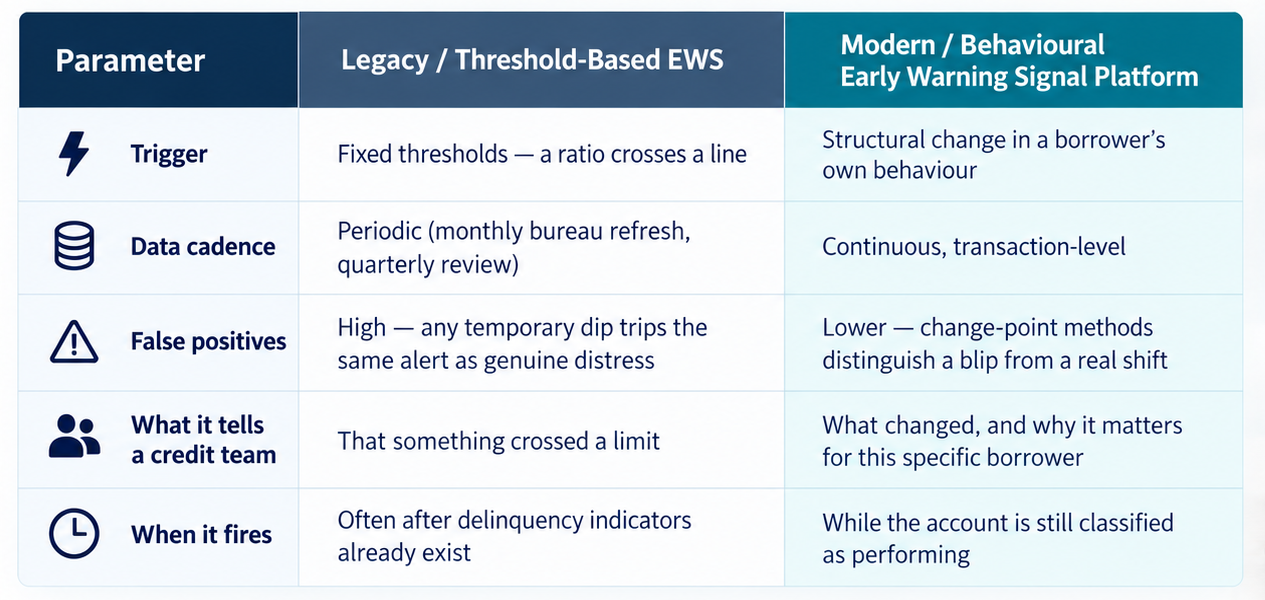
The false-positive problem is the most important distinction for any portfolio of any real size. The problem with a fixed-threshold system is that it treats a self-employed borrower’s one slow month the same as a real, sustained downturn, because they both cross the same static line. A change-point approach asks a different question: Is this a temporary fluctuation or a permanent shift in how this particular borrower’s money moves? That’s the difference between a risk team that trusts its alerts, and one that’s learned to ignore half of them.
What “Early” Should Really Mean for a Financial Institution
The early warning signs for loan accounts are not one dramatic event but rather a change in pattern and that is exactly why they are easy to miss if you’re only looking at repayment status:
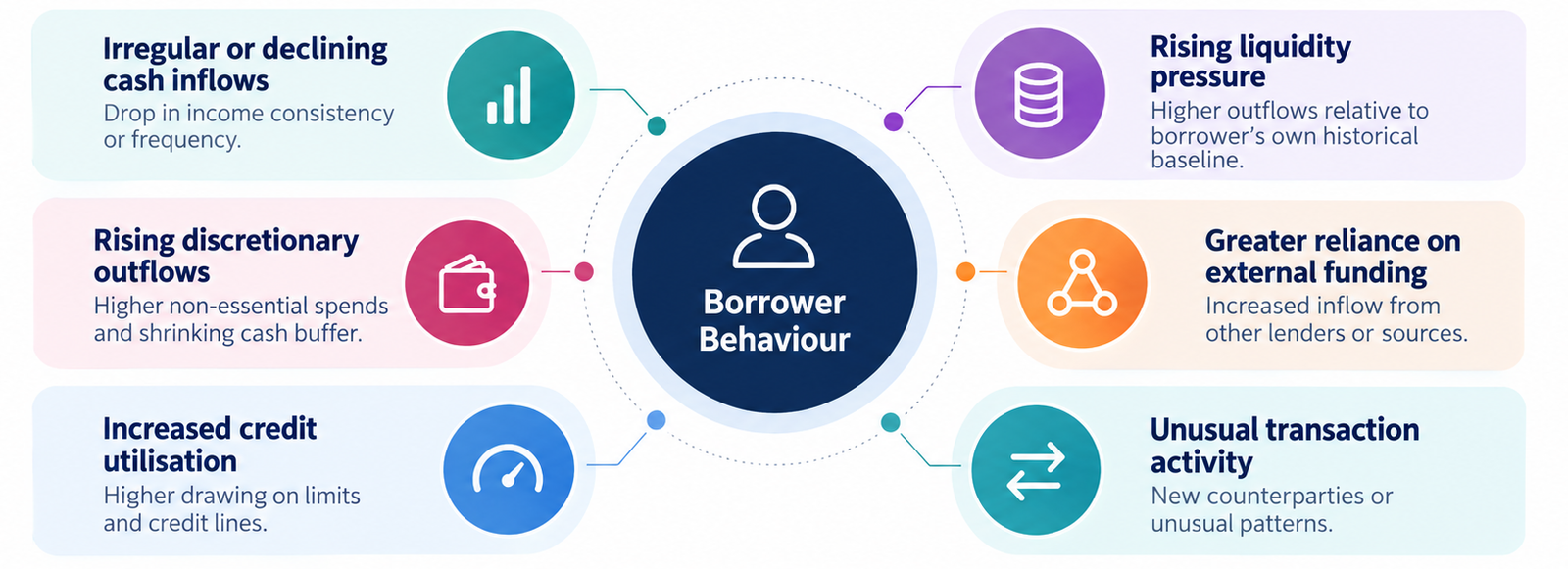
For self-employed borrowers and MSMEs in particular, where income is naturally volatile, these behavioral signals contain more information than a periodic bureau snapshot ever will. But a bad month doesn’t show up cleanly on a credit report. You can tell immediately from the way cash actually comes out of an account.
Practical Checklist: What to Look for in an EWS for NBFC
If you are considering options rather than reading about the idea, here is what a truly useful early warning signal platform needs to do in order:
- Detect material change, not threshold transgression. Ask any vendor directly: does this system differentiate a temporary dip from a structural shift, or does everything above a line get the same treatment?
- Combine signals into one view, not a list of disparate alerts. If a platform is giving its risk team twenty unrelated flags per account, it hasn’t solved the analysis problem, it’s just moved it.
- It explains itself. Every alert needs to have a reason attached to it - which signal moved, by how much, against what baseline - or a risk team will spend more time researching the alert than the account.
- Report, don't just prioritize. Who to call this week, not who technically makes a watchlist.
- Partner with account types your portfolio really has. If a bank runs retail, MSME and corporate books in parallel, it needs one coherent view, not three disconnected tools.
How This Plays Out Differently for Banks, NBFCs and HFCs
The underlying need is the same-spot deterioration earlier, act when there is still scope to help-but what "early" means varies by lender type. A bank with a mixed retail-MSME-corporate book needs portfolio-wide visibility across very different borrower profiles. For an NBFC that runs high volume, you need a behavioral layer that can scale without scaling headcount. An HFC, with loans that run for decades, has to track how a borrower’s circumstances change over a much longer horizon than a typical personal loan.
None of this changes the basic credit risk logic. It changes what a portfolio
team wants the platform to prioritize for their particular book.
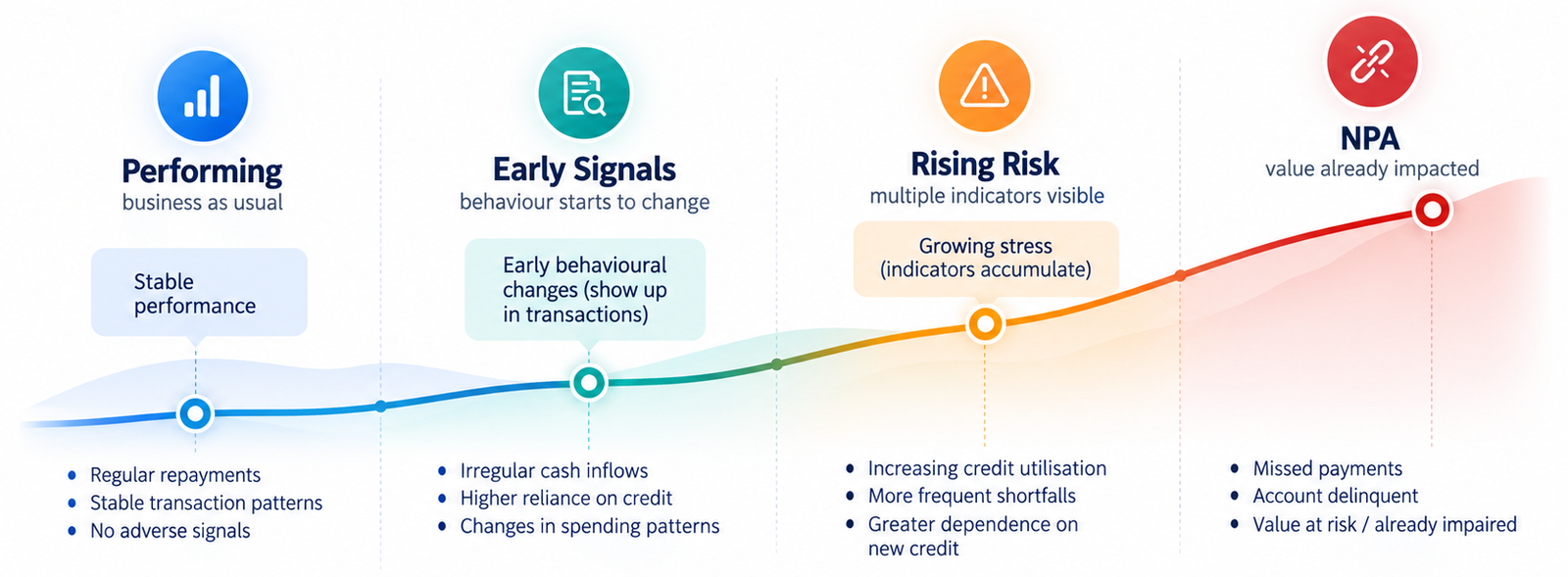
Where This Fits: Hawkeye’s Method
Novel Patterns’ post-disbursement monitoring engine, Hawkeye, is built around the behavioral approach described above - using Core Banking System and Account Aggregator data as well as change-point detection to highlight borrower stress while an account is still performing, not after. Learn how Hawkeye’s five-layer architecture works in detail and how Account Aggregator data enhances post-disbursement visibility.
The short version: It was never about creating more alerts. It's about making sure a financial institution knows about stress in its own data, not a missed payment.
If your institution is considering how to shift from reactive delinquency tracking to authentic early warning, check out Hawkeye to see what a behavioral approach to portfolio monitoring really looks like in practice.