
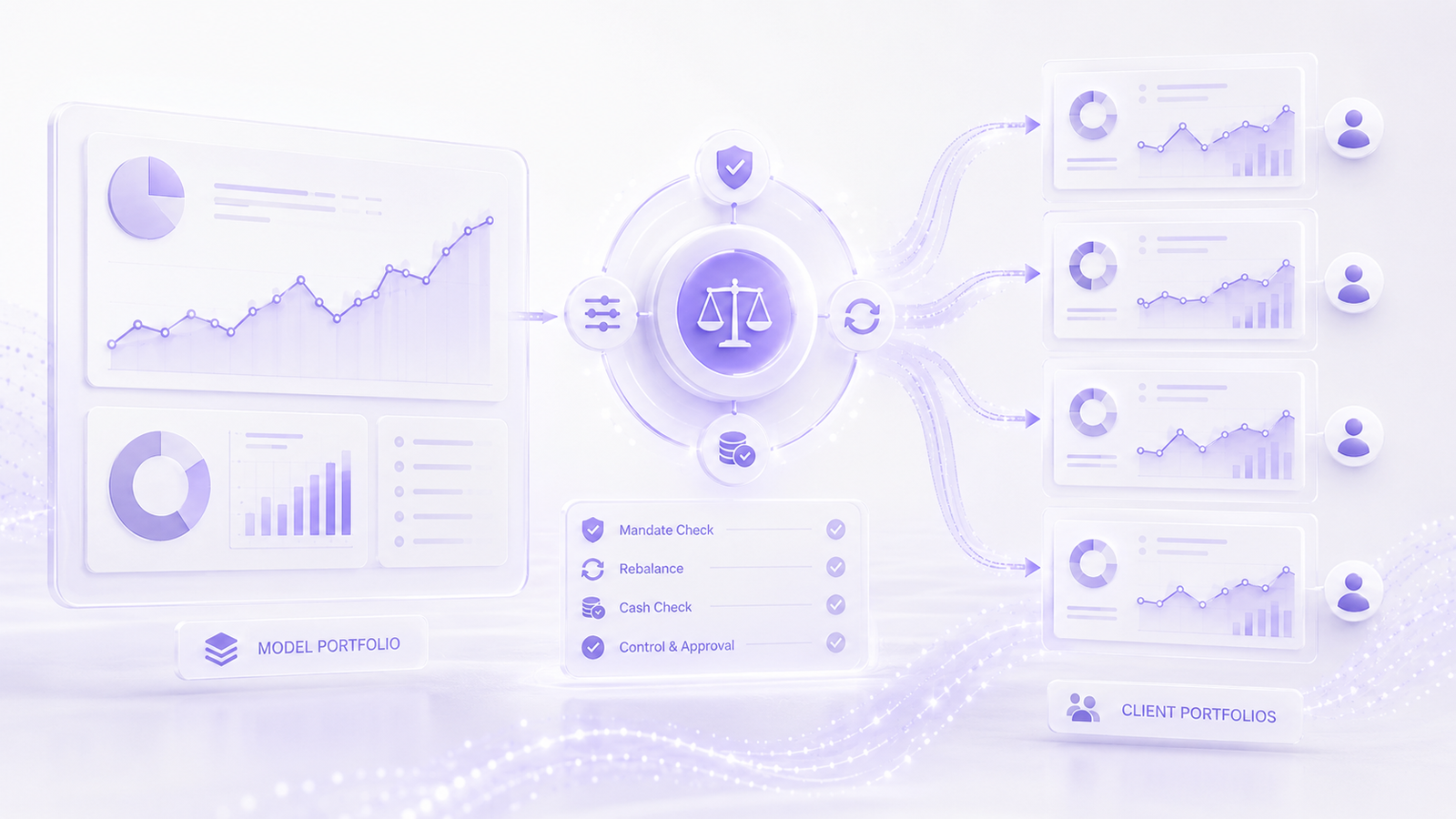
One Investment Decision Can Become Hundreds of Portfolio Decisions
Consider a simple investment decision. A portfolio manager decides that Stock A should move from 7% of the model portfolio to 4%. At the model level, the instruction appears straightforward. The target allocation changes, and the team knows that exposure to the security should reduce.
Now consider the same decision across 500 client portfolios.
One client may currently hold Stock A at 8.2% because the stock has appreciated significantly. Another may already be close to 4%. A recently onboarded client might hold only a small position, while another investor may not own the stock at all.
There could also be portfolios where a sell order has already been placed but has not fully executed. Another account may have a restriction that changes whether the proposed trade should apply. Some portfolios may have experienced recent cash flows that have already altered their overall allocation.
The model change is still
the same.
The action required at the
client level is not.
This is where portfolio management starts moving beyond a simple model-to-order workflow. The operating environment has to understand which portfolios are affected, how much each one needs to change and whether there is anything about the individual account that changes the appropriate action.
A model portfolio therefore provides direction. It does not automatically provide the final trade for every client.
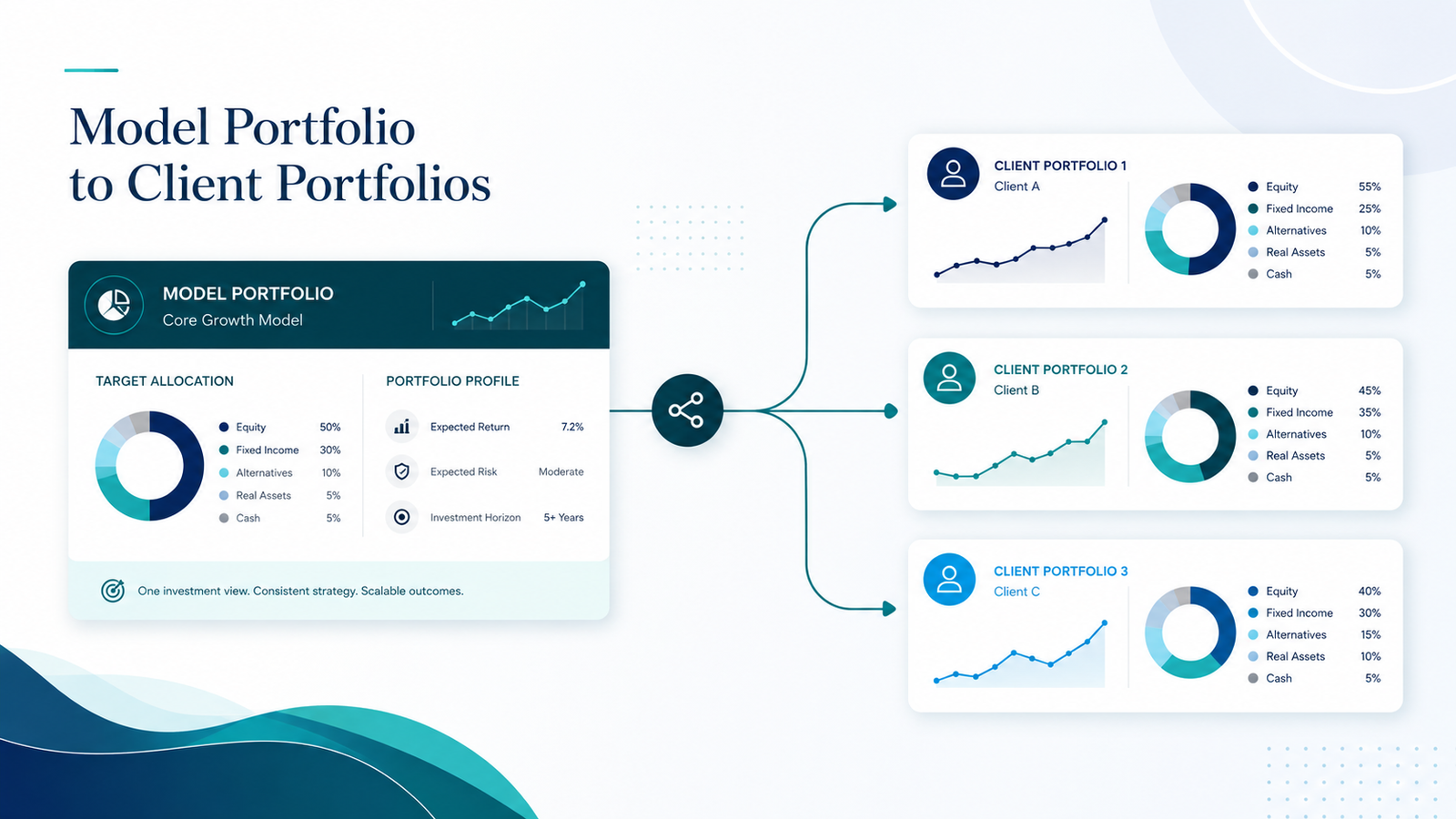
Why Client Portfolios Naturally Move Away From the Model
Portfolio drift is often discussed as something that needs to be corrected, but some degree of drift is a natural part of managing individual investment accounts.
Clients do not all enter a strategy on the same day. One investor may have started two years ago, while another joined only last month. Their original purchase prices, quantities and portfolio compositions will therefore be different.
The portfolios continue to evolve differently after onboarding.
A client may add fresh capital. Another may withdraw funds. A security may appreciate faster than the rest of the portfolio. An order may only receive a partial fill. A corporate action may change the quantity held in an account.
There may also be client-specific restrictions that intentionally make one portfolio different from another.
None of these situations necessarily indicates a problem.
What matters is whether the investment and operations teams can explain the difference.
If a portfolio is away from the model because a client made a withdrawal yesterday, that may be expected. If it is away from the model because an order has remained unresolved for several days, the situation requires a different response.
Simply identifying that two numbers are different is therefore not enough.
The operating environment needs to preserve the context around that difference.
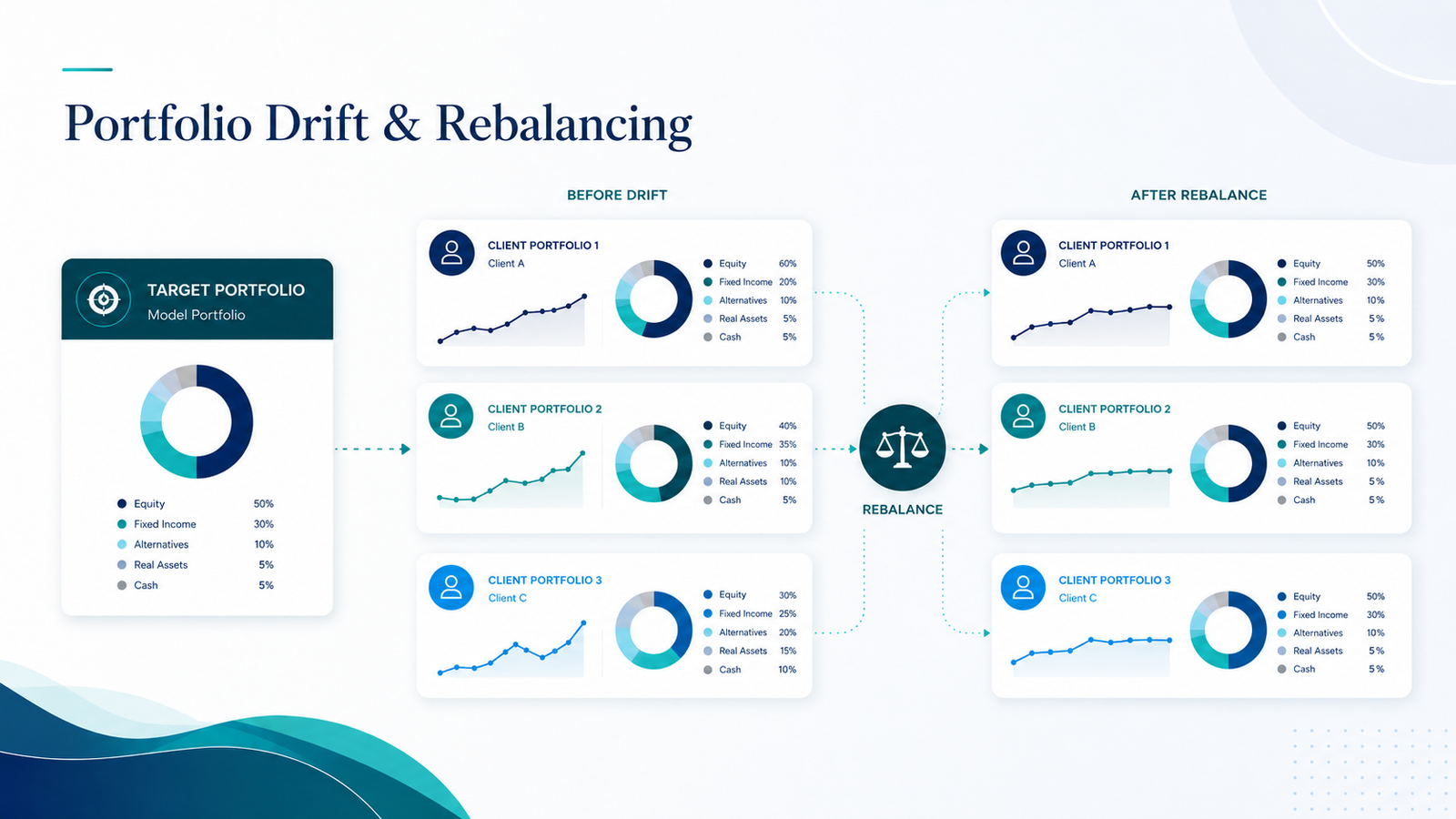
Rebalancing Needs Portfolio Context Before It Needs an Order
Rebalancing is sometimes presented as astraightforward calculation.
- Current allocation: 7%.
- Target allocation: 4%.
- Difference: 3%.
In a live PMS environment, however, the calculation is only one part of the process.
Before an order moves forward, the team may need to understand the client’s current holdings and available quantity. It may need to know whether another order is already open, whether a previous trade has partially executed or whether unsettled activity will change the portfolio shortly.
Cash also matters.
When the model calls for increasing a position, the portfolio may or may not have enough available cash to participate in the same way as another account.
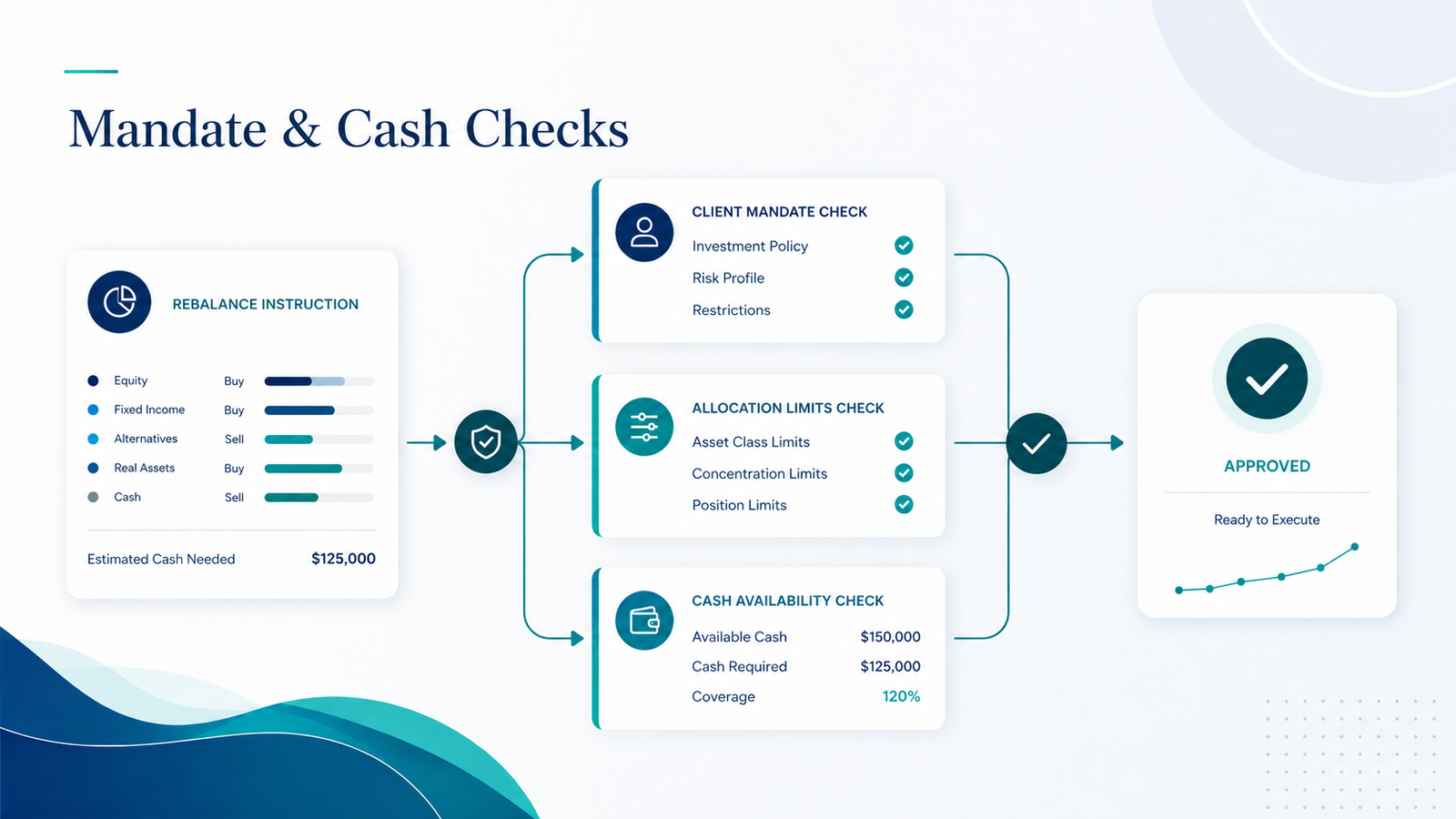
Client mandates can add another layer. A security that is suitable within the overall strategy may still be restricted for a particular client. Concentration limits, investment restrictions or other account-level rules can influence what action should be taken.
This means the practical workflow looks less like:
Model Change → Order
and more like:
The difference is important.
In the second workflow, the investment decision remains connected to the context of the client portfolio throughout the process.
The Hard Part Is Often Knowing What Still Needs Attention
For smaller portfolio books, investment and operations teams can often carry a surprising amount of information in their heads.
Someone remembers that a particular client added money yesterday. Another person knows that an order was only partially filled. The portfolio manager remembers that one account has a specific restriction.
That knowledge is valuable, but it becomes difficult to scale.
As the number of clients grows, so does the number of portfolio-level situations that need to be remembered, checked or followed up.
The operational question gradually changes.
Instead of asking only, “Which orders need to be placed?”, teams also need to know which portfolios have already been rebalanced, which are currently in progress, which are blocked, which are intentionally different and which have simply not reached the expected outcome.
This is where visibility becomes as important as processing speed.
An exception should not disappear because the person who knew about it is unavailable that day. The reason for the exception, its current status and the action required should remain visible within the workflow.
The same applies to portfolio drift.
Investment teams need to know whether a difference is expected. Operations teams need to know whether something is already being done about it.
Without that shared context, both teams may spend time investigating something the other team already understands.
Not Every Client Portfolio Should Look Identical
There is another important distinction when thinking about model portfolios. The objective should not be to make every client account identical at every moment.
A PMS manages individual investors, not copies of a single portfolio.
There can be valid reasons why two clients following the same investment strategy are positioned differently.
One client may have joined recently. Another may have withdrawn capital. One account may contain an investment restriction. Another may be waiting for an order to complete.
Forcing each portfolio into immediate uniformity can therefore be the wrong objective.
A more useful operating principle is controlled variation.
The PMS should be able to see which portfolios differ from the model and understand why. The team should know which differences are intentional, which fall within acceptable tolerance and which require action.
That requires portfolio positions, mandate information, rebalancing decisions and order activity to remain connected.
When these elements are visible together, a difference can be explained.
When they are fragmented across systems and spreadsheets, even a legitimate difference can create another cycle of reconciliation and follow-up.
What Changes When a PMS Starts Scaling
As AUM and client count increase, the operational challenge is not simply that there are more transactions.
There are more relationships between investment decisions, portfolios, mandates, exceptions and execution outcomes.
A model change that once affected 50 client accounts may eventually touch 500 or 5,000.
The investment decision itself may not have become more complicated. The coordination required to carry that decision across the organization has.
This is why adding more people does not always solve the underlying problem.
Additional capacity can help teams process more work, but if the same portfolio change still requires people to move between spreadsheets, portfolio reports, mandate records, approval screens and order systems, the amount of coordination continues to grow with the business.
Amore scalable operating model keeps those stages connected.
When a model changes, teams should be able to understand which portfolios are impacted. They should be able to see which accounts can participate, what needs to be rebalanced, what has entered the order workflow, what has executed and which portfolios remain unresolved.
The objective is not simply to process a higher volume.
It is to make the higher volume easier to understand and control.
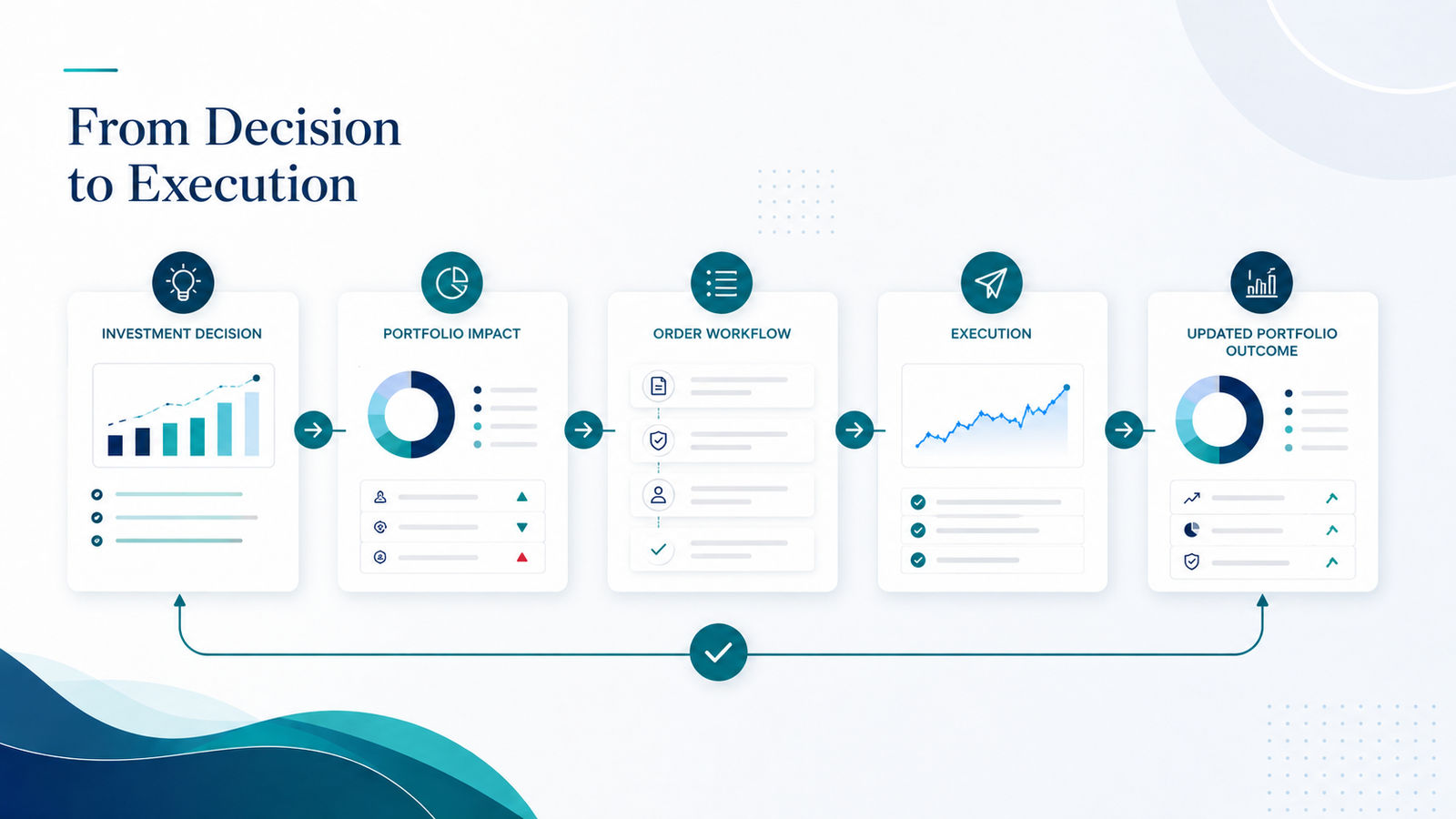
From Investment Intent to Client Portfolio Outcome
For a portfolio manager, the starting point is investment intent. Perhaps the team wants to reduce exposure to a sector, increase conviction in a particular security or adjust the overall asset mix.
For the PMS operating model, however, the job is not complete when the model is changed. The decision needs to travel through several layers before it becomes an actual portfolio outcome. The portfolio impact has to be understood. Client-level conditions need to be checked. Rebalancing requirements need to be determined. Orders need to be created and reviewed. Execution needs to be captured.
Once that happens, the resulting portfolio needs to be evaluated again.
Did the intended change actually happen?
Which accounts are now aligned?
Which remain different?
And, more importantly, why?
This final feedback loop is what turns rebalancing from a transaction-processing exercise into aportfolio management process.
Where Genesis Fits
Genesisis designed to bring these stages of PMS operations into aconnected investment management environment.
Portfolio views, client-level positions, mandate controls, rebalancing and order workflows can work from ashared portfolio contextrather than becoming separate activities that have to be stitched together later.
For portfolio managers, this creates clearer visibility into how an investment decision is translating across actual client accounts.
For operations teams, it creates a more structured view of which portfolios require action, which orders are already moving and which exceptions still need attention.
The objective is not simply faster order generation.
It is to preserve the connection between the original investment decision and the eventual client portfolio outcome.
As a PMS grows, that continuity becomes increasingly valuable because scaling should not mean adding another layer of manual coordination every time the model changes.
The Model Changed. What Happened Next?
Updating a model portfolio can take a few minutes. Understanding what happened after the update is a much better test of the operating environment behind a PMS.
Did the right portfolios participate?
Were client mandates taken into account?
Were exceptions visible?
Did the orders execute?
Which portfolios remain away from the intended allocation, and is there a clear reason why?
For a growing PMS, these questions become increasingly important because investment intent only creates value when it can be translated consistently into client-level outcomes.
Genesis helps investment and operations teams keep portfolio management, mandate controls, rebalancing and order workflows connected through that journey.