

A portfolio management service is no longer judged on returns alone. Clients, distributors and regulators now look closely at how a provider reports, controls risk and communicates, and all of that depends on operations as much as on the investment team. For PMS, AIF and bank operations teams, choosing a provider, or judging whether your own setup is ready to be chosen, means looking well beyond a track record. This guide explains what a portfolio management service is in India, how the models and fees work and what regulators expect. It ends with checklists you can apply in your next review.
What a Portfolio Management Service Means in the Indian Context
In India, a portfolio management service (PMS) is a customised investment service offered to an individual client under the SEBI (Portfolio Managers) Regulations, 2020. The client's securities sit in a separate account in the client's own name, and the manager invests on the client's behalf under a written agreement. Providers must be registered with SEBI, and the minimum investment is Rs 50 lakh per client.
Because every client holds an individual portfolio, holdings, cash balances and entry timing can differ even within the same strategy. That flexibility is the strength of a portfolio management service. It is also the reason the service is operationally demanding.
Discretionary, Non-Discretionary and Advisory Models Compared
- Discretionary: The manager decides and executes within the agreed mandate, without seeking approval for each transaction. This gives speed and consistency across clients, but it needs strong mandate checks and clear records of every decision.
- Non-discretionary: The manager recommends, and the client approves each transaction before execution. Clients keep control, but execution depends on client response, so approval trails and timing matter.
- Advisory: The provider gives advice only and the client executes. Responsibility for execution and record keeping sits largely with the client.

The model a provider runs changes what you should examine in their operations.
Typical Fee Structures in a Portfolio Management Service
Most providers use one of three structures:
- Fixed fee: A percentage of assets under management, charged at agreed intervals.
- Performance-linked fee: A share of profits above a hurdle rate, usually calculated with a high water mark so that clients are not charged twice for the same gains.
- Hybrid: A lower fixed fee combined with a performance component.
Brokerage, custody, audit and similar charges are usually billed separately. The key question is not which structure is cheapest. It is whether every charge is disclosed in writing and can be reproduced from the provider's records.

Regulatory Considerations That Shape Day-to-Day Operations
SEBI's framework affects daily operations in several ways. Providers are expected to issue a disclosure document and a client agreement, keep client assets segregated and use a custodian. They must also maintain compliance and grievance processes and send clients periodic reports. Performance is expected to be presented using standardised methods so that returns can be compared across providers.
Each of these obligations depends on accurate data, timely reconciliation and a reliable audit trail. Requirements are updated from time to time, so confirm current rules against the latest SEBI circulars.
Performance and Risk Metrics Clients and Regulators Expect
- Returns: Time-weighted returns against a stated benchmark, across multiple periods and reported consistently.
- Risk: Standard deviation, maximum drawdown, beta and Sharpe ratio, along with concentration, portfolio turnover and cash levels.
- Dispersion: How far individual client returns within one strategy differ from the model portfolio. Wide dispersion often points to operational issues such as allocation delays or cash handling rather than investment decisions.
A provider that can explain these numbers client by client is demonstrating real operational control.
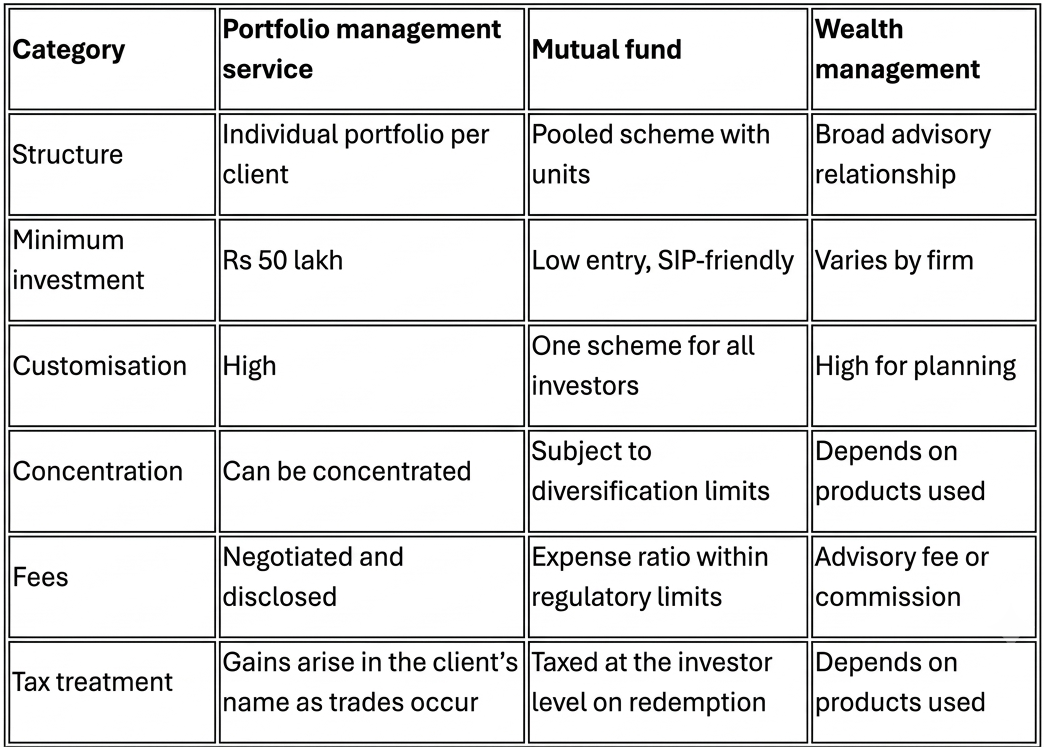
A mutual fund suits investors who want low-cost, pooled diversification. A portfolio management service suits investors with a larger corpus who want a customised, directly held portfolio. Wealth management is the widest of the three. It covers planning, insurance, estate and tax alongside investments and often includes a PMS as one component.

A Practical Checklist for Choosing a Portfolio Management Service Provider
- Verify SEBI registration, the disclosure document and standardised performance data.
- Understand the investment process and how consistency across clients is maintained.
- Get every fee, expense and fee calculation basis in writing.
- Ask about pre-trade checks, mandate limits and approval workflows.
- Confirm custody arrangements and how holdings are reconciled.
- Review sample client statements and ask how any figure is traced back to source.
- Check how clients receive updates and how quickly queries are answered.
- Assess whether the provider's technology can scale as clients and portfolios grow.
Ask for evidence, not assurances. A provider with strong operations will show you sample reports and process documents without hesitation.
Operational Readiness Checklist for PMS,AIF and Bank Operations Teams
If you sit on the provider side or are evaluating a partner's back office, test these points:
- Can you value every client portfolio daily and explain any movement?
- Are corporate actions processed without manual re-entry?
- Is reconciliation with custodians and brokers automated, with exceptions flagged?
- Are approvals and changes recorded in an audit trail?
- Can client statements and reports be produced on demand in consistent formats?
- Can you provide evidence on how fees and performance were calculated?
Where the answers rely on spreadsheets and manual checks, risk grows with every new client.

Where Technology Fits: Genesis by Novel Patterns
Novel Patterns builds Genesis, an investment operations platform that supports portfolio management, accounting, NAV, compliance and reporting for PMS providers, AIFs, wealth managers and other financial institutions. On the reporting side, Genesis helps automate fund reporting and investor communication, with configurable reports, dashboards and an investor portal, backed by maker-checker controls and a recorded audit trail. For operations teams, that means less time assembling statements and more time on exceptions and client service.