
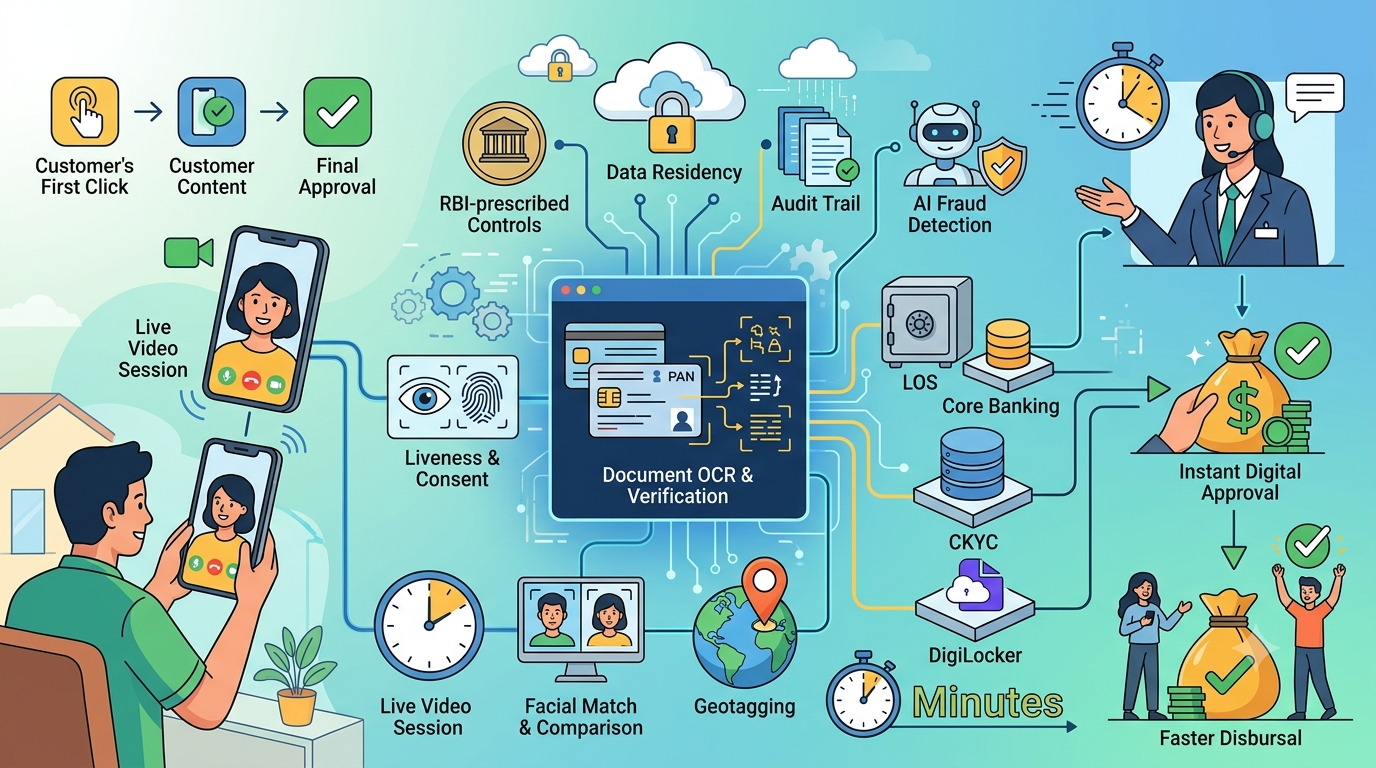
Video KYC (vKYC) has become a standard onboarding route for Indian banks, NBFCs and fintechs. A customer completes identity verification on a live video call from home, and the financial institution receives a verified, auditable record within minutes. The path from application to disbursal is shortened for lenders that are competing on turnaround time, while maintaining all compliance obligations.
What vKYC Involves from the Customer's First Click to Final Approval?
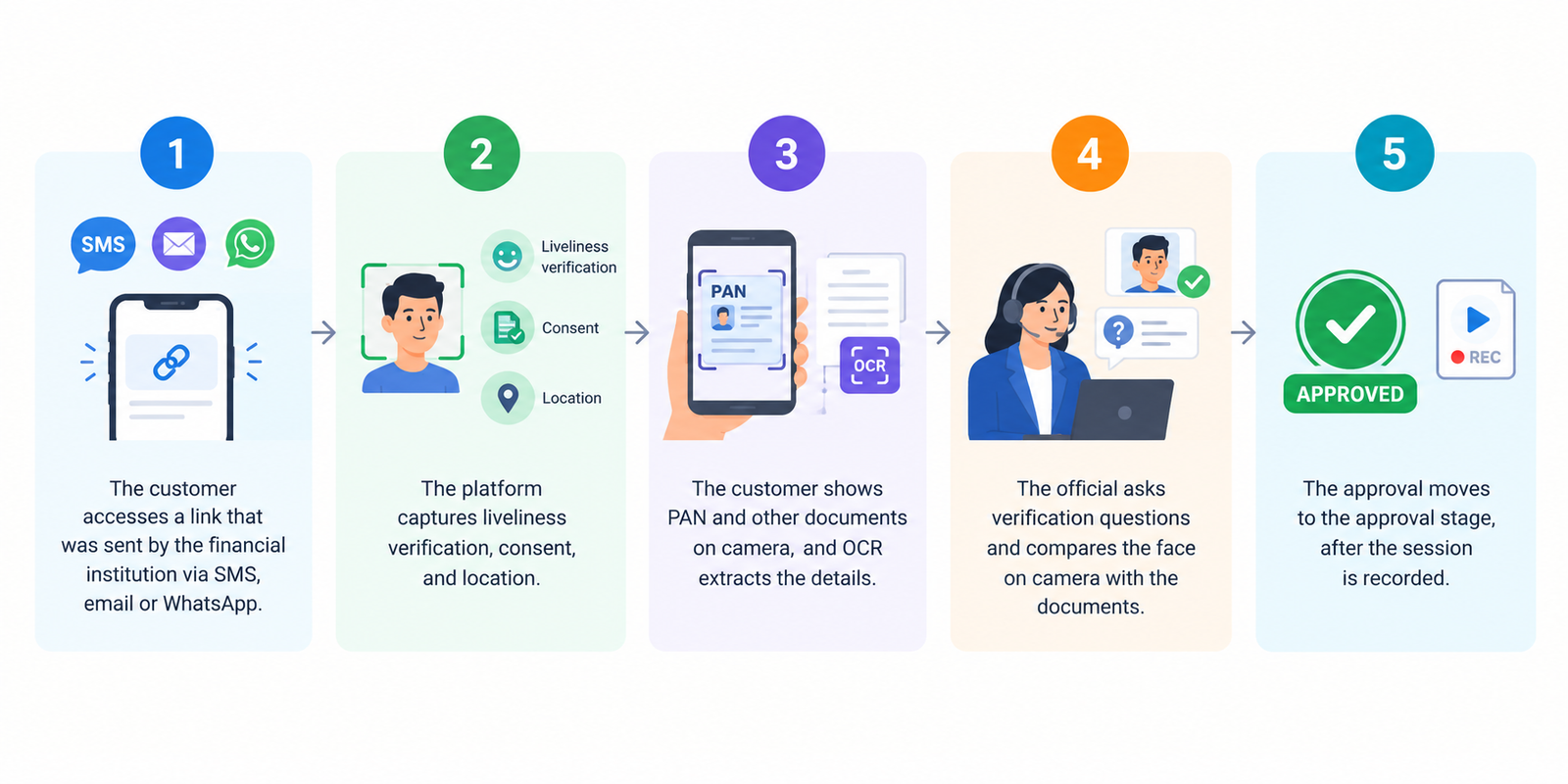
vKYC is a live, recorded conversation between a trained official and the customer over a secure video session, usually in five steps.
- The customer accesses a link that was sent by the financial institution via SMS, email or WhatsApp.
- The platform captures liveliness verification, consent, and location.
- The customer shows PAN and other documents on camera, and OCR extracts the details.
- The official asks verification questions and compares the face on camera with the documents.
- The approval moves to the approval stage, after the session is recorded.
Industry sources put a typical session at five to ten minutes, and the customer never visits a branch.
The Regulatory Context in India and What RBI Expects from a Compliant V-CIP Process
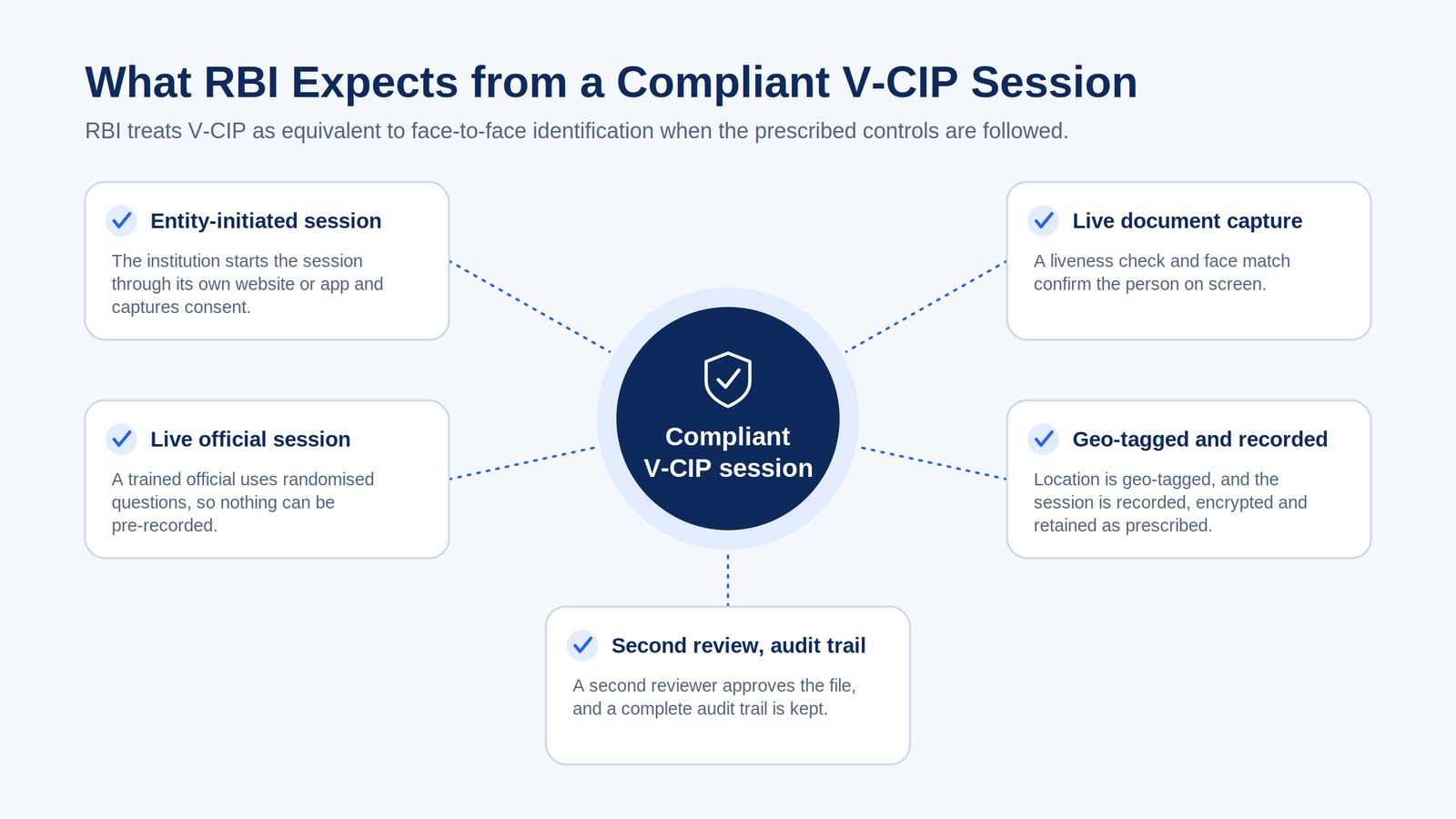
The Reserve Bank of India refers to video KYC as the Video-based Customer Identification Process, or V-CIP. RBI introduced it through a notification dated 9 January 2020 and treats it as equivalent to face-to-face identification when the prescribed controls are followed. The framework now sits within the KYC Master Direction, the latest version of which was issued by the RBI on 28 November 2025.
The controls that matter most in practice are these:
- The entity initiates the session through its website or app and captures consent.
- A trained official runs a live session with randomised questions, so nothing can be pre-recorded.
- Documents are captured live, and a liveness check and face match confirm the identity of the person on screen.
- Location is geo-tagged, and the session is recorded, encrypted and retained as prescribed.
- A second reviewer approves the file, and a complete audit trail is kept.
SEBI and IRDAI run parallel frameworks for mutual funds and insurance.
Why Video KYC Delivers Faster Onboarding, Lower Fraud and a Better Customer Experience
Speed is the first gain. Branch visits and paper collection add days to onboarding, while a video session verifies identity in one slot that can be completed the same day. In lending, every day of delay raises the chance an applicant goes elsewhere.
Fraud control improves because the checks run on live evidence. Liveness detection confirms a real person is present, face matching ties that person to the documents, and forgery detection examines the documents themselves. A trained official adds judgement on top, noticing inconsistencies that software alone can miss.
Customers gain convenience. They verify from home on their own phone, without taking time off work or travelling to a branch. Fewer steps mean fewer abandoned applications.
Operations benefit too, since recorded sessions replace paper files and give auditors a searchable trail.
The Technical Building Blocks of a Reliable vKYC Platform
A dependable platform combines six components, each with a clear job.
- Video engine.Low-latency streaming that adapts to weak networks keeps sessions alive where connectivity varies.
- Liveness and deepfake detection.Active and passive checks confirm a live person and flag photos, replayed videos or synthetic faces.
- OCR and document intelligence.Automated extraction reads PAN, Aadhaar, and address proofs, flagging poor captures or tampering.
- eKYC and registry connections.OTP-based Aadhaar eKYC, offline Aadhaar verification, DigiLocker, and CKYC records provide verified data for confirmation.
- Geo-tagging and device signals.GPS and IP data establish where the session took place.
- Storage and audit trail.Encrypted recordings, timestamps, access logs and retention rules produce an evidence file that can be exported on request.
These parts must hand off cleanly. A liveness result that never reaches the reviewer, or a recording that cannot be matched to its application, weakens the audit trail.
Integration Considerations for Core Banking Systems and Lending Stacks
Video KYC delivers its full value when the session outcome flows into the systems that act on it: the loan origination system (LOS), loan management system, CRM and core banking system.
Four design choices shape the result. First, webhooks push session status to the LOS in real time, so an approved KYC can trigger the next underwriting step. Second, a shared application ID ties every recording, document and decision to one file. Third, the verified identity record should feed customer creation in the core banking system and the CKYC upload without re-keying. Fourth, scheduling and retry rules should match staffing, with a fallback to branch or assisted journeys when a session fails.
Security reviews and data residency checks belong early in the plan.
A Short Implementation Checklist for Banks and NBFCs Launching vKYC
- Write the V-CIP policy, SOP and workflow against the current RBI Master Direction.
- Train officials, with randomised question banks and clear escalation rules.
- Choose a platform with liveness, OCR, geo-tagging, encrypted recording and an exportable audit trail.
- Integrate through APIs with the LOS, core banking system, CKYC and DigiLocker.
- Set up second-reviewer approval and a concurrent audit process.
- Complete security testing and confirm data residency and retention rules.
- Pilot on one product, track completion rate, rejection reasons and turnaround, then scale.
An Illustrative Example of vKYC Impact in Lending Operations
Consider a mid-sized NBFC that relies on field agents for identity checks and personal discussions. Novel Patterns puts the delay from a physical visit at three to five days of turnaround. Moving the same step to a scheduled video session removes travel time and scheduling gaps. Novel Patterns reports that institutions using MyConCall see up to 90 percent faster turnaround, from days to minutes, and up to 90 percent lower onboarding costs. This scenario is illustrative, and actual results depend on the starting process, so a pilot on one product gives the most reliable baseline.
How Novel Patterns Delivers vKYC with MyConCall and DecisionOS
MyConCall, a DecisionOSmodule from Novel Patterns, enables Ai-assisted video KYC. It combines real-time liveness detection, OCR for identity and address documents, AI and ML forgery detection, geo-tagging, IP capture and timestamped recordings in one regulator-ready workflow. A proprietary low bandwidth video engine runs on 2G and 3G networks, extending reach to smaller towns, and co-browsing lets an official guide form fill during the call. It is available through API, web dashboard and mobile, with cloud or on-premises deployment, and more than ten enterprise customers run it today.
DecisionOS picks up where the video session ends. It connects vKYC outcomes to explainable policy workflows, so each approval or referral can be traced to the rules behind it. Pre-built connectors speed up integration and live deployment.
Taking the First Step from vKYC Pilot to Full-Scale Rollout
Video KYC gives banks and NBFCs a compliant route to faster onboarding, stronger fraud control and a smoother customer journey. A clear policy, a capable platform and a focused pilot put that route within reach. Novel Patterns can walk your team through MyConCall and DecisionOS whenever you are ready.