
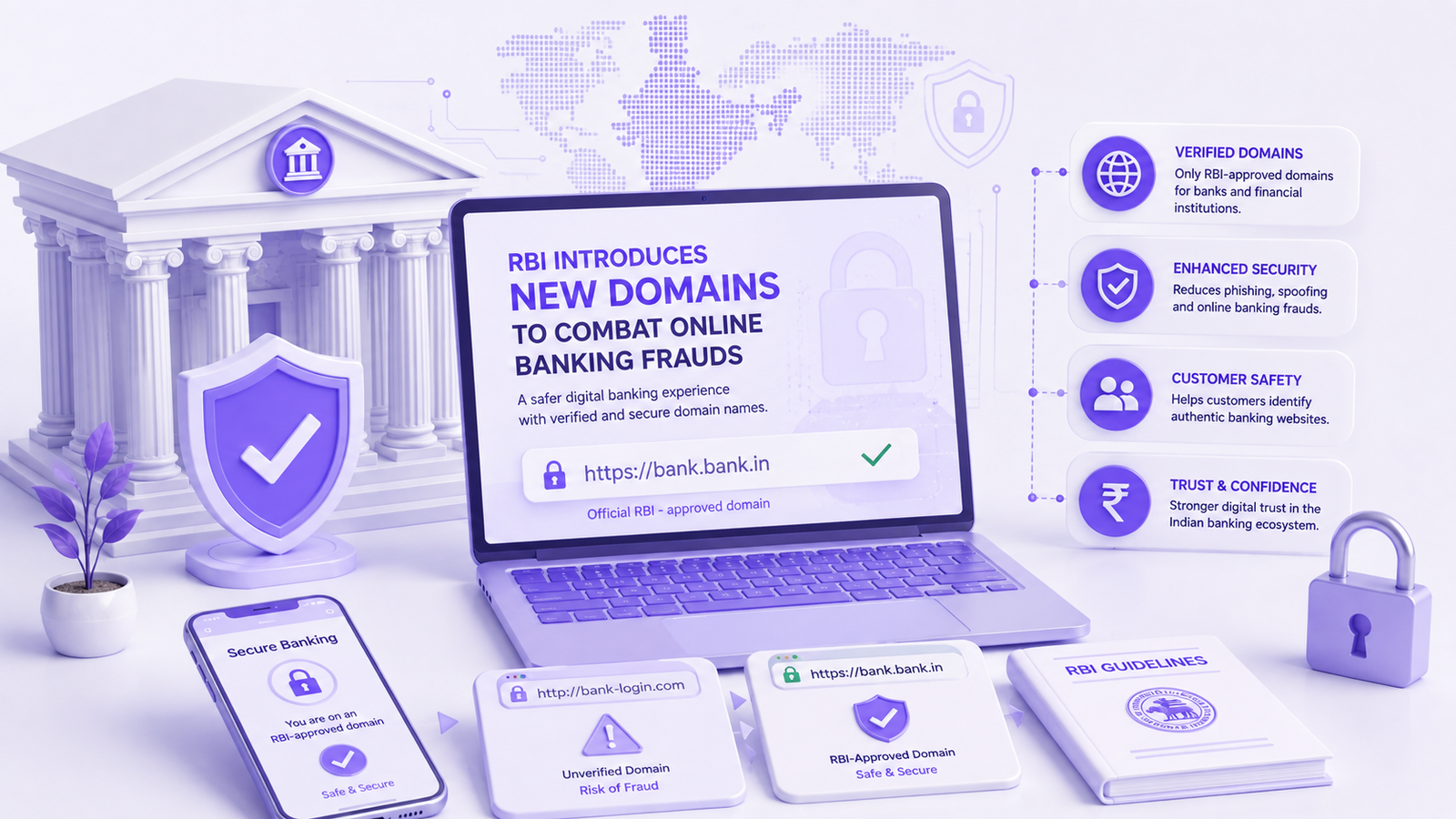
RBI Introduces ‘.bank.in’ & ‘.fin.in’ Domains to Combat Online Banking Frauds
Strengthening Cybersecurity in the Banking Sector
With the rapid rise of digital banking, cyber threats such as phishing scams and fraudulent websites have become a major concern. To tackle this growing issue, the Reserve Bank of India (RBI) has introduced exclusive domain names—‘.bank.in’for banks and‘.fin.in’for non-banking financial institutions (NBFCs). This initiative aims to enhance online security, prevent financial fraud, and ensure that only verified financial institutions operate under these domains.
Why the Need for ‘.bank.in’ and ‘.fin.in’ Domains?
Scammers often create fake banking websites with URLs that closely resemble legitimate ones, tricking users into sharing sensitive information. The RBI’s initiative to launch restricted domains will help establish a secure online identity for banks and financial institutions, making it easier for consumers to identify genuine websites.
As per a report by news agency PTI, citing RBI data, banking fraud cases in India saw a 27% year-on-year increase, rising to 18,461 cases in the first half of the current financial year, compared to 14,480 cases during the same period last year.Additionally, the total value of fraudulent transactions surged nearly eight times, reaching ₹21,367 crore in the first half of FY25, a significant jump from ₹2,623 crore recorded in the corresponding period of the previous fiscal.Key Features of the RBI’s Secure Domain Initiative
- Exclusive Use for Verified Institutions: Only banks can register under‘.bank.in’, while‘.fin.in’will be designated for NBFCs and financial service providers.
- Phased Rollout:‘.bank.in’domain registration will be available for banks startingApril 2025.‘.fin.in’will be introduced at a later stage, with details yet to be announced.
- Centralized Domain Management: TheInstitute for Development and Research in Banking Technology (IDRBT)will oversee domain registration, ensuring only approved financial entities get access.
- Improved Consumer Trust: These domains will provide a verifiable online presence for financial institutions, reducing the risk of phishing scams and fraudulent banking websites.
The Scale of India's Banking Sector
With India’s vast financial ecosystem, securing online transactions is more important than ever. Here are some key statistics:
- Scheduled Commercial Banks:137banks operate in India, including public sector banks, private banks, regional rural banks, and foreign banks.
- Public Sector Banks:12major public sector banks hold a significant share of the country’s financial network.
- Non-Banking Financial Companies (NBFCs): India has around9,516 NBFCs, offering financial services beyond traditional banking.
Source:financialservices.gov.in
With such a broad network of financial institutions, ensuring a secure digital banking experience is a crucial step forward.
Impact on Consumers
For customers, this initiative will bring several key benefits:
✅Easier Verification of Banking Websites– A ‘.bank.in’ or ‘.fin.in’ domain will indicate an official, RBI-approved financial institution.
✅Reduced Risk of Phishing Scams– Cybercriminals will find it harder to create fake banking websites.
✅Increased Confidence in Online Banking– Consumers can conduct digital transactions with greater trust and security.
Final Thoughts
The RBI’s introduction of‘.bank.in’(from April 2025) and‘.fin.in’(to be introduced later) is a significant step toward securing India’s digital financial landscape. As cyber threats continue to evolve, this initiative will play a crucial role in preventing fraud and ensuring safer online banking experiences.
Financial institutions should prepare for this transition, while consumers must stay informed and verify banking website domains before making transactions. With a more secure digital framework, RBI is paving the way for a safer and more trustworthy banking environment in India.