
Understanding the Difference Between Traditional AI and Agentic AI
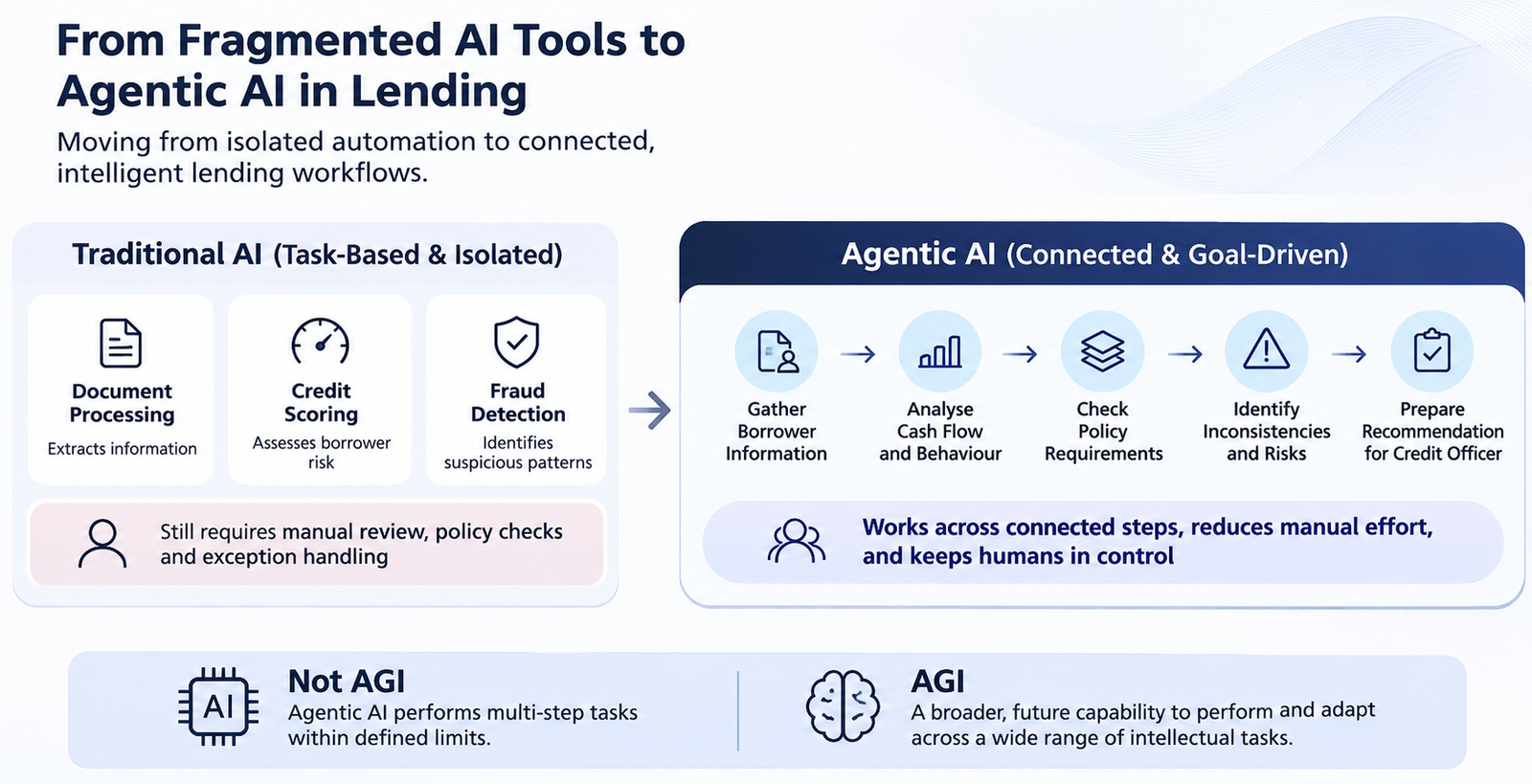
Most financial institutions are already familiar with traditional AI. Credit scoring models measure the risk of borrowers, document processing tools extract information and fraud detection systems identify suspicious patterns. These technologies can perform their assigned tasks efficiently, but they generally work within defined boundaries.
So one system might pull transactions from a bank statement, and another model might calculate a credit score, for example. A credit officer may still have to review the data, compare it to lending policy, investigate exceptions, and put it all together before making a decision.
This is where the process can become slow and fragmented. The individual tools may work well, but the overall workflow still depends on people connecting the dots.
Agentic AI takes a different approach. It can be made to work through a series of connected steps, within some defined limits, using connected tools, assessing intermediate results, and deciding what needs to be done next. In lending, this could mean gathering borrower information, analysing cash flow, checking policy requirements, identifying inconsistencies, and preparing a recommendation for a credit officer.
That is not to say that the system should approve every loan on its own. It means the system can take on more of the work required to reach a decision, while people remain responsible for oversight and important decisions.
And it is important to distinguish Agentic AI from AGI (Artificial General Intelligence). Agentic artificial intelligence systems are able to perform multi-step tasks within a defined operating environment. AGI, by contrast, refers to a much broader capability to perform and adapt across a wide range of intellectual tasks. They are not the same thing, and current agentic systems should not be presented as AGI.
For lenders, the immediate opportunity is to make today's AI capabilities work together more effectively.
Why It Matters To Indian Banks And NBFCs
“It’s a lot more than just looking at a credit score in lending. Institutions need to understand a borrower's financial position, verify documents, assess repayment capacity, apply credit policies, identify fraud risks, and monitor the account after disbursement. These activities often involve different systems, teams, and data sources. When information does not move smoothly between them, even a well-designed process can become time-consuming. Consider a self-employed borrower who is looking for a business loan. Their income can fluctuate from one month to another and a typical salary based assessment may not give a true picture of their financial position. They need to look at bank statements, identify regular business income, understand seasonality, look over existing obligations and check to see if the application fits within policy. A traditional system might complete some of these tasks, leaving the rest to the credit team. An agentic workflow could coordinate several of them, highlight unusual patterns, and present the relevant findings together for review. The benefit is not just speed. It is a more complete view of the borrower and a clearer understanding of why a particular recommendation was made. For Indian lenders managing growing application volumes, diverse borrower profiles, and increasing expectations around risk management, this kind of connected approach can make a meaningful difference.
Where Agentic AI Can Make a Practical Difference in Lending
Making credit underwriting more connected
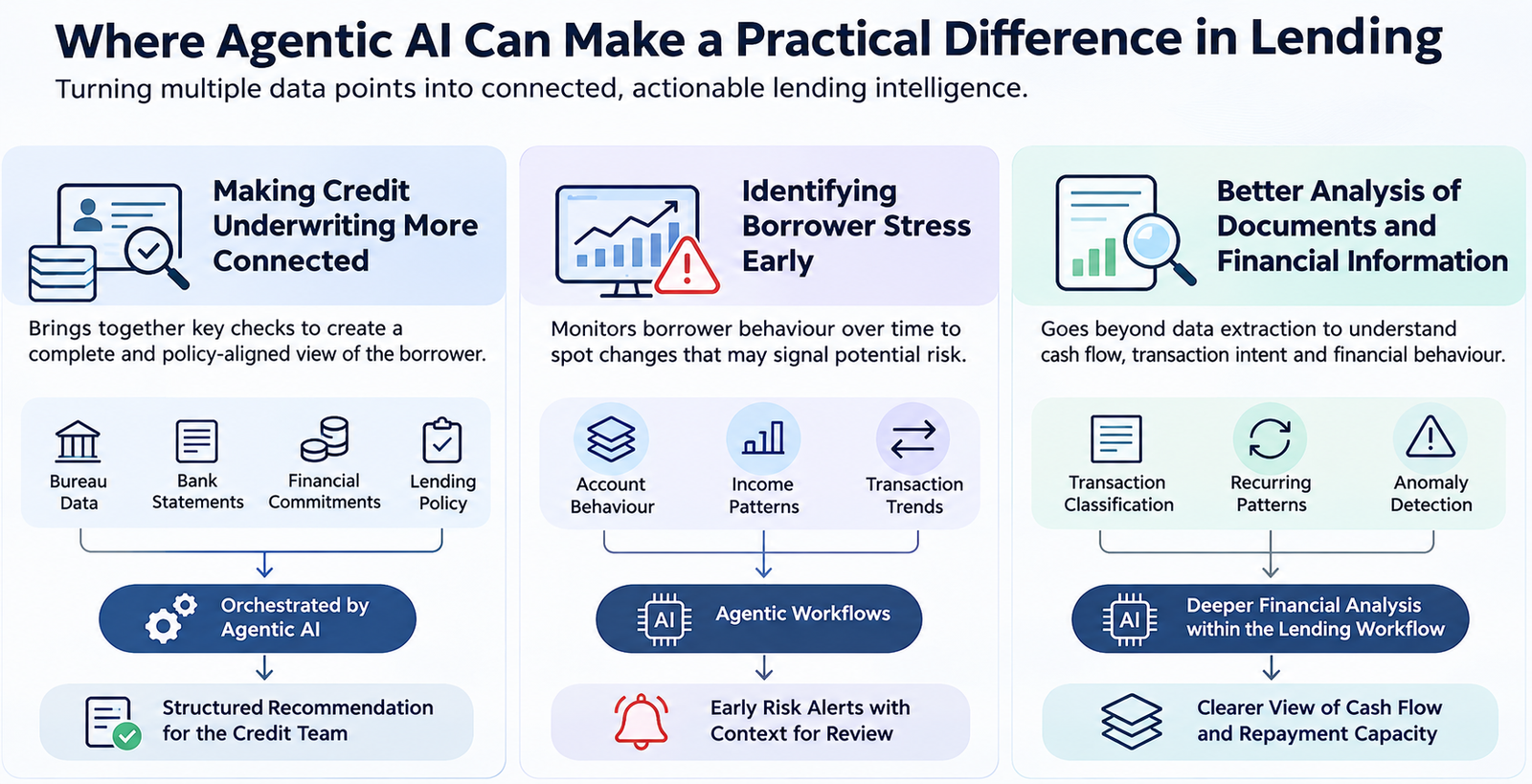
Credit underwriting is a natural starting point because it involves multiple checks that need to work together.
analyse bank statement transactions, understand income patterns, assess existing financial commitments, and compare the findings against lending policy. When these activities happen across disconnected systems, the officer spends valuable time collecting and reconciling information.
Agentic AI is able to help orchestrate these steps. It can combine information from the linked sources, gather the relevant financial signals, highlight missing information and flag cases for further investigation. It can then prepare a structured recommendation for the credit team.
For example, if the applicant states a certain income level, but the bank statement shows inconsistent inflow, the system can flag it and explain why further review might be necessary.
The final decision should still follow the institution's approved policy and governance framework. The aim is to help credit teams work with better-organised information, rather than asking them to rely on an unexplained AI-generated answer.
Identifying borrower stress before it becomes a larger problem
A loan may appear healthy because the borrower is making repayments on time. However, repayment history alone does not always reveal what is happening beneath the surface.
Changes in account balances, irregular income, increasing financial commitments, or unusual transaction patterns may indicate a change in a borrower’s financial position. If these developments are only in periodic reviews, the opportunity to respond may already be diminished.
With AI-powered post-disbursement monitoring, lenders can review the behavior of borrowers over time to detect patterns that need to be acted upon.Agentic workflows can take this further by aggregating relevant signals, validating them against defined risk criteria and routing cases to the right team for review.
For instance, if a business borrower starts to show erratic inflows and more outward payments, the system might flag the change and provide the supporting information for a risk officer to investigate.
Such monitoring does not guarantee that every default will be predicted or prevented. Its value lies in helping lenders identify potential concerns earlier and take a more informed approach to portfolio management.
Better analysis of documents and financial information
Bank statements and other financial documents are a gold mine of information, but they are only part of the problem of extracting that information. Lenders also need to understand what the numbers mean.
The transaction may be an inflow but the credit team may still need to determine whether it is genuine business revenue, a transfer between accounts, receipt of a loan or an unusual transaction. The distinction can materially affect an assessment of repayment capacity.
AI based bank statement analysis can help in transaction classification, recurring pattern recognition and anomaly detection. When incorporated into a wider lending workflow, these insights can be compared to borrower information, credit policy and other financial evidence available.
This helps move the process beyond document extraction towards a more useful understanding of cash flow and financial behaviour.
Why Human Oversight and Explainability Must Come First
As AI systems take on more responsibility, financial institutions need to be clear about what those systems can do, where their authority ends, and how their outputs will be reviewed.
A recommendation is useful only when the institution can understand the factors behind it. Credit teams should be able to examine the relevant financial information, identify policy exceptions, question an output, and correct it when necessary.
This becomes especially important when an AI system encounters incomplete information, conflicting data, or a situation outside its expected operating conditions.
Human oversight should therefore be built into the workflow from the beginning. Institutions can specify what tasks an AI system can do autonomously, what cases require human approval, and what exceptions need to be escalated. They should also maintain appropriate records of the information used, the checks performed, the recommendations generated, and any human intervention.
Governance is more than explainability too. Think about data privacy, access control, model performance, security and ongoing monitoring.An AI system that does well in a pilot can act differently when it encounters new borrower profiles, changing market conditions, or different data quality.
Controls for Indian financial institutions should be designed in accordance with applicable regulatory requirements and the institution ’ s own risk policies . AI can support decision-making, but accountability for lending decisions must remain clear.
The goal is not to remove human judgement from lending. It is to give people better information, reduce avoidable manual work, and make decisions easier to review.
Building the Right Foundation for Agentic AI
Adopting Agentic AI does not have to begin with a complete transformation of the lending business. It’s generally more practical to start by setting up a well-defined workflow rather than trying to automate everything at once.
Step 1. Know how the current process works. Where do teams spend most time? Which activities involve repeated data entry? Where do applications get delayed? Which decisions require information from several systems? And where do manual checks leave room for inconsistencies?
The answers can help identify a suitable starting point, such as bank statement analysis, document verification, or post-disbursement monitoring.
Institutions should also evaluate their current infrastructure before choosing a solution. Is their core banking system, Loan Origination System (LOS) and bureau sources and other relevant platforms able to share information reliably? Are the lending policies well documented? Can the institution trace how a decision was reached? Are there defined procedures for reviewing exceptions and handling system errors?
These are important questions because Agentic AI is more than just the AI model.It needs trustworthy data, clear rules, connected systems and good governance.
Once the foundation is in place, the institution can run a controlled pilot with clear success measures. These might include application processing time, manual review effort, data extraction accuracy, exception rates, fraud detection outcomes, or the time taken to identify emerging portfolio risks.
You don’t pre-assume the results, you measure them against a baseline. A successful pilot can then provide the evidence needed to decide whether to expand the workflow, improve it further, or choose a different starting point.
This gradual approach helps institutions learn from real operating conditions without taking unnecessary risks.
How New Patterns Enable More Connected Financial Workflows
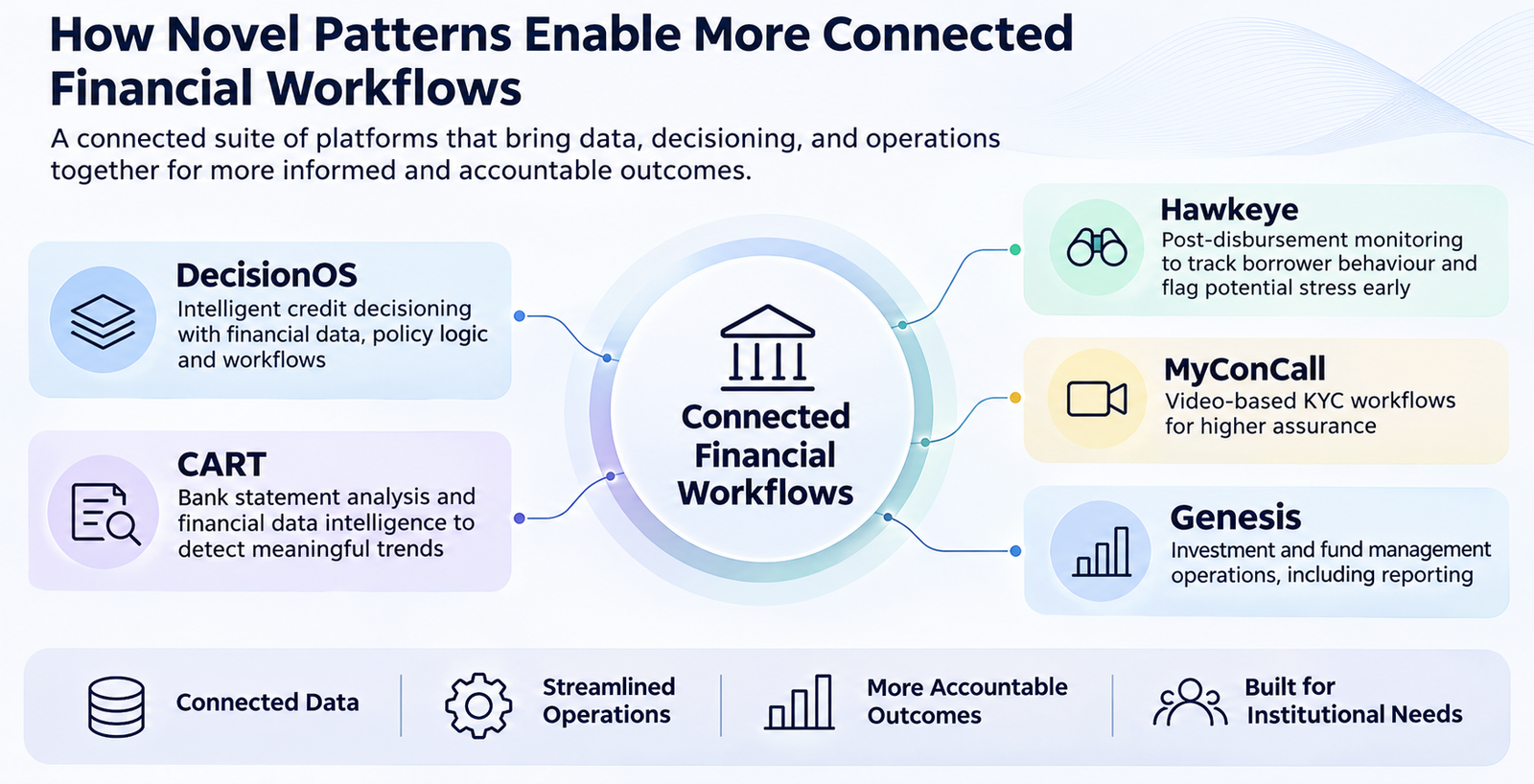
Novel Patterns’ mission is to help financial institutions connect data, decision processes, and operational workflows to achieve better informed and more accountable outcomes.
DecisionOS offers intelligent credit decisioning by combining relevant financial information, policy logic and workflow steps. CART is focused on bank statement analysis and financial data intelligence, helping lenders to extract meaningful information and detect trends that may warrant further investigation. Hawkeye also facilitates post-disbursement monitoring, enabling lenders to monitor borrower behavior and identify potential signs of financial stress.
MyConCall supports video-based KYC workflows whereas Genesis takes care of investment and fund management operations, including reporting and related processes.
Each platform addresses a different operational need. Together, they reflect an important principle: better AI outcomes depend not only on the intelligence of individual models, but also on how effectively information and decisions move through an institution.
The capabilities, implementation approach, and expected outcomes should always be evaluated against the institution's specific systems, requirements, and operating environment.
The Next Step Is to Start Building Today
Artificial General Intelligence may eventually change how financial services operate, but lenders do not need to wait for that future to improve the way they work.
The practical opportunity is already here. Institutions can begin connecting fragmented workflows, improving the use of financial data, reducing repetitive manual effort, and making credit decisions easier to understand and review.
Agentic artificial intelligence can help, but only if it is deployed with clear boundaries, reliable integrations, measurable goals and human supervision.
It’s not just a question of whether standard artificial intelligence can automate a task anymore for banks and NBFCs. It is whether the technology can help the institution manage the entire process more effectively, from understanding a borrower to monitoring the loan after disbursement.
The best place to start is with a real business problem, a well defined workflow, and a way to measure progress. Build from there, learn from the results, and expand when the evidence supports it.
Ready to explore Agentic AI for your lending workflows?
Partner with Novel Patterns to review your current lending procedures, define achievable first steps and see how connected AI workflows can help move your institution toward its goals.