
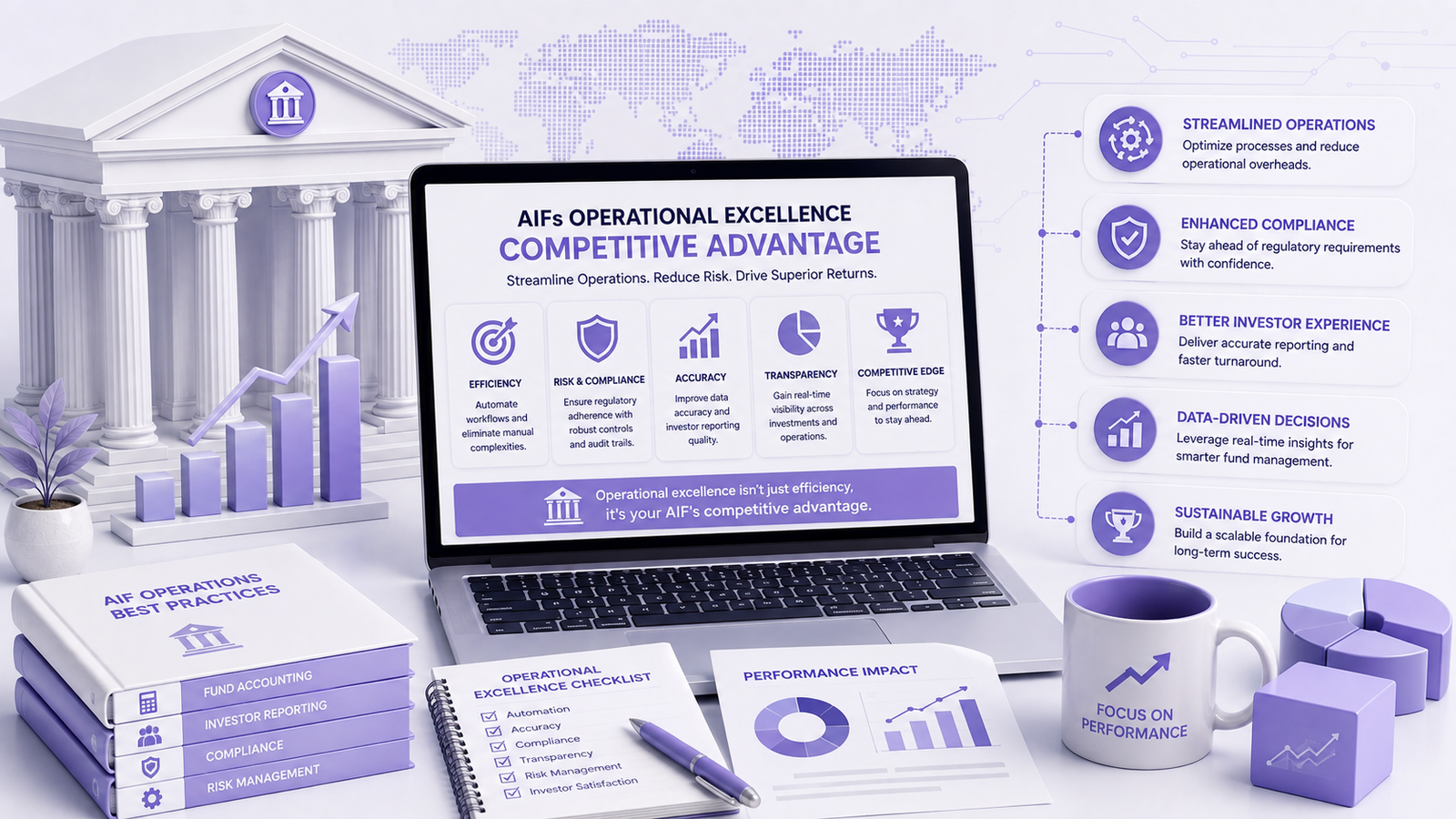
India's Alternative Investment Industry Is Entering a New Phase of Institutional Growth
Over the last decade, India's alternative investment landscape has evolved into one of the fastest-growing segments of the financial services industry. According to SEBI, the country now has more than 1,900 registered Alternative Investment Funds, with commitments exceeding ₹15 trillion and investments crossing ₹6 trillion. Institutional investors, Family Offices, pension funds, and global allocators continue to increase their exposure to private markets as they seek differentiated investment opportunities.
Growth, however, introduces a different set of challenges.
Managing a diversified investment portfolio today involves significantly greater operational complexity than it did just a few years ago. Investment managers are expected to oversee multiple strategies, manage diverse investor groups, support complex valuation methodologies, coordinate with custodians, generate timely investor reports, comply with evolving regulatory requirements, and maintain complete operational transparency.
As Assets Under Management (AUM) continue to grow, the strength of a Financial Institution's operating model increasingly determines its ability to scale efficiently while maintaining investor confidence.
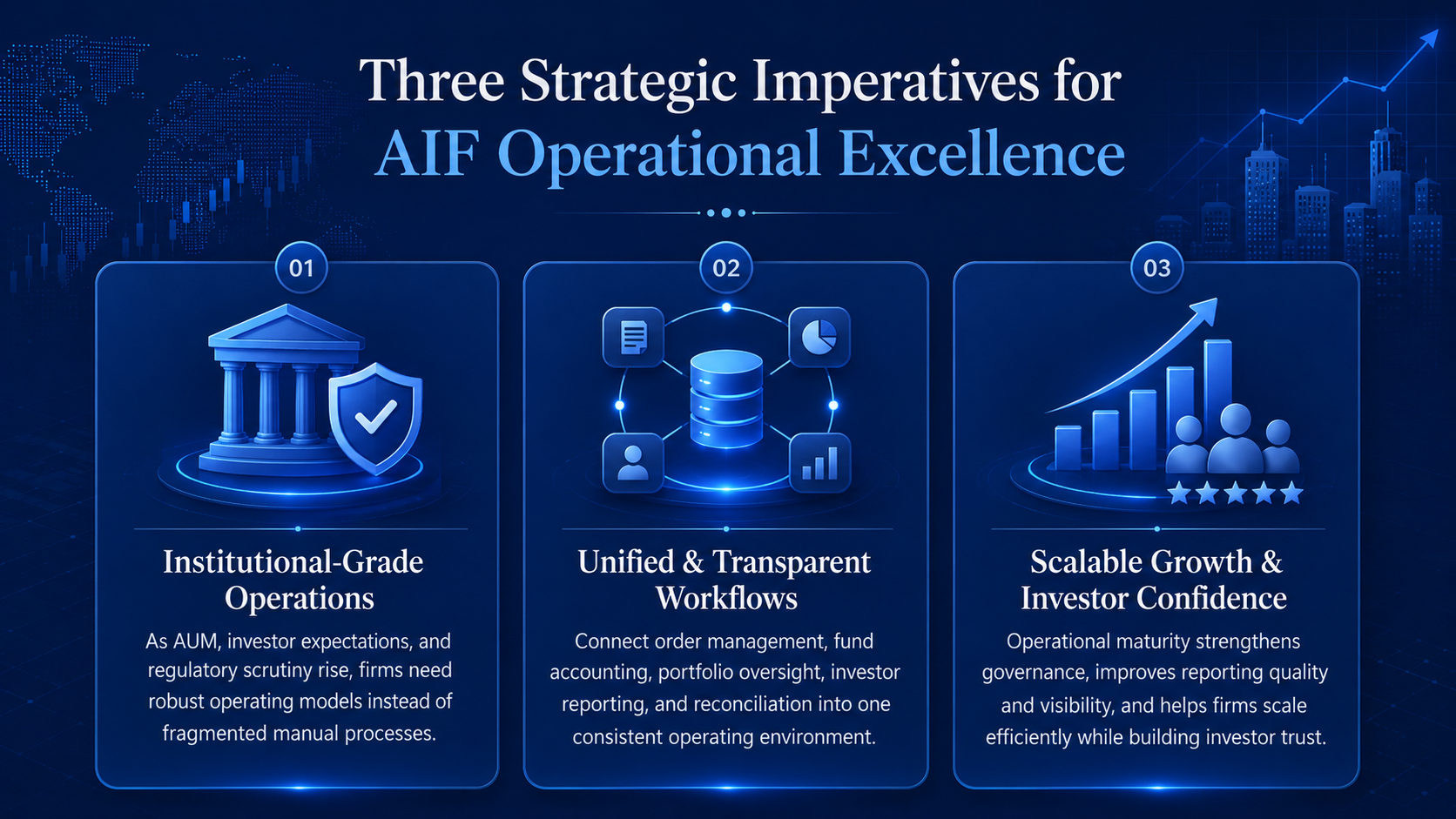
Investment Performance Alone Is No Longer Enough to Differentiate Financial Institutions
For decades, investment management firms competed primarily on one metric: performance.
While generating alpha remains fundamental, today's investors evaluate Financial Institutions through a much broader lens. Institutional due diligence increasingly extends beyond investment philosophy to assess governance frameworks, operational controls, reporting quality, technology infrastructure, cybersecurity, valuation processes, and business continuity.
This shift reflects a broader change within global investment management.
Operational excellence is no longer viewed as an administrative function supporting investment teams. Instead, it has become an important indicator of how effectively a Financial Institution can protect investor interests, manage risk, and sustain growth over the long term.
For newly established AIFs, Portfolio Management Services (PMS), Family Offices, and Fund Administrators, demonstrating operational maturity early in their journey can significantly strengthen investor confidence and support future fundraising efforts.
Growing Assets Under Management Without Increasing Operational Complexity Is Becoming Increasingly Difficult
Operational complexity rarely increases in a linear manner.
Launching a second fund does not simply double operational activities. It introduces additional investors, capital commitments, distribution waterfalls, valuation methodologies, reporting schedules, compliance obligations, reconciliation requirements, and approval workflows.
As Financial Institutions expand, operational teams often find themselves managing multiple disconnected systems, manually reconciling information across platforms, preparing reports through spreadsheets, and responding to increasing operational exceptions.
These challenges create hidden costs that extend well beyond efficiency.
Delayed investor reporting can affect client confidence. Manual reconciliations increase operational risk. Fragmented data limits visibility for decision-makers. Scaling requires additional resources rather than better operating models.
The critical question therefore shifts from "Can we grow our assets?" to "Can our operations support that growth without becoming a constraint?"
Institutional Investors Are Expanding Operational Due Diligence Beyond Investment Performance
Investor expectations have changed considerably over the past decade.
Sophisticated investors increasingly evaluate how Financial Institutions operate, not just how they invest. Transparency, governance, operational resilience, and reporting quality now influence investment decisions alongside performance.
During operational due diligence, investors often assess questions such as:
- How robust are the firm's operational controls?
- Are valuation methodologies consistent and transparent?
- How quickly can investor reports be generated?
- How effectively are operational risks monitored?
- Can the operating model scale with increasing AUM?
- Are audit trails and governance frameworks sufficiently mature?
Operational excellence therefore contributes directly to investor trust.
Strong operations reduce uncertainty, improve transparency, and provide confidence that a Financial Institution can continue delivering consistent service as complexity increases.
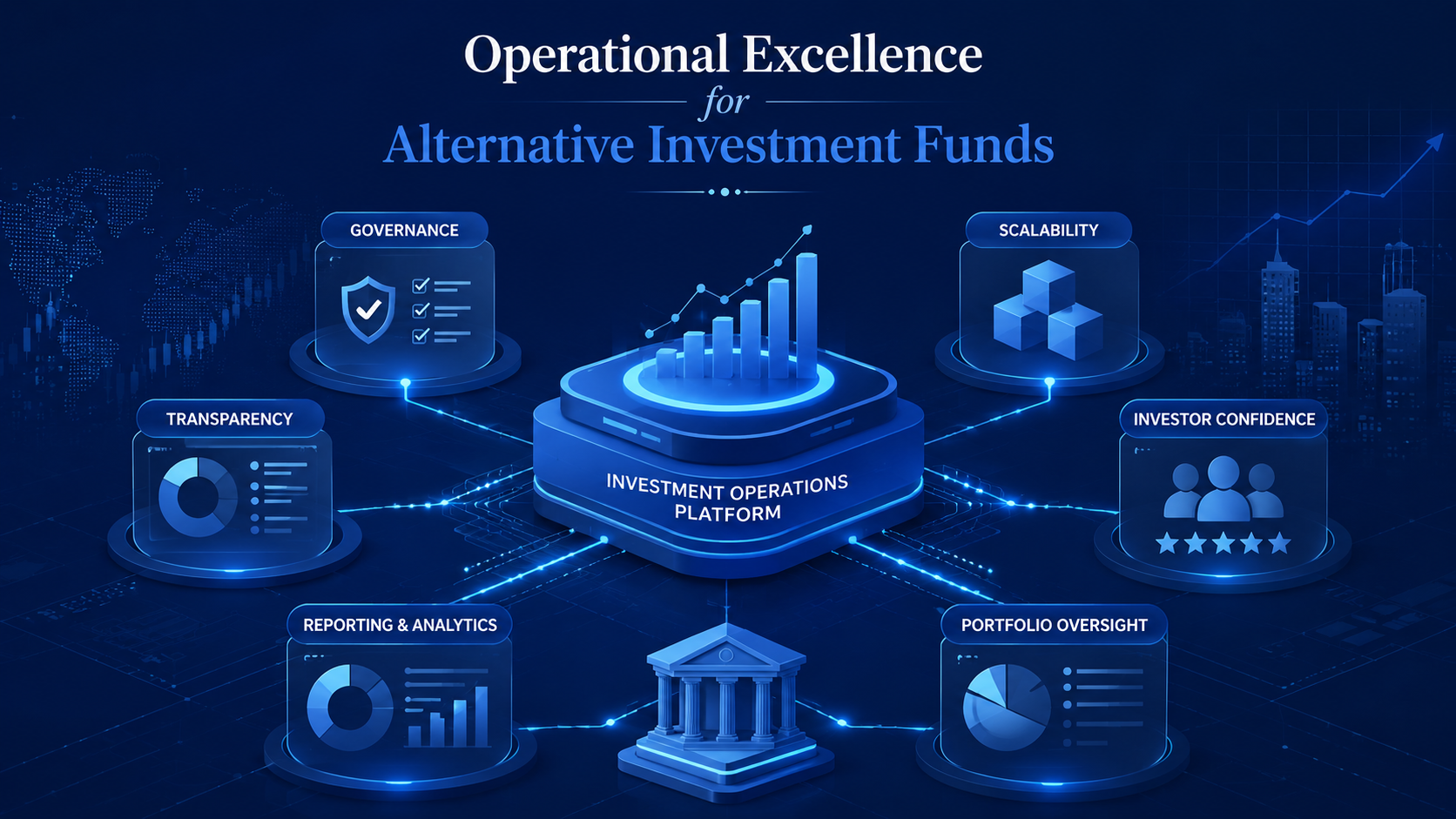
Technology Is Evolving from Supporting Individual Functions to Enabling Enterprise-Wide Investment Operations
Technology conversations within investment management have traditionally focused on individual functions.
Five core capabilities form the operational backbone:
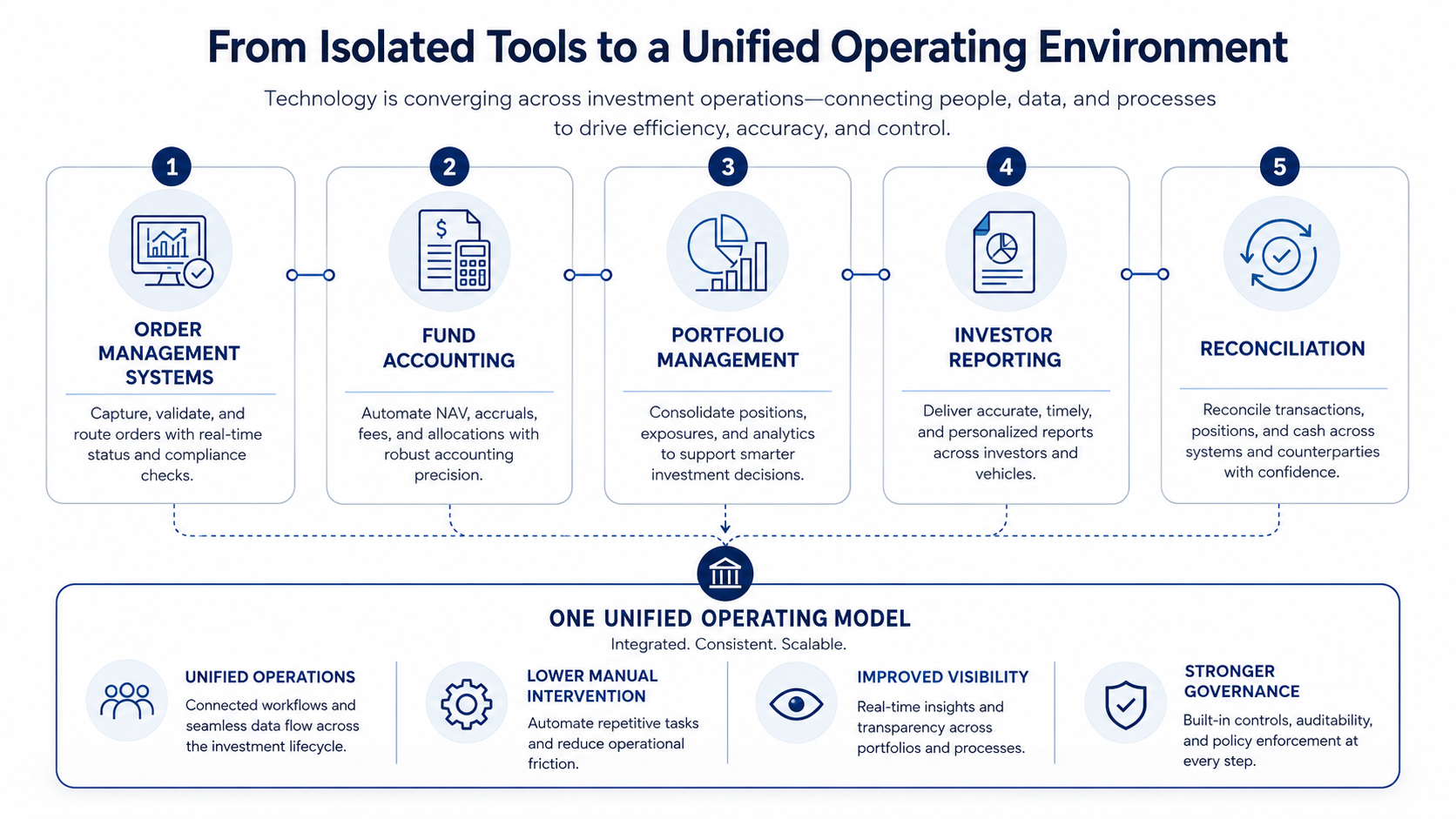
Today, leading Financial Institutions are adopting a different perspective.
Rather than selecting best-of-breed applications independently, they are increasingly seeking unified operating environments capable of connecting front-office, middle-office, and back-office functions through a single operational framework.
The objective is not merely automation.
It is creating a consistent operating model where investment data flows seamlessly across teams, operational visibility improves, manual intervention decreases, and governance strengthens as the organization grows.
Four Pillars That Will Define the Next Generation of Institutional-Grade Investment Operations
Financial Institutions preparing for long-term growth increasingly share four common operational characteristics.
- Unified Operations
Leading organizations are replacing fragmented systems with integrated operating environments that create a single source of truth across investment operations. A unified operating model improves collaboration, eliminates duplicate data, and provides consistent visibility across portfolios, accounting, reporting, and operational workflows.
- Intelligent Automation
Automation is moving beyond routine transaction processing to include reconciliation, fund accounting, investor reporting, exception management, and operational monitoring. This enables operations teams to focus on oversight, governance, and decision-making rather than repetitive manual activities.
- Real-Time Visibility and Governance
As investment portfolios become increasingly complex, access to timely and reliable operational data becomes essential. Financial Institutions that can monitor operations in real time are better positioned to identify exceptions early, strengthen governance, support timely and consistent regulatory reporting processes, and make informed business decisions.
- Scalable Operating Models
Perhaps the most important characteristic of future-ready Financial Institutions is their ability to grow without proportionally increasing operational complexity. Scalable operating models enable firms to launch new funds, manage additional investors, expand into new markets, and support larger AUM while maintaining operational efficiency.
From Operational Readiness to Sustainable Growth
The evolution of India's alternative investment industry presents significant opportunities for emerging and established Financial Institutions alike.However, sustainable growth will increasingly depend on more than investment expertise.
As investor expectations rise and regulatory environments continue to evolve, operational maturity will become a defining characteristic of successful investment firms. Organizations that invest early in governance, automation, operational resilience, and scalable operating models will be better positioned to attract institutional capital, strengthen investor relationships, and respond confidently to future market opportunities.
Operational excellence should therefore not be viewed simply as a technology initiative or an efficiency program. It is becoming a strategic business capability that enables Financial Institutions to build trust, scale responsibly, and compete effectively in an increasingly sophisticated investment landscape.
Enabling Financial Institutions to Build Institutional-Grade Investment Operations with Genesis
As Financial Institutions transition from emerging investment firms to scalable, institution-ready organizations, technology plays a critical role in supporting operational excellence. However, the objective is not to digitize isolated processes. It is to establish a connected operating model that enables efficiency, transparency, governance, and long-term scalability.
Genesis is Novel Patterns' cloud-native Investment Operations Platform, purpose-built for Alternative Investment Funds (AIFs), Portfolio Management Services (PMS), Family Offices, Custodians, and Fund Administrators. The platform unifies Order Management, Fund Accounting, Investment Book of Record (IBOR), Accounting Book of Record (ABOR), reconciliation, corporate actions, investor reporting, regulatory workflows, and managed services within a single operating environment. By reducing operational fragmentation and enabling standardized workflows, Genesis empowers Financial Institutions to strengthen governance, improve investor servicing, enhance operational visibility, and scale confidently as assets, investors, and regulatory expectations continue to grow. In an industry where operational maturity is increasingly influencing investor confidence, Genesis is designed to provide a technology foundation that helps investment professionals to remain focused on delivering investment performance while building resilient, future-ready operations.