
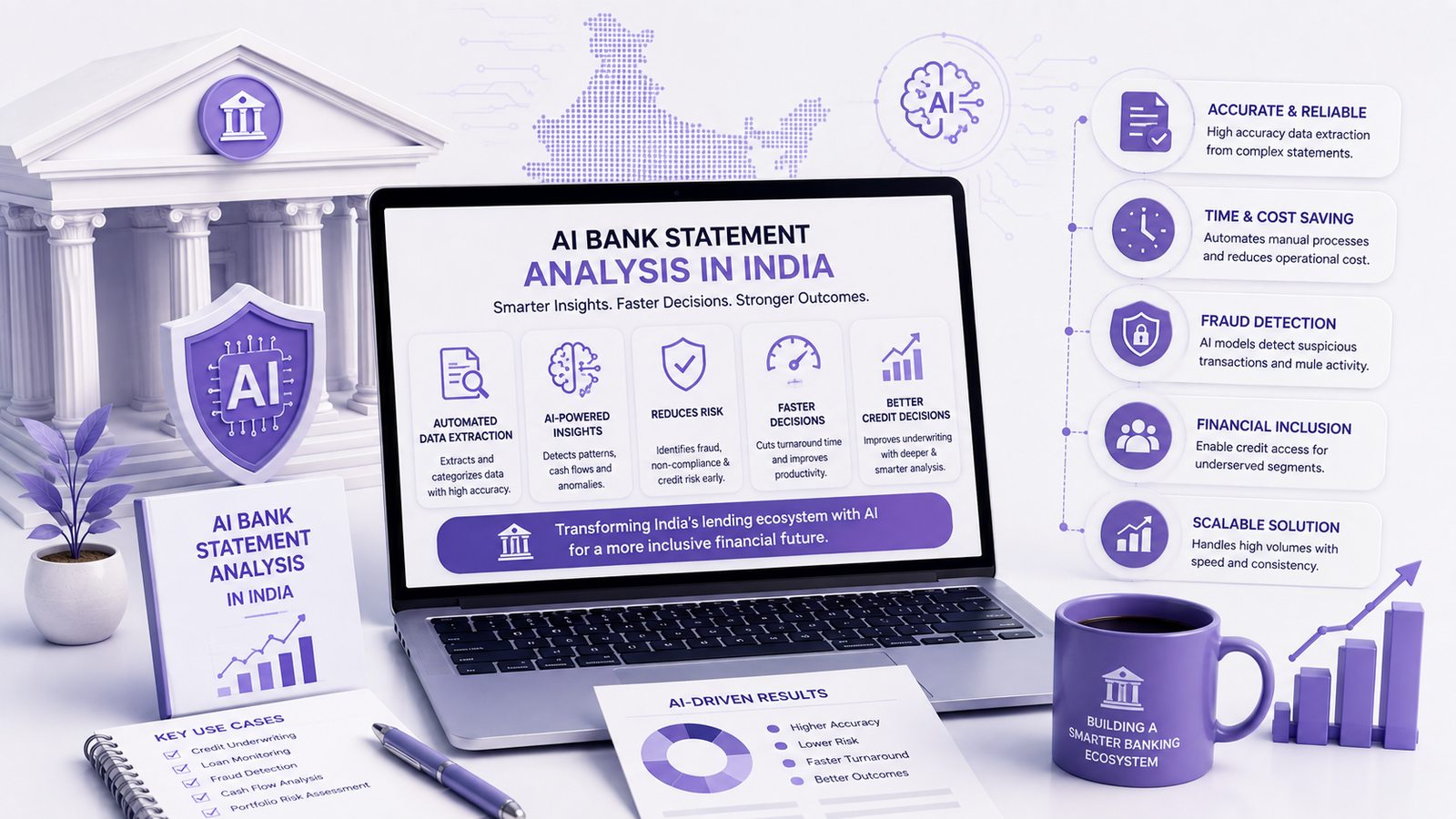
AI Bank Statement Analyzer: How Transaction-Level Intelligence Improves Lending Decisions
Definition:AnAI bank statement analyzeris software thatextracts, classifies, and interprets bank-statement transactionsto producecredit, risk, and fraud insightsfor lending—at scale.
Quick Summary
- Why it matters:Bank statements reflect real cash flows, repayment behavior, and financial discipline.
- What AI changes:Automation + transaction-level intelligence reduces manual effort and improves consistency.
- Best for:Retail, MSME/SME lending, fraud detection, and early warning monitoring (EWS).
- Why manual bank statement analysis breaks at scale
- What is an AI bank statement analyzer?
- How AI analyzes bank statements (step-by-step)
- Key lending use cases
- Impact on business metrics
- What differentiates advanced platforms
- Future outlook
- FAQ
Bank statements are among the most reliable sources of financial truth in lending because they captureactual cash movement,repayment behavior, andliquidity patternsover time. As underwriting volumes grow, lenders increasingly rely onAI-powered bank statement analysisto improve speed, accuracy, and risk control.
Why Manual Bank Statement Analysis Breaks at Scale
In many lending operations, analysts spend significant time reviewing statements manually. At scale, this creates slower turnaround, inconsistent decisions, and missed behavioral risk patterns.
Common failure points
- Turnaround time increasesas volume grows
- Subjective interpretationleads to inconsistent outcomes
- Fatigue-driven missescause errors and overlooked risk
- Operational cost riseswith manual effort
What Is an AI Bank Statement Analyzer?
An AI bank statement analyzer automatically converts statement files into structured transaction data and then applies intelligence to generateexplainable credit insights—not just totals. Instead of focusing only on surface numbers, modern systems evaluate how money flows, how stable income is, how obligations are serviced, and whether patterns suggest stress or manipulation.
Key idea:Advanced analyzers prioritizebehavioral intelligenceover basic parsing.
How AI Analyzes Bank Statements (Step-by-Step)
- Intelligent ingestion:Accepts PDFs (native/scanned), images, or account-aggregator feeds and supports diverse bank formats.
- Transaction extraction & normalization:Extracts date, narration, credit/debit, balance, and counterparty fields and normalizes them into a unified schema.
- Transaction classification:Categorizes transactions into income, expenses, liabilities, transfers, and discretionary spends.
- Cash-flow & behavioral modeling:Builds a consistent borrower view using transaction-level patterns—timing, balances, inflows/outflows, and counterparties.
- Risk & anomaly detection:Flags manipulation indicators such as artificial balance build-ups, circular movements, abnormal spikes, and peer deviations.
What “transaction-level triangulation” means
Instead of interpreting signals in isolation, advanced systems triangulateinflows,outflows,running balances,counterparty behavior, andtiming patternsto produce an explainable risk narrative.
Key Lending Use Cases
1) Credit Underwriting
Automates statement review to speed decisions while preserving risk discipline—especially helpful for high-volume retail and MSME/SME underwriting.
2) Fraud Detection
Detects patterns such as income inflation, temporary fund parking, and circular transfers that may indicate manipulation or fraud risk.
3) Post-Disbursement Monitoring (EWS)
Enables continuous monitoring and early warning signals when stress indicators emerge before delinquency events.
4) Portfolio Risk Management
Aggregates borrower insights to identify segment stress, recalibrate policies, and improve risk-adjusted returns.
Impact on Business Metrics
| Metric | What improves | Why it improves |
|---|---|---|
| Turnaround time (TAT) | Faster underwriting cycles | Automation of extraction, classification, and summarization reduces manual review load |
| Underwriting effort | Lower analyst workload | Standardized pipelines reduce repetitive statement work |
| Risk separation | More consistent decisions | Transaction-level triangulation reduces subjective interpretation and surfaces hidden risk patterns |
| Fraud losses | Earlier detection | Anomaly detection highlights manipulation signatures that are hard to spot manually |
Importantly, performance gains should come frombetter signal alignmentandrisk separation—not by relaxing credit policy.
What Differentiates Advanced Platforms
- Explainable outputs:Clear reasoning behind risk flags and behavioral insights
- Policy-aligned configurability:Rules and thresholds aligned to lender underwriting policies
- LOS/LMS integration:APIs and workflows that plug into origination and decision engines
- Scalability:Works across banks, geographies, and statement formats
- Audit readiness:Traceability of extracted fields, classifications, and flags
Future Outlook: From Static Review to Continuous Risk Intelligence
Bank statement analysis is evolving into a continuous intelligence layer enabling near real-time monitoring, dynamic thresholds, automated EWS triggers, and deeper integration into credit decisioning workflows.
Conclusion
AI-powered bank statement analyzers are becoming foundational in modern lending. By combining automation with transaction-level intelligence, lenders can scale operations, improve risk outcomes, and maintain regulatory confidence while delivering faster decisions to borrowers.
FAQ (Featured Snippet-Ready)
What is an AI bank statement analyzer?
An AI bank statement analyzer is software that automatically extracts, classifies, and interprets bank-statement transactions to generate credit, risk, and fraud insights for lending.
How does AI analyze bank statements?
AI analyzes bank statements by ingesting statement files or feeds, extracting transactions, normalizing data into a standard structure, classifying transaction types, modeling cash flows and behavior, and flagging anomalies and risk patterns.
How accurate are AI bank statement analyzers?
Leading systems typically achieve high extraction accuracy on digital statements and improve over time through model learning and format coverage.
How much time can AI save in underwriting?
AI reduces underwriting time by automating extraction and analysis, allowing credit teams to focus on exceptions rather than manual statement reading.
Can AI detect fraud from bank statements?
Yes. AI can detect artificial balance build-ups, circular fund movements, temporary fund parking, abnormal income spikes, and suspicious counterparty behavior.
Is AI bank statement analysis suitable for MSME lending?
Yes. It is especially useful for MSMEs where income can be irregular and transaction-level signals provide stronger underwriting evidence than static documents.