
The loan looks fine. Until you look closer
Imagine an MSME borrower that has been repaying on time for the past year. EMIs are current. DPD is zero. Nothing in the repayment history suggests an immediate problem.
But over the last few months, something has changed.
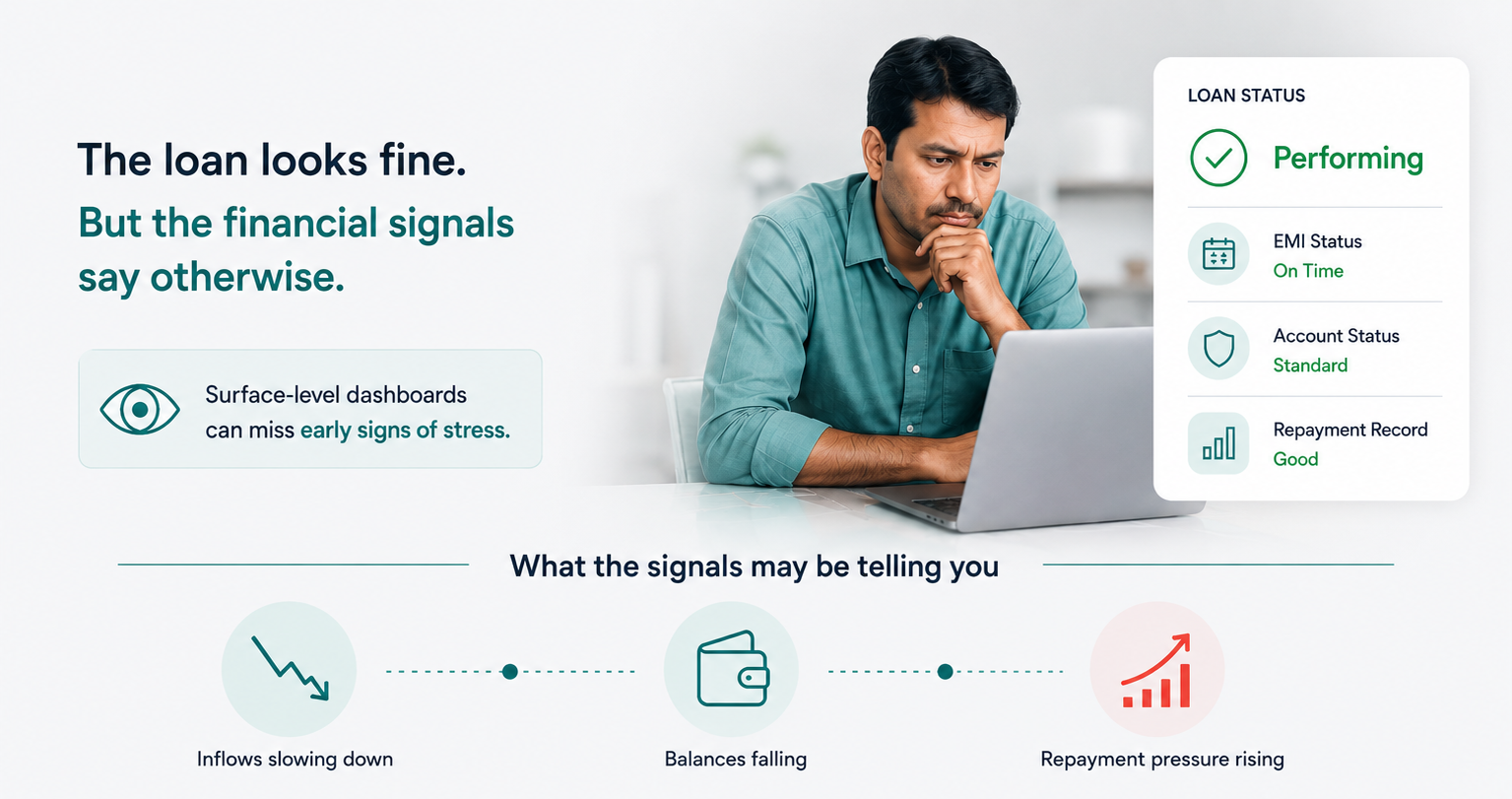
On a traditional repayment dashboard, the loan still looks healthy.
Look at the borrower’s financial behavior, though, and the picture is different.
The stress has started before the delinquency has.
That gap between what the loan status shows and what the borrower’s behavior is beginning to reveal is exactly where post-disbursement monitoring becomes important.
The problem HawkEye is built to solve
Credit underwriting answers an important question at origination: does this borrower look suitable for credit based on the information available today?
But that answer has a shelf life. Once the loan is disbursed, the borrower keeps changing.
A business may lose a major customer. Collections can become slower. A salaried borrower may take on new obligations. Cash availability may shrink gradually. None of this necessarily causes an immediate repayment failure.
Traditional loan monitoring often sees the outcome later through overdue payments, DPD movement, bureau refreshes or account-level exceptions. HawkEye focuses on the period before that outcome becomes visible.
The question changes from what is the account status? to what is changing in the borrower’s financial behavior?
A borrower can look current and still be getting weaker
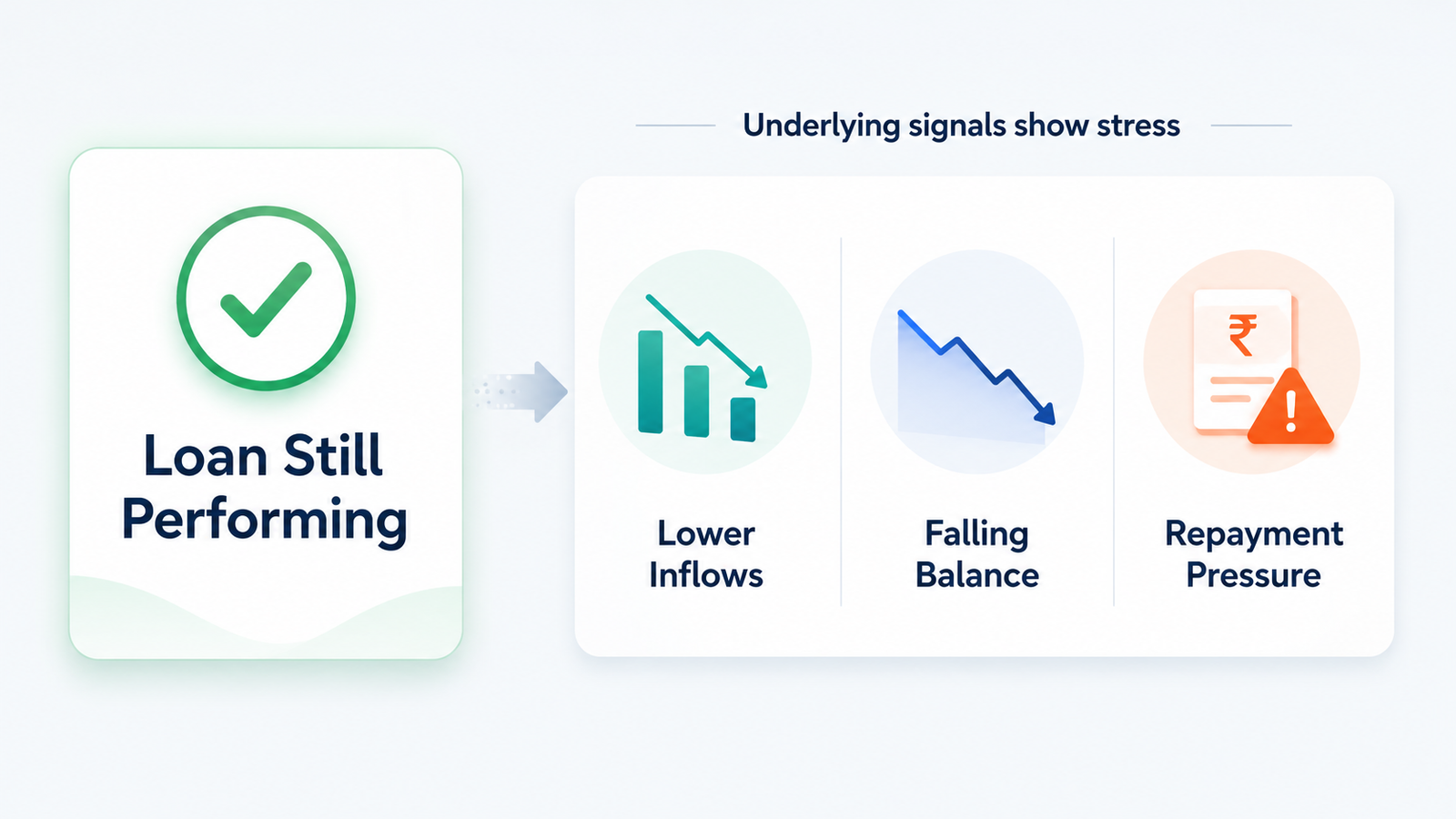
Consider a borrower whose repayments are still on time. Three months ago, customer credits were regular and the account maintained a comfortable balance. Today, the same account looks different.
Monthly inflows have started tapering off. Outward transfers remain high. Average balances are lower. Customer receipts are less regular. Repayment obligations now absorb more of the liquidity left in the account.
Any one of these changes can have an innocent explanation. The risk becomes more interesting when several move together.
That is where HawkEye’s behavioral view matters. Instead of treating a single transaction as the story, it looks for deterioration across the borrower’s broader financial pattern.
A performing loan today does not necessarily mean a healthy loan tomorrow.
What HawkEye watches after disbursement
HawkEye brings post-disbursement monitoring into five connected layers. The value is not in any one layer on its own; it is in how the signals combine.
1. Identity - Is the financial activity still consistent with the borrower profile? A material change in the nature of activity can be a reason to look closer.
2. Liquidity - Is the borrower maintaining the cash cushion seen historically? Falling average balances, weaker inflow consistency or sustained pressure on available cash can point to emerging stress.
3. Repayment - Is repayment behavior still developing as expected? Changes in timing, failed transactions, partial payments or rising repayment pressure can add important context even before a formal delinquency event.
4. Behavioral drift - Every borrower develops a financial rhythm. HawkEye looks for meaningful movement away from that normal pattern, such as customer credits becoming less regular or balances staying below their historical range.
5. Anomalies - Unexpected counterparties, abnormal spikes, circular movements or unusual fund flows can become more relevant when they appear alongside liquidity or repayment deterioration.
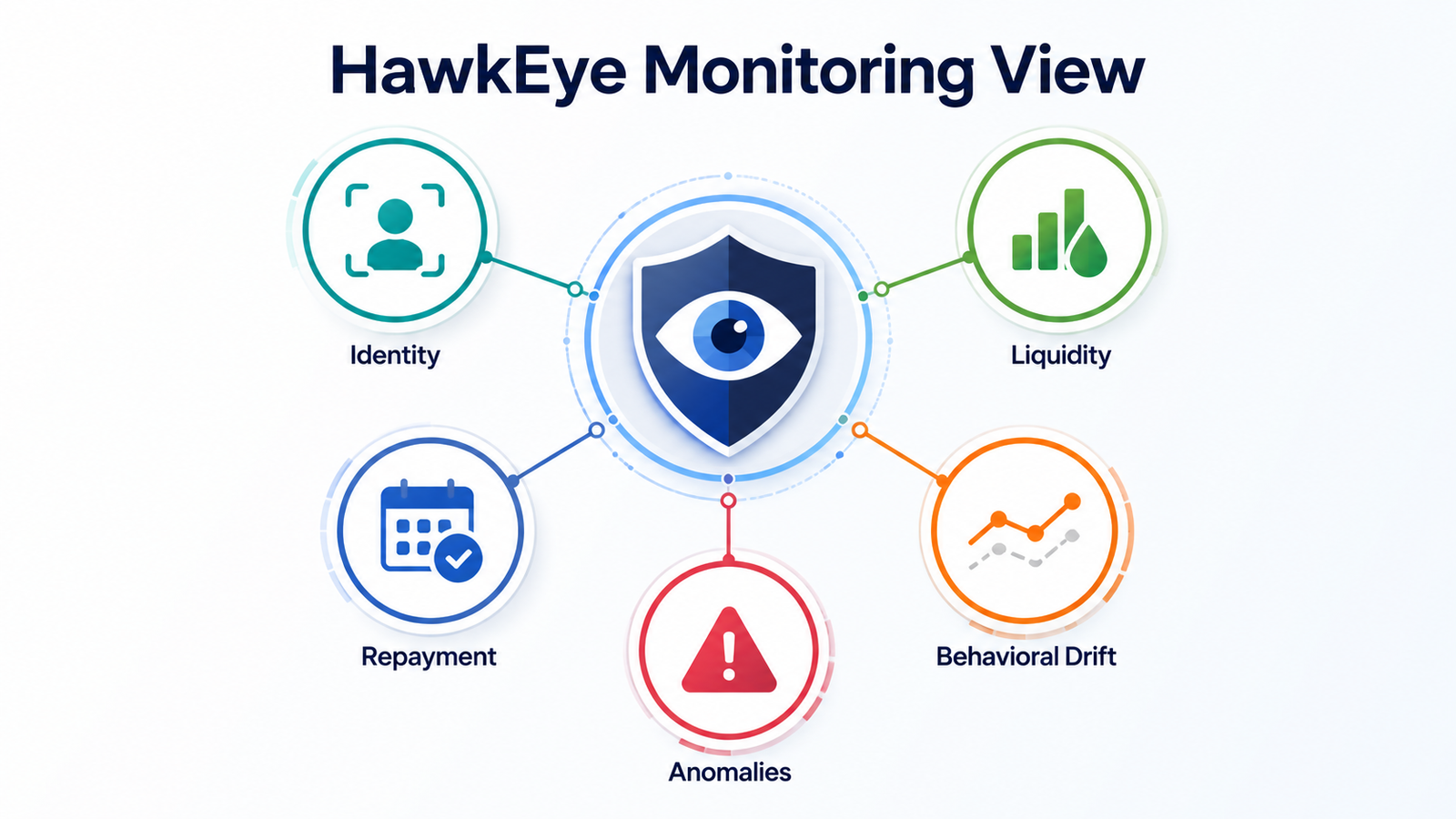
The five-layer view helps HawkEye avoid overreacting to one isolated signal. It creates a more contextual picture of whether the borrower is genuinely changing.
Why Account Aggregator data fits the HawkEye model
The Account Aggregator ecosystem can provide consent-based access to updated financial information from participating institutions. For post-disbursement monitoring, that creates an important shift: financial-data intelligence does not have to stop once underwriting is complete.
HawkEye can use more recent financial behavior as part of the monitoring picture, subject to customer consent, data availability and applicable processes. That is particularly relevant when the lender wants to understand how cash flows, liquidity and transaction behavior are evolving during the life of the loan.
Transaction-level financial analysis can add depth to this view by bringing together inflows, outflows, balances, counterparties and timing patterns instead of relying only on high-level account status.
For HawkEye, Account Aggregator is therefore not the story by itself. It is one of the ways fresher financial information can feed a stronger post-disbursement surveillance layer.
From transactions to a borrower risk story
The challenge for a lender is not lack of data. It is deciding which changes deserve attention.
A bank or NBFC may have millions of active accounts, and each borrower can generate thousands of transactions. Manual transaction-by-transaction monitoring simply does not scale.
HawkEye is designed to convert that activity into an explainable borrower-level risk story.
A fall in inflows alone may not require intervention. But declining inflows, falling balances, continued high outflows and changing repayment behavior together can create a much stronger indication of liquidity pressure.
The output is not meant to be another unexplained score. The point is to show what changed, how the signals relate to one another and why the account deserves more attention.
From borrower signal to portfolio prioritization
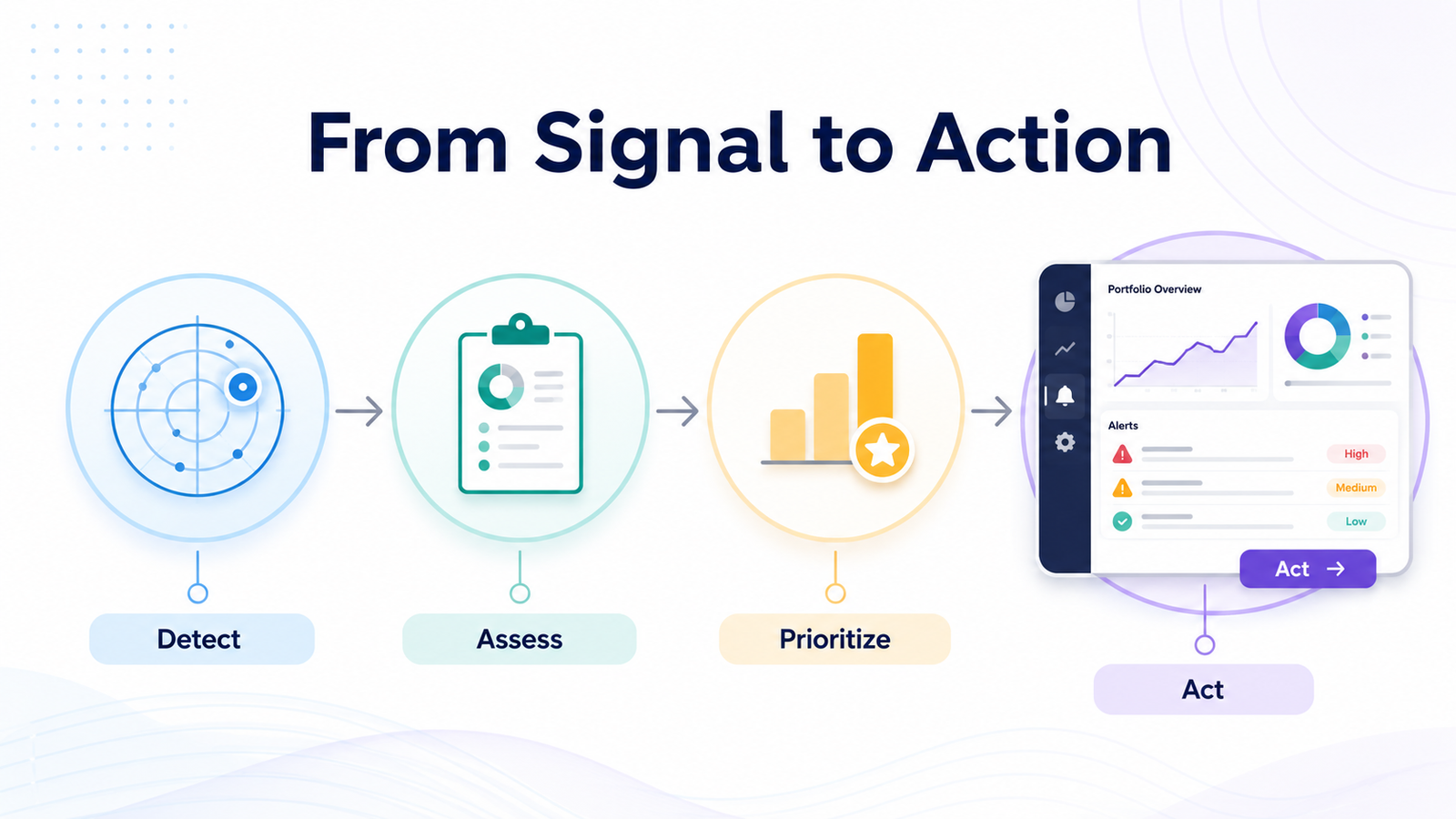
Early warning becomes valuable only when the signal changes what the lender does next.
HawkEye connects borrower-level deterioration to portfolio action. A stable account can remain under routine surveillance. An account showing meaningful behavioral or liquidity change may need closer monitoring or relationship-manager outreach. An account showing several risk indicators may need priority review or earlier collections engagement.
This turns monitoring from a passive watchlist into a way to decide where attention should go first.
For risk teams, that means visibility into which accounts and portfolio slices are beginning to weaken. For RMs and collections teams, it means a clearer reason to engage earlier while the account may still be current.
HawkEye is designed to move the lender from seeing a signal to deciding who needs attention now.
Why fewer, better signals matter
Post-disbursement monitoring can fail in another way: too many alerts.
If every unusual transaction becomes a case, risk teams quickly face alert fatigue. One odd movement may mean nothing. A persistent shift across liquidity, repayment behavior and transaction patterns may mean much more.
HawkEye’s value comes from putting those changes in context rather than maximizing alert volume.
The objective is fewer and more meaningful signals, with a clear explanation of why the borrower was flagged.
That also keeps human judgment where it belongs. AI and analytics can surface deterioration at scale, but credit and risk professionals still need to understand the context and decide the appropriate response.
How HawkEye extends the lending lifecycle
Most lending technology is strongest at two ends of the lifecycle.
At the beginning, underwriting decides whether credit should be extended. At the other end, collections becomes central once repayment trouble is visible.
HawkEye is focused on the space between them.
Its role is to carry financial and behavioral intelligence beyond origination, continuously reassess how the borrower is changing and surface the accounts where the risk profile may no longer look the way it did at sanction.
That makes post-disbursement monitoring a living process instead of a periodic status check.
What this looks like for banks, NBFCs and HFCs
The monitoring logic is common, but the operating need can differ by lender.
A bank may want a common portfolio view across retail, MSME and corporate accounts. An NBFC may use HawkEye as an additional behavioral layer alongside repayment and bureau checks across a high-volume portfolio. An HFC may need to see how borrower circumstances change over the long life of a housing loan.
Across all three, the underlying need is similar: identify meaningful deterioration earlier, prioritize the right accounts and connect the signal to action.
The business value is not another dashboard
A post-loan monitoring platform is useful only if it improves how teams work.
Earlier visibility can help risk teams see borrower health between formal review cycles. Relationship teams can engage sooner. Collections teams can focus resources on accounts showing stronger evidence of deterioration instead of treating the entire portfolio with the same urgency.
Portfolio teams can also see whether stress is clustering within a product, borrower segment or other part of the book.
The value of HawkEye is therefore broader than delinquency prediction. It is about making portfolio risk visible earlier and making the response more focused.
A stronger HawkEye monitoring strategy
The strongest implementation does not begin by tracking every variable available. It begins with signals that matter to borrower behavior and portfolio risk.
Borrower-specific baselines are important because a meaningful change for one account may be normal for another. Multiple moderate changes can also be more informative than one extreme event.
Explainability matters for the same reason. Risk teams need to know why an alert was generated before acting on it.
And every alert needs an owner, a priority and an action path. Otherwise, even good intelligence can end up sitting unused on a dashboard.
HawkEye works best when surveillance, risk judgment and workflow operate as one continuous post-disbursement process.
The question HawkEye helps lenders ask earlier
A missed EMI is clear. A rising DPD is clear. The harder part is seeing the borrower who has not crossed either line yet but is already beginning to weaken.
That is the space HawkEye is designed to make visible.
The goal is not to predict every default. It is to identify meaningful change early enough for risk, relationship and collections teams to respond while more options are still available.
The question is not only “Who has become delinquent?” It is “Who is beginning to show signs of stress - and how early can we see it?”