NAV in 5 Minutes, Not 5 Hours: Is a 95% Reduction in NAV Prep Time Actually Realistic?
AI can accelerate NAV workflows, but speed alone does not eliminate operational complexity. This article explores why unified investment, accounting, and trading records create more sustainable NAV efficiency than adding automation on top of fragmented systems.
2026 6 min read Novel Patterns insight
Share this article
Executive summary
AI is improving fund administration by automating repetitive NAV activities such as pricing checks, data processing, and mismatch detection. However, NAV preparation involves a complete lifecycle - from trade capture to verification and release. The real question is whether AI improves the entire process or only individual tasks. Sustainable efficiency comes from reducing operational complexity through unified investment, accounting, and trading records.
The 95% NAV Speed Claim Needs ContextNAV preparation involves multiple connected activities rather than a single step. A claim of dramatic time reduction is meaningful only when the exact measurement point is clear. Faster pricing checks or automated entries may reduce effort, but they represent only part of the complete NAV preparation lifecycle.
AI Improves Efficiency, But Does Not Remove Structural GapsAI reduces manual effort through automation, faster processing, and mismatch detection. However, when investment, accounting, and trading records remain in separate systems, reconciliation risks still exist. Speed alone does not fix fragmented operations.
The Real Advantage Comes From Better ArchitectureThe strongest operational models are built around fewer systems, fewer hand-offs, and stronger verification. A unified operating architecture reduces the distance between investment records, accounting records, and trading records, creating a more reliable foundation for faster NAV delivery.
Beyond the 5-Minute NAV: Rethinking Speed, Automation, and Fund Operations
A number is making the rounds in fund administration circles this year, and it's a good one:
AI-driven workflows have supposedly cut NAV preparation time by 95%, turning a process that used to take hours into one that finishes in under five minutes.
It first appeared in a March 2026 blog post from NAV Fund Services, attributed to Sumit Sharma, and within a month a second fund administrator, Charter Group, was repeating the same figure in its own content, alongside a slightly different claim elsewhere in the same piece that AI cuts manual processing time by "as much as 80%."
Neither number is tied to an independent study, a client dataset, or a named methodology.
It is, as far as the public record shows, one vendor's claim about its own platform, already being repeated by a second vendor as if it were settled fact.
That's worth pausing on, not because the number is necessarily false, but because of how quickly it traveled without anyone asking the obvious question:
95% faster at what, exactly?
The Question Nobody's Asking
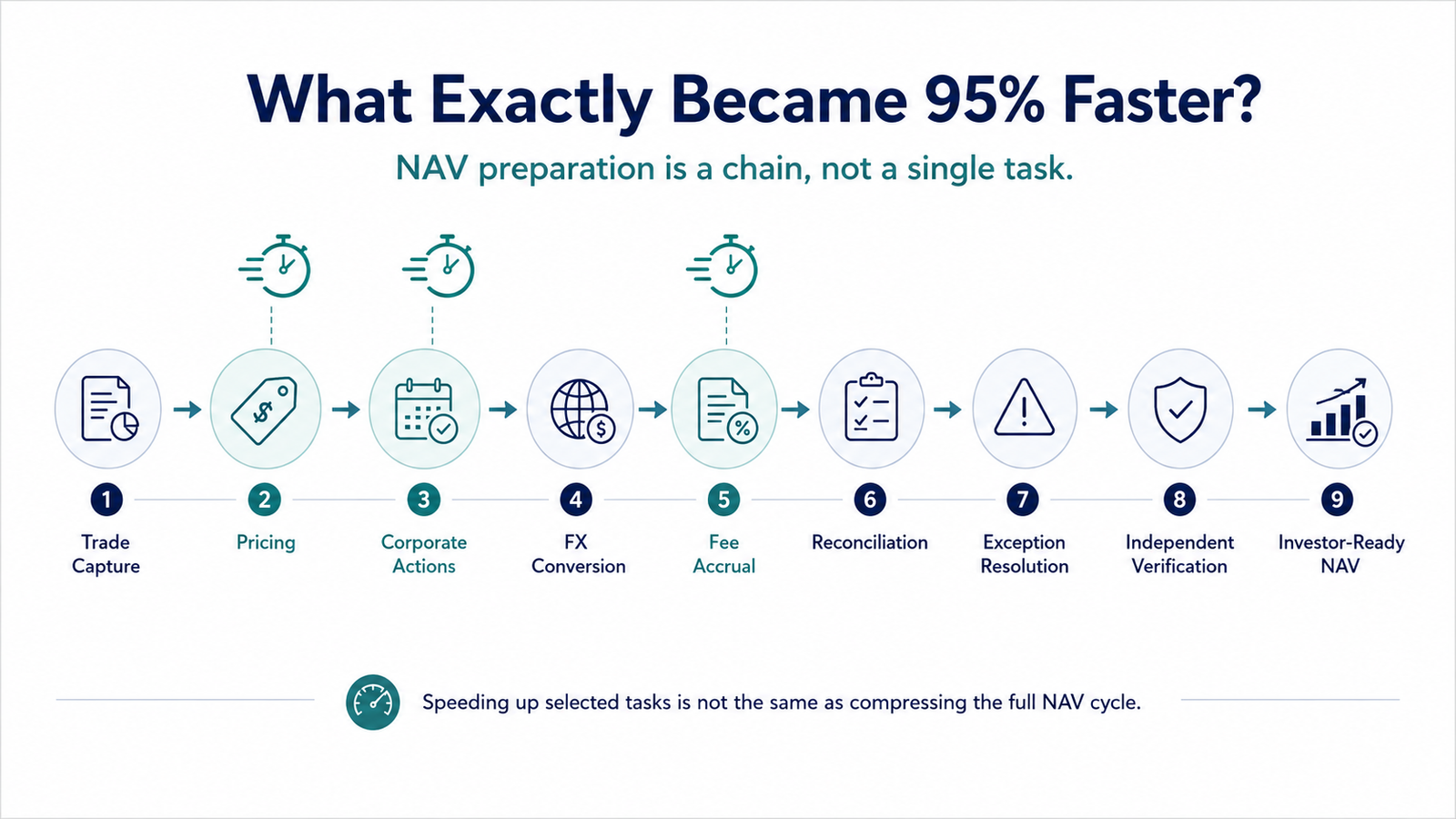
NAV preparation isn't one step.
It's a chain:
Trade capture
Pricing
Corporate actions
FX conversion
Fee accrual
Reconciliation against custodian and broker records
Exception resolution
Final sign-off
When a vendor says AI cut "NAV prep time" by 95%, the honest next question is:
Which link in that chain got faster, and whether the other links got faster too, or just got skipped over in the marketing copy.
AI genuinely does speed up parts of this chain.
Pulling in pricing feeds
Flagging obvious data mismatches
Auto-populating standard entries
These are real, measurable time savers, and they add up.
But speeding up data entry into a reconciliation process is a very different achievement than fixing the reconciliation process itself.
If a fund's:
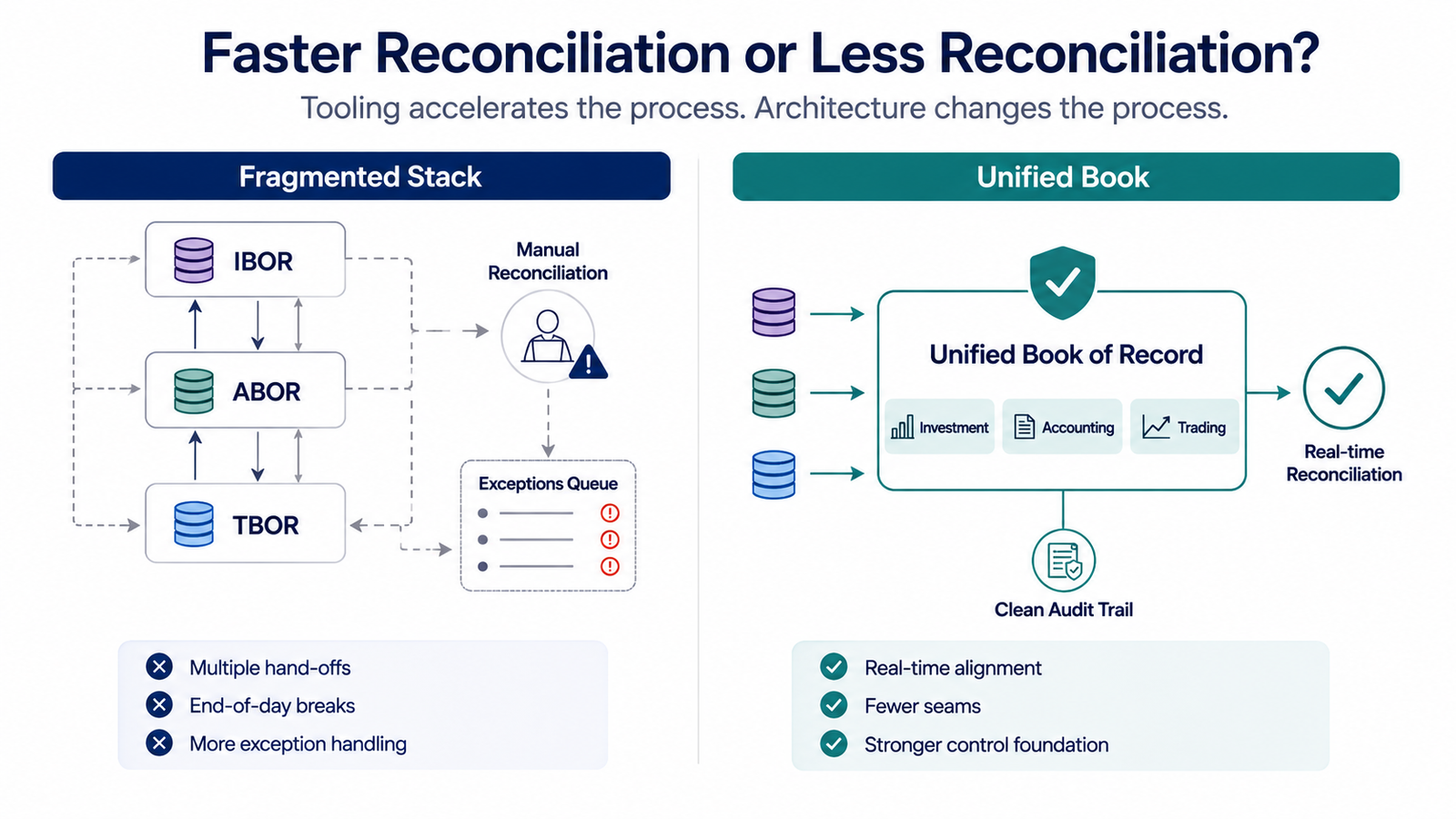
Investment Book of Record
Accounting Book of Record
Trading Book of Record
still live in three different systems that get reconciled manually at the end of the day, AI can make the manual part faster.
It cannot make the reconciliation disappear, because the reconciliation only exists because the books were never unified in the first place.
The Distinction Between Speed and Structure
This is the distinction that gets lost when a headline number travels faster than its footnotes.
A five-minute NAV that's assembled from three systems still carries the same underlying risk of:
A break between those systems
A corporate action booked with the wrong ex-date
A stale FX rate
A fee calculated against the wrong high-water mark
AI can catch some of these faster than a human would.
It doesn't eliminate the structural reason they happen.
What This Actually Means for Fund Managers
For a COO or Head of Fund Accounting evaluating this claim, the useful reframe is:
AI removes keystrokes, not necessarily risk.
Fewer keystrokes means:
Fewer hours billed
Fewer late nights before a redemption deadline
A smaller team able to service more funds
Those are real operational wins, and no one should dismiss them.
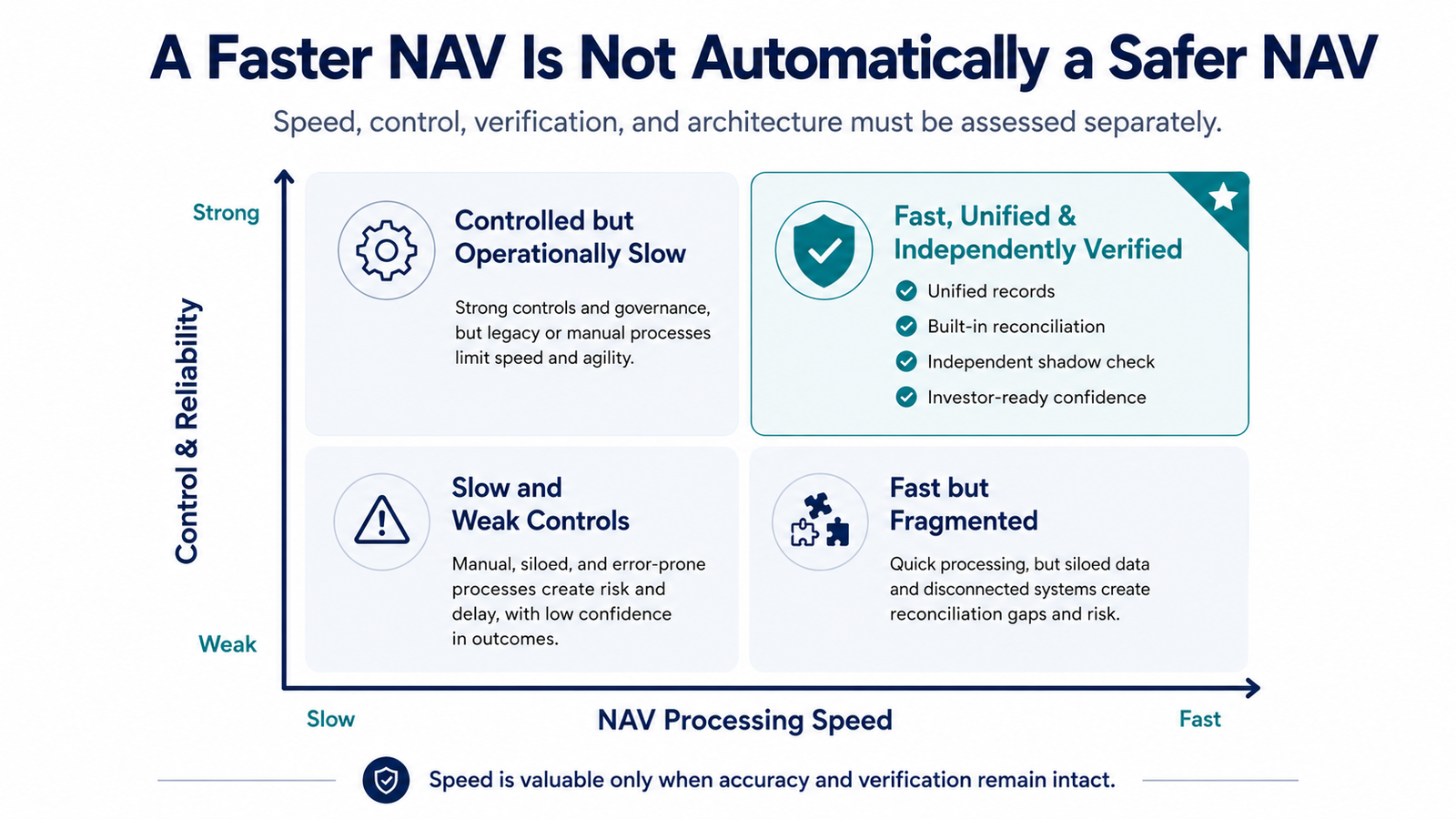
But speed and safety are not the same axis, and treating them as interchangeable is where this gets dangerous.
A NAV that goes out same-day instead of next-day is only a win if it's the same NAV either way.
If a fast, AI-assisted process is layered onto a fragmented back office and simply catches fewer of its own errors because there's less time between calculation and release, the fund hasn't gotten faster and safer.
It's gotten: Faster and quieter.
And the errors that used to surface during an overnight review now surface after the number has already gone to investors.
The managers who benefit most from AI-driven speed are the ones whose underlying architecture was already sound:
A single book of record
Real reconciliation built into the process rather than bolted on after it
An independent shadow check verifying the output
For everyone else:
AI on top of a fragmented stack is a faster version of the same risk, not a smaller one.
A same-day NAV that's occasionally wrong is a worse investor experience than a next-day NAV that's reliably right, and any institutional allocator doing real due diligence already knows this.
That's why questions about:
Independent verification
Audit trail integrity
are becoming standard in investor onboarding, alongside the usual questions about track record and strategy.
A fund that can say:
"Our NAV is fast because we don't have anything to reconcile."
is making a fundamentally different, and more durable, claim than a fund that says:
"Our NAV is fast because AI checks our reconciliation faster."
The first is an architecture claim.
The second is a tooling claim.
And tooling claims age quickly as every competitor adopts the same generic AI layer within a year or two.
Three Questions Worth Asking Any Vendor Making This Claim
Before taking a 95% figure at face value, whether from an administrator, a software vendor, or an internal team proposing a new tool, it's worth asking:
1. Is this timing the full NAV cycle?
Is this timing the full NAV cycle, from trade capture to investor-ready output, or just one step within it, like:
Data entry
Pricing lookup
2. What happens to unresolved exceptions?
What happens to the exceptions the AI can't resolve on its own?
Are they queued for the same manual review that used to happen anyway, just later in the process?
3. How is the number independently verified?
How is the number independently verified before release?
Does that verification step happen in the same five minutes, or does it happen separately, and get left out of the stopwatch?
The Right Question Is Not Whether AI Is Useful
None of these questions require distrust of AI as a tool.
They require distrust of any number that arrives without its methodology attached, which is simply good practice whether the number comes from a vendor's blog post or an internal pilot project.
The Architecture Question Behind the Speed Question
The fund administration industry is right that speed matters more in 2026 than it used to:
Same-day liquidity
Faster reporting cycles
Investor expectations shaped by real-time everything elsewhere in their financial lives
But durable speed comes from:
Collapsing the number of systems a number has to pass through, not from making each system faster individually.
A unified book, where:
IBOR
ABOR
TBOR
sit on one platform instead of three reconciled ones, has less distance to travel and fewer seams where errors hide.
That kind of speed doesn't need a 95% headline to be credible, because:
There's nothing left to reconcile after the fact.
Genesis: Built Around Unified Investment Operations
This is the architecture Genesis, Novel Patterns' investment operations platform, was built around:
A single unified book across investment, accounting, and trading records, with real-time reconciliation built into the structure rather than layered on top of it afterward.
For:
AMCs
PMS providers
AIFs
Family offices
evaluating fund accounting software or wealth management software on the promise of AI-driven speed, the more useful question isn't:
How fast the tool makes the old process?
It's:
Whether the process still needs to exist at all.
Frequently asked questions
Questions & answers
Can AI really reduce NAV preparation time by 95%?
AI can significantly reduce manual effort in specific activities, but the impact depends on what part of the NAV lifecycle is being measured.
What activities are involved in NAV preparation?
NAV preparation includes trade capture, pricing, corporate actions, FX conversion, fee accrual, reconciliation, exception handling, verification, and final sign-off.
Does faster NAV processing mean lower operational risk?
Not necessarily. Speed improvements do not automatically remove risks caused by disconnected systems and reconciliation gaps.
How does AI help fund administrators?
AI can automate repetitive tasks, identify mismatches, and improve processing efficiency.
Why is reconciliation still important?
Reconciliation exists because different records and systems need to be aligned. Faster processing does not remove the need for accuracy checks.
What should fund managers evaluate beyond NAV speed?
They should evaluate architecture, verification processes, audit trails, and how investment, accounting, and trading records are connected.
What is a unified book of record?
A unified book of record brings investment, accounting, and trading information together instead of relying on separate systems requiring reconciliation.
Why does architecture matter in fund operations?
Because long-term operational speed comes from reducing system complexity, hand-offs, and points where errors can occur.