
PMS Operations in India Key Challenges and How Genesis Helps Portfolio Managers Scale

A client may choose a PMS firm for its investment approach. They are also placing trust in everything that happens after an investment decision is made.
An order has to reach the market, trades need to be allocated to the right accounts, and records must match those of brokers and custodians. At reporting time, clients expect to see where their money is invested, how it has performed and what they have been charged.
Much of this work happens out of sight. In many firms, it also happens across several systems, emails and spreadsheets. When a figure does not match, someone has to trace it back, find out why and make sure the correction reaches every place it needs to.
That is the operating challenge Genesis by Novel Pattern is built to address. It brings together portfolio management, order workflows, accounting, controls and reporting, helping investment and operations teams work from a more connected view.
Why PMS operations become more complex as firms grow
PMS firms manage investments for clients under individual mandates. Unlike investors in a pooled fund, PMS clients generally hold their own portfolios. That makes room for personalisation, but it also means the operations team has more account-level detail to manage.
Think of two clients following the same strategy. One joined three years ago and has added funds since. The other joined last month, holds more cash and has a restriction on a particular security. Their portfolios may follow the same broad approach, but their transactions, fees and reports will not be identical.
Now extend that across a growing client base. A rebalance that looks straightforward at the strategy level can involve different orders and checks for each account. The investment decision is only the beginning of the work.
1. Managing multiple portfolios and client mandates
Before acting on a portfolio, the investment team needs to know what the client already holds, how much cash is available and whether any restrictions apply. That sounds simple until the model allocation sits in one system, holdings in another and mandate details in a separate file. Every hand-off creates another opportunity for information to be missed or go out of date.
Genesis gives teams a place to review model portfolios alongside holdings, cash and allocation drift. It also supports rebalancing workflows and mandate-related checks, so teams can work through portfolio actions with the client’s account in view.
2. Coordinating orders execution and allocations
Once the investment team decides to trade, someone still needs to create the order, complete the relevant checks, obtain approvals where needed and track execution. With a basket covering several accounts, a dealer or operations colleague may spend time chasing status updates or checking whether each allocation is complete. Emails and spreadsheets can make that trail difficult to follow.
Genesis connects portfolio actions with order and allocation workflows. Teams can prepare basket orders, review checks, follow approvals and see execution status without piecing together the story from separate trackers.
3. Reconciling holdings cash and transactions
The holdings and cash shown in an internal system should agree with records received from brokers, custodians and other relevant sources. A difference may be caused by timing, a missing transaction, a corporate action or a data-format issue. Not every break signals a serious error, but someone has to identify the cause before relying on the numbers downstream.
Genesis supports trade, holdings, cash and reconciliation inputs, with visibility into exceptions that need review. The exact data connections and reconciliation process should be assessed against the firm’s sources and operating model.
4. Maintaining consistent portfolio accounting records
Portfolio accounting depends on a steady flow of reliable transaction, valuation and cash data. When a correction is made in one system but not another, the team can end up checking the same information repeatedly before a close or reporting deadline. Individual client histories add another layer: the firm needs to understand the position for each account, not just for a strategy overall.
Genesis brings portfolio accounting together with order management and reporting. This gives teams a more connected set of records to work with when preparing accounting information and reviewing portfolio activity.
5. Calculating management and performance fees
A fee may look straightforward in a client agreement, but the calculation can require care. Clients may have joined at different times, added or withdrawn money, or agreed to different management and performance fee terms. Where a high-water mark applies, the team needs to know which prior level is relevant. Just as important, it must be able to explain the calculation when a client asks.
Genesis supports configurable management and performance fee models, including high-water-mark logic. The setup should follow each client agreement and the calculation methods approved by the firm.
6. Producing accurate investor reports
A client statement brings together information from across the business: holdings, transactions, performance and charges. If the underlying records still need attention, the reporting team may have to resolve those questions before it can issue a statement. A late correction can mean another round of checks and another version of the report.
Genesis supports investor reporting alongside portfolio and accounting workflows. Bringing reporting closer to the underlying records can reduce the effort involved in assembling information and make review more consistent.
7. Embedding compliance and operational controls
A portfolio team needs to consider client mandates and applicable rules while work is moving, not only after a trade has been completed. For example, an order may need to be checked against a restriction or an exposure limit. If a reviewer later asks who approved the action, the firm also needs a clear record of the decision.
Genesis supports configurable checks, approvals and audit trails as part of the operating workflow. Those tools help a team apply its control framework; responsibility for supervision and compliance remains with the firm.
Preparing for regulatory change
SEBI has published the SEBI (Portfolio Managers) Regulations, 2026, with an effective date of 1 April 2027. Firms should review the regulations and applicable circulars against their own activities and assess what may need to change in their policies, systems and reporting. Technology changes should follow that legal and compliance assessment.
8. Scaling without adding manual work at the same pace
Winning new clients is good news. It also means more accounts to monitor, more trades to reconcile and more statements to prepare. If each increase in volume adds another round of manual work, experienced people can find themselves spending too much of the day moving data between files or chasing routine exceptions.
Genesis connects portfolio, order, accounting and reporting activities in one platform. Firms can assess where that connection would remove the most friction in their own processes and build from there.
What a connected PMS workflow can look like
Take a common situation: a portfolio manager decides to rebalance a strategy across several client accounts. The investment view may be shared, but the work still has to be completed and recorded for each relevant account. A connected workflow might follow these steps:
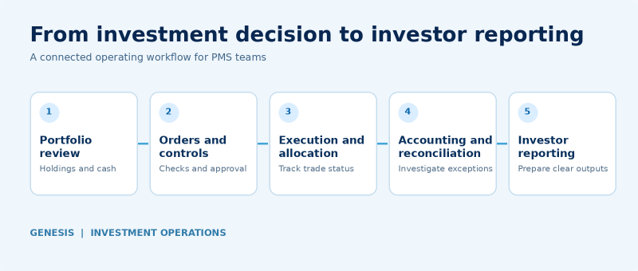
Illustration: An example workflow, from portfolio review to investor reporting.
1. Review portfolios:Compare model allocations with actual holdings, cash and portfolio drift.
2. Prepare actions:Create investment actions or basket orders for the relevant portfolios.
3. Apply controls:Review orders against applicable restrictions, exposure checks and approval requirements.
4. Track execution:Monitor order status, execution and allocation.
5. Update and reconcile records:Investigate discrepancies across trade, cash and holdings information.
6. Prepare reports:Use reviewed portfolio information to support performance, fee and investor reporting.
Where Genesis fits into a PMS firm’s technology landscape
Genesis is designed for PMS providers, AIF managers, wealth firms and other investment businesses. The starting point for each firm will be different. One team may want a clearer order workflow; another may be looking to bring accounting and investor reporting closer together. The right scope depends on the firm’s existing systems, data and priorities.
· Portfolio management:Model portfolios, holdings and cash visibility, drift review and rebalancing.
· Order management:Basket orders, workflow checks, approvals and execution tracking.
· Portfolio accounting:Connected portfolio records and accounting workflows.
· Reconciliation and exceptions:Trade, cash and holdings inputs, with visibility into items requiring review.
· Fees and performance:Configurable management and performance fees, including high-water-mark logic.
· Compliance and governance:Checks, approval workflows and audit trails.
· Investor reporting:Reporting workflows supported by portfolio and accounting information.
Building a stronger foundation for PMS growth
For a PMS firm, growth brings a practical question: can the same team continue to deliver a careful, personal service as the number of portfolios rises? The answer depends partly on how easily people can find reliable information and resolve the issues that need their attention.
Genesis is designed to make that day-to-day work easier to follow, from the portfolio decision through to the client report. With a clearer view of the process, teams can spend less time pulling information together and more time on investment decisions and client relationships.