

Why AIFs matter to banks, investment firms, and custodians
If you are a bank or NBFC, Alternative Investment Funds show up in multiple ways, for example as balance sheet investments, wealth products for priority clients, or counterparties you finance. For investment companies, AIFs are often the primary route to raise and deploy third party capital across private equity, credit, or alternative strategies. For custodians, AIFs mean complex asset types, layered structures, and stringent record keeping across units, capital calls, distributions, and compliance reporting.
The common thread is responsibility. Every stakeholder in the AIF ecosystem is expected to understand how these vehicles are structured, what the SEBI regulations require, and where the operational and fiduciary risks sit. This is exactly the gap we see when firms still try to run AIFs on generic systems that were built around mutual funds.

AIFs versus mutual funds, the fundamental difference
On the surface, AIFs and mutual funds both pool investor money. That is where the similarity ends. Mutual funds are public, highly standardised products with tight investment rules, diversified portfolios, high liquidity, and strong protective norms for retail investors. AIFs, in contrast, are privately placed, less liquid, and far more flexible in terms of strategy and structure.
For your teams, this changes everything. From suitability assessment and documentation, to valuation and NAV, to how you monitor risk. A purpose-built operating platform such as Genesis can support these requirements by connecting portfolio operations, fund accounting, investor servicing, and compliance workflows. You cannot treat an AIF like a mutual fund and expect clean operations or clean compliance.
Regulatory framework and how AIFs are structured
If you work in Indian BFSI, you cannot treat AIF regulations as background noise. The SEBI (Alternative Investment Funds) Regulations, 2012 effectively define who can run an AIF, how it must be structured, and what your custody and oversight responsibilities look like.
Registration and core SEBI expectations
Every AIF must register with SEBI under a specific category. That registration is not a one time approval, it anchors a continuing set of conditions that your teams need to track, such as:
• Sponsor and manager fit, including qualification, track record, and contribution requirements.
• Private placement only, with information memoranda and marketing restricted to eligible investors.
• Defined investment policythat matches the chosen category and is disclosed to investors upfront.
• Periodic reporting to SEBI and investors, covering portfolio, valuation, risk, and key operational aspects.
If you are a bank, NBFC, investment firm, or custodian, your internal controls have to align with these conditions, not with mutual fund style norms. A dedicated AIF operating layer removes a lot of friction by translating regulatory requirements into repeatable controls and workflows.
Permitted legal structures
SEBI permits AIFs to be set up as:
• Trusts, the most common structure for pooled vehicles with a separate trustee overseeing the fund.
• Companies, where the fund exists as a corporate entity with a board and statutory requirements.
• Limited Liability Partnerships (LLPs), useful when sponsor and manager want more partnership style economics and governance.
Each structure changes who is legally responsible for what, from signing investment agreements to interacting with custodians and auditors. Your operations stack has to respect these legal lines, especially for approvals and signatories.

Where custodians fit into the AIF regime
Custodians sit at the heart of regulatory comfort for AIFs. Their role is not just safekeeping of securities. In practice, a custodian is expected to:
• Maintain legal ownership records that clearly distinguish fund assets from manager or sponsor assets.
• Validate trade instructions against fund documents, category restrictions, and internal limits.
• Support valuation and NAV through accurate position records and corporate action processing.
• Facilitate regulatory and investor reporting with clean, reconciled data across portfolios, units, and cash.
For BFSI players that act as both distributor and custodian, this separation of roles becomes even more critical. Clean, system driven controls across custody, investment operations, and reporting reduce the chance that a regulatory requirement is missed in day to day execution.
Classification and characteristics of AIF categories
Once you understand the basic structure of an AIF, the next filter is category. SEBI classification is not cosmetic, it drives what the fund can buy, how it can use leverage, and how you must monitor risk and compliance.
Category I AIFs, growth and development focused
Category I covers strategies that channel capital into productive, often early stage or impact oriented parts of the economy. Typical schemes include:
• Venture capital funds, investing in early and growth stage unlisted equity and equity linked instruments.
• Social venture funds, targeting investments with defined social outcomes alongside financial returns.
• Infrastructure funds, focusing on projects and companies in core and allied infrastructure.
• SME or sector focused funds, backing smaller companies or specific industries.
Regulatory intent here is long term capital formation. You usually see tighter rules on use of leverage, longer investment horizons, and concentration in unlisted or less liquid assets. For a bank or custodian, this means more attention to capital call mechanics, monitoring of investee covenants, and valuation of illiquid positions, supported by institutional grade fund administration and investment operations systems.
Category II AIFs, private equity and credit strategies
Category II houses funds that do not fall under Category I or III and that do not carry leverage beyond limited, regulation driven thresholds. Common strategies include:
• Private equity funds, taking significant stakes in unlisted or privately placed listed securities.
• Debt funds, investing in a mix of listed and unlisted debt instruments, including structured credit.
• PIPE oriented funds, participating in privately placed equity in listed companies.
These funds often run closed ended structures with defined investment and harvest periods. From an operational perspective, you manage commitment based investing, security creation and charge monitoring, and more complex fee waterfalls. Leverage, if permitted, typically supports short term funding or bridging, not trading style gearing. Your systems must capture these limits as hard rules, not spreadsheet notes.
Category III AIFs, hedge and trading oriented funds
Category III funds pursue diverse or complex trading strategies that may involve shorting, derivatives, and meaningful leverage within regulatory boundaries. Typical approaches include:
• Hedge fund style strategies, long short equity, event driven, or relative value trades.
• Quant and systematic strategies, using models to take directional or market neutral positions.
These funds can be open or closed ended and often use leverage more actively, subject to SEBI limits and internal risk frameworks. For custodians and banks, this category demands robust margin monitoring, exposure reporting by asset class and counterparty, and daily or near daily NAV cycles. An integrated operating platform helps keep portfolio, risk, and accounting views in sync, which is non negotiable when leverage is in play.
It tells you the liquidity profile, the operational complexity, and where SEBI expects your controls to be sharpest.
Investor eligibility, investment criteria, and procedural aspects
If you are structuring, distributing, or servicing AIFs in India, you need a clear view of who is allowed in, how much they must commit, and what the onboarding and reporting journey looks like. This is where most operational breakdowns happen, especially when teams rely on mutual fund style assumptions.
Who can invest in AIFs and on what terms
AIFs are meant forsophisticated investors. In practice, you usually deal with:
• Resident individuals and HNIs, investing directly or through family offices.
• Institutional investors, such as banks, NBFCs, insurers, and corporates.
• NRIs and foreign investors, participating under the applicable foreign investment rules.
Regulations prescribe a minimum investment size per investor, with limited relaxations for specific investor classes or employees of the manager or sponsor. Each scheme also has a cap on the number of investors, which you must monitor across direct and feeder or pooling structures.
Most AIFs run withlock in or long fund tenures. Category I and II are usually closed ended with defined investment and harvest periods, while Category III can adopt open or closed formats. As a custodian or fund administrator, you should capture lock in logic and exit rights as hard rules in your system, not as narrative in a PDF.
Procedural journey, from commitment to reporting
The operational flow is predictable if you standardise it. A practical framework is:
1. Suitability and onboarding
Distributor or RM assesses investor category, risk appetite, and regulatory
fit, then shares the private placement memorandum and related documents.
2. KYC and eligibility checks
Collection and validation of KYC documents, tax identifiers, declarations on
residency and beneficial ownership, and any sector specific approvals. Video
based KYC through platforms such as MyConCall can streamline this for
wealth channels.
3. Execution of fund documents
Subscription agreement, contribution agreement, side letters where permitted,
and power of attorney or mandate instructions. Signatory controls sit at the
heart of clean custody operations.
4. Capital contribution and unit allotment
Receipt of funds into the designated account, unit calculation as per scheme
terms, and recording of units in the investor register and custodian books.
5. Ongoing reporting and compliance
Periodic statements, capital call and distribution notices, regulatory
disclosures, and tax reports. A unified platform such as Genesis
can bring these activities onto a common data and workflow layer, reducing
reconciliation pain for managers, banks, and custodians.
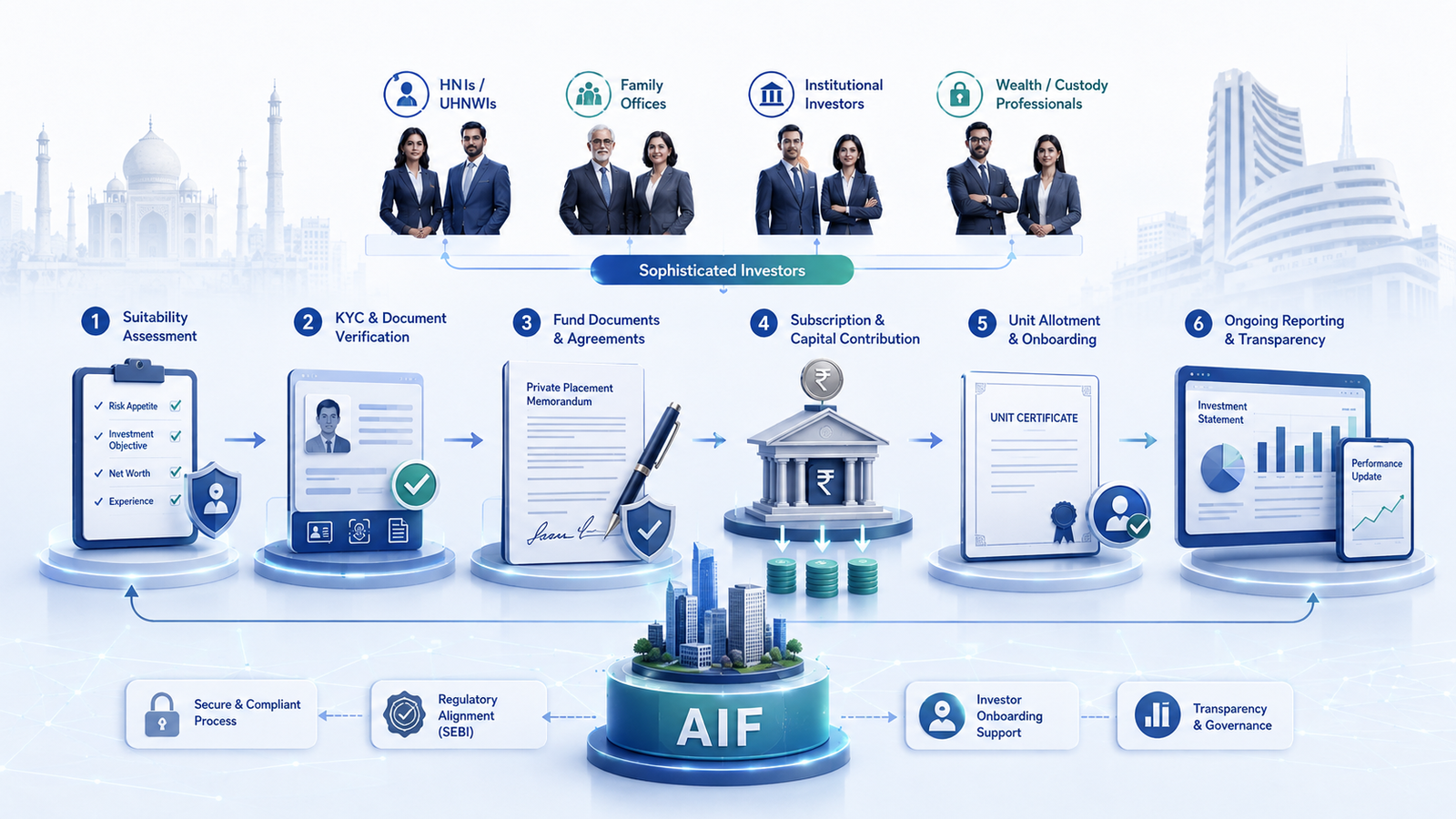
If you align investor criteria, KYC, documentation, and reporting in one consistent workflow, you protect your institution and give regulators far fewer reasons to ask hard questions.
Benefits and risks of investing in AIFs
If you sit in product, treasury, investments, or custody, you cannot look at AIFs only as a return story. You need a clear, balanced view of what they add to a portfolio and what they can quietly break if you miss the fine print.
Key benefits, when AIFs are used deliberately
1.
Real diversification beyond listed markets
AIFs give access to private equity, private credit, infrastructure, special
situations, and hedge strategies. For Indian allocators, this can create return sources that do not move in lockstep
with listed equity or bond indices. If you run asset allocation for a bank
or wealth platform, AIFs help fill those non public market buckets that mutual
funds cannot reach in the same way.
2.
Higher return potential for patient capital
Because AIFs can invest in unlisted companies, structured credit, and complex
strategies, they can capture value that public markets reflect only much later.
This suits investors who accept longer holding periods and higher complexity in
return for a chance at better risk adjusted outcomes.
3.
Customisation and strategy depth
AIF mandates can be tightly defined, for example by sector focus, capital
structure, or risk profile. For institutional investors, this makes it easier
to plug specific gaps in a strategic asset allocation plan, instead of relying
only on broad based mutual fund exposure.
4.
Operational leverage for BFSI players
For banks, insurers, and investment firms, sponsoring or distributing AIFs can
deepen client relationships and broaden fee pools. If you run these strategies
on a purpose built investment operations platform, you also standardise workflows
that are hard to scale on spreadsheets.
The real risks you must underwrite upfront
1.
Illiquidity and long fund life
Most AIFs lock capital for long tenures with limited or no interim exit
options. That is acceptable only if investor profiling, suitability checks, and
internal ALM views are honest. Liquidity assumptions borrowed from mutual funds
create stress later.
2.
Complex and layered fee structures
Management fees, performance fees, hurdle rates, catch up mechanics, and deal
level charges all affect net returns. If your systems cannot model these
correctly, you risk misreporting investor returns and mispricing internal
performance.
3.
Regulatory and documentation risk
SEBI has been steadily tightening expectations around AIF disclosures, related party
transactions, leverage, and valuation. Weak documentation standards or ad hoc
side letters can create uneven treatment across investors and regulatory
friction.
4.
Market and strategy risk
Leverage in Category III, concentration in single sector or credit in Category
II, or early stage exposure in Category I, all carry real downside. Without
disciplined risk analytics and independent valuation, portfolios can look fine
on paper while risk builds underneath
The practical takeaway is simple. AIFs work well for Indian investors who understand what they are buying and who have institutions behind them that run tight operations. That is why more firms are moving to integrated platforms such as Genesis, so that diversification benefits are not wiped out by operational and compliance mistakes.
Comparative analysis, AIFs versus other investment vehicles
If you sit in product or investment committees, your real question is not “what is an AIF” anymore. It is “when do I prefer an AIF over a mutual fund, PMS, direct equity or debt, or offshore private structures”. You need a clear comparison on regulation, investor protection, liquidity, and fit for different client segments.
AIFs versus mutual funds
Regulation
and investor protection
Mutual funds are built for broad retail participation with granular disclosure,
daily NAV, and strict diversification and liquidity norms. AIFs operate under a
private placement regime for sophisticated investors with higher minimum ticket
sizes, flexible mandates, and customised documents. In practice, mutual funds
give you stronger standardised protections, while AIFs rely more on document
quality and manager governance.
Liquidity
and strategy
Mutual funds usually offer frequent subscription and redemption and stick
largely to listed or easily valued assets. AIFs often use closed ended
structures, capital calls, and exposure to unlisted or complex instruments. For
wealth desks, that means mutual funds suit short to medium horizon, liquidity
conscious clients, while AIFs suit patient capital and specific alternative
strategy needs.
AIFs versus PE or VC vehicles outside the AIF framework
Some investors still use offshore or non AIF pooled structures. Those can bring foreign law, different disclosure standards, and diverse regulator expectations. AIFs give Indian allocators a SEBI recognised framework, domestic dispute resolution, and clearer coordination with local banking, tax, and custody rules. For banks and custodians, it is much easier to embed AIFs in standardised operations and regulatory reporting when they are supported by an institutional asset and investment management platform.
AIFs versus traditional direct investments
Direct equity and bonds put control and transparency directly in the investor’s hands but require internal research, risk, and trading capability. AIFs intermediate that through a manager, a mandate, and pooled diversification. For smaller treasuries and family offices, AIFs often provide institutional quality access to private equity, private credit, and structured strategies without building an in house team.
Which investor segment fits where
You can use a simple framework. Retail and mass affluent clients lean toward mutual funds and simpler listed products. HNIs, family offices, and institutions with longer horizons and higher risk appetite lean toward AIFs and private strategies, often alongside mutual funds. Your job in BFSI is not to “push AIFs”, it is to map each client’s liquidity needs, governance comfort, and portfolio gaps, then decide whether an AIF or a more traditional vehicle is the right tool.
Operational considerations for banks, investment firms, and custodians

Fund administration, get the core plumbing right
For AIFs, administration is not a light version of mutual fund ops. You need tight control on:
• Capital calls and distributions, with clear schedules, investor wise breakups, and matching bank entries.
• Investment lifecycle tracking, from deal approval to signing, funding, follow on, and exit.
• Fee and carry calculations, based on the exact waterfall, hurdles, and clawback terms in the documents.
• NAV and unit capital, especially for Category III, where frequency and leverage raise the bar.
If you try to stitch this across spreadsheets, emails, and generic accounting systems, breaks are guaranteed. A unified platform such as Genesis can keep investment, accounting, investor, and compliance records in one source of truth, which is what your trustee, custodian, and auditor expect.
Risk management that matches AIF complexity
Banks, insurers, and NBFCs face two layers of risk on AIFs, balance sheet exposure and reputational or fiduciary risk when you distribute or manage funds. You need live visibility into:
•Exposure by fund, category, strategy, sector, and manager.
•Leverage, margin, and derivatives usage versus SEBI and internal limits.
•Concentration by issuer or group and any related party linkages.
Risk teams should not be reverse engineering this from PDF reports. They should be pulling it straight from a systematized investment book. That is how you align treasury, risk, and product views when regulators ask hard questions.
Compliance monitoring and reporting discipline
Compliance is where AIFs often trip up. Common friction points include delayed SEBI filings, inconsistent investor communication, and document terms that are not fully operationalized. Practical safeguards are:
• Pre trade and post trade checks configured to category rules and fund level restrictions.
• Template driven reporting for SEBI, trustees, and investors, generated from the same data stack.
• Audit trails for every approval, override, and exception.
AIFs sit inside a broader regulatory shift around governance and digital controls. If you want a sense of where this is headed, it is worth looking at how regulators are treating AI led banking operations in pieces such as Agentic AI in Banking.
Best practices for smooth governance with SEBI alignment
You do not need a hundred new policies. You need a short, disciplined playbook:
1. Standardise fund setups, with approved templates for PPMs, LPAs, side letters, and operational SOPs.
2. Segregate duties cleanly, especially where your institution is sponsor, distributor, and custodian for the same AIF.
3. Automate reconciliations, across bank accounts, custody records, portfolio systems, and investor registers.
4. Run periodic “regulation to system” checks, map every SEBI requirement to an actual control in your workflow or platform.
5. Train front line teams, so RMs, product desks, and ops staff know what makes AIFs different from mutual funds.
When these controls come together on an operating platform such as Genesis, AIF operations stop feeling like a special project. They become just another part of your institutional grade investment stack, ready for scrutiny from boards, regulators, and global LPs.